
What Pennsylvania’s New Limits on Warrantless Property Searches Mean for Homeowners

A “No Trespassing” sign on Pennsylvania land used to stop a nosy neighbor.
It never had to stop a state game warden.
Not anymore.
Pennsylvania’s Supreme Court just told every government official the same rule homeowners assumed applied all along, and the new limits go far beyond hunting land.
This is what Pennsylvania’s new limits on warrantless property searches mean for homeowners.
Note: This is general information, not legal advice. Search-and-seizure and property laws can vary by county and are subject to change, so confirm the details of your situation with an attorney.
Your Porch Was Already Safe
This ruling doesn’t change what happens on the ground right around your house.
That patch of land carries a legal name: Curtilage, meaning the porch, the attached garage, and the immediate yard where daily life happens.
Courts have protected curtilage from warrantless searches for generations, long before this case.
Nothing new there.
A game warden or a code officer already needed a warrant, consent, or a real emergency to walk up your driveway and knock on the door.
Nothing about July 21 changes that baseline.
The new protection starts where curtilage ends.
A Camera on the Tree
Land beyond that boundary is where everything changed.
A Pennsylvania Game Commission (PGC) warden strapped a trail camera to a tree on posted hunting land in Clearfield County.
It stayed there for 78 days.
Nobody asked a judge first.
That was legal for decades under a rule called the open fields doctrine, which let officials search or watch most land beyond a house’s immediate yard without a warrant.
On July 21, the Pennsylvania Supreme Court ruled 7-0 that the doctrine no longer holds up under the state’s own constitution.
The case, Punxsutawney Hunting Club v. Pennsylvania Game Commission, began after two hunting clubs sued over years of warrantless visits from state wardens.
Homeowners with land past the yard just inherited that same shield.
Acres Behind It Just Changed
Everything beyond curtilage, a back field, a stand of woods, a pond, a hunting camp two ridges from the house, used to sit almost entirely outside constitutional protection.
Research cited by the Institute for Justice, which represented the hunting clubs, found that more than 90% of Pennsylvania’s private land had been exposed to warrantless searches under the old rule.
That’s most of the state.
The court, in an opinion written by Justice Kevin Brobson, based its ruling on a single word in Pennsylvania’s constitution.
Article I, Section 8 protects your “possessions,” not your “effects,” the word the Fourth Amendment uses, and the court ruled that possessions have always included land.
Brobson’s opinion overturned the court’s own 2007 decision in Commonwealth v. Russo, which had read that word narrowly.
Officials now need a warrant based on probable cause, or a recognized exception, before entering posted land anywhere on your property.
That reading of the word stood for nineteen years.
Pennsylvania Joins a Short List
Pennsylvania isn’t the first state to reach this conclusion, just one of the most recent.
Vermont and Tennessee have both rejected warrantless game-warden searches of private land through their own court rulings.
Washington, Oregon, New York, and Montana went further, reading that same protection straight out of their own state constitutions.
That makes Pennsylvania the seventh state where the open fields doctrine, the old federal rule, no longer controls what happens on private land.
That leaves forty-three states behind.
Most states still follow the traditional rule, which is why property-rights groups are watching Pennsylvania’s case as a possible model elsewhere.
Posting Land the Legal Way
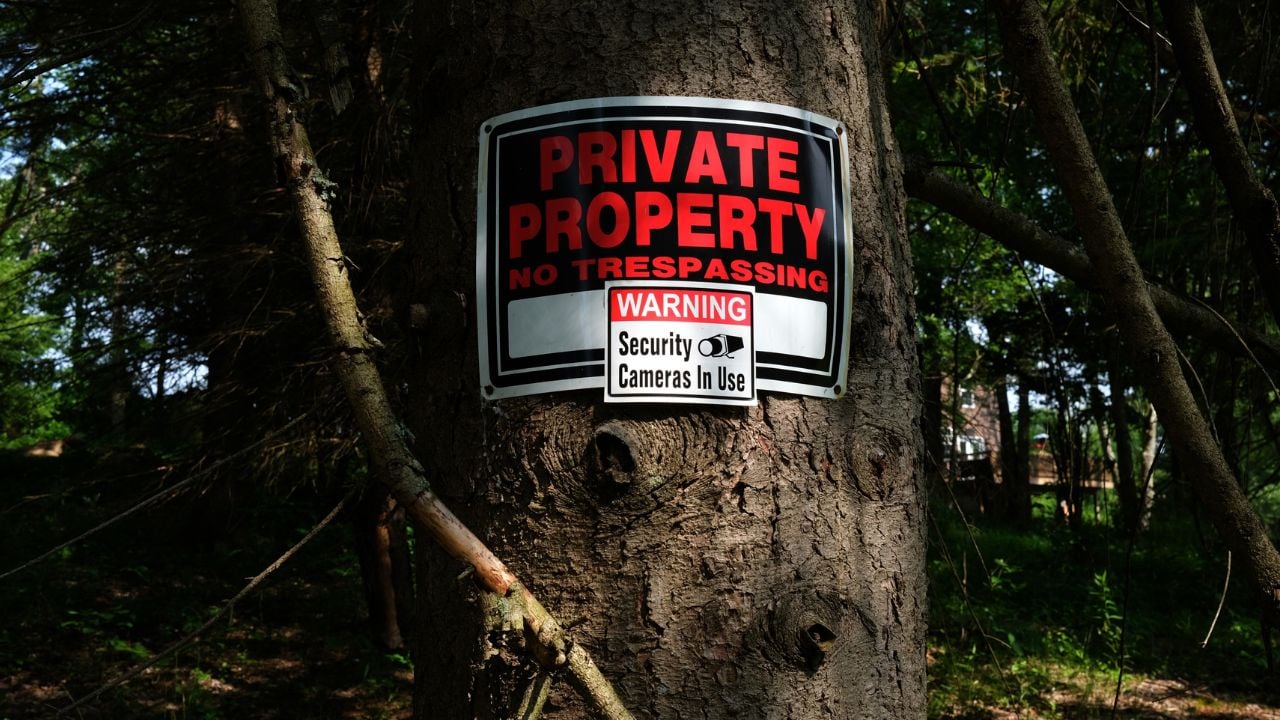
The ruling only protects land where an owner has “demonstrated a reasonable expectation of privacy,” in the court’s own words, so posting your property correctly matters more now than ever.
Pennsylvania gives landowners two ways to do it.
Take your pick.
Signs are the classic option, but paint works too.
Since a 2020 change to the state’s Crimes Code, a landowner can mark a property line with vertical purple paint instead of, or alongside, a sign.
The Pennsylvania Game Commission spells out the exact standard for purple paint: Each mark runs at least 8 inches long and 1 inch wide, sits 3 to 5 feet off the ground, and appears no more than 100 feet apart along the boundary.
Paint that meets that standard carries the same legal weight as a posted sign.
A faded sign torn half off a fence post won’t cut it, since a court needs to see the owner demonstrated intent to keep people out.
The purple paint law doesn’t apply in Philadelphia or Allegheny counties, so check local rules before reaching for a paintbrush.
Game Wardens Aren’t the Only Officials
The lawsuit that produced this ruling was about game wardens, not code officers or health inspectors.
But the court didn’t write the rule that narrowly.
Its opinion says the commission’s officers, employees, and representatives, “as well as any other government officials,” must get a warrant or satisfy a recognized exception before entering posted land.
A local zoning officer, an environmental inspector, or another state agency now faces the same requirement on land a homeowner has posted.
Joshua Windham, the Institute for Justice attorney who argued the case, put it plainly: “If government officials want to invade your posted land without your consent and spy on you, they need to get a warrant.”
It reaches far beyond wardens.
That applies whether the visitor carries a badge from the Game Commission or a clipboard from the township.
What Still Lets Officials In
Officials aren’t locked out completely.
A warrant based on probable cause still opens the door, the same as it always did.
That part never moved.
So does a recognized exception, like the owner’s consent, a genuine emergency, or an officer chasing someone caught in the act.
Game laws themselves didn’t change either.
Hunting without a license, baiting bears, and every other violation the Game Commission investigates are still against the law in Pennsylvania.
What changed is how officials go about proving it.
They can’t walk onto posted land on a hunch anymore.
Psst! Think you know how far Pennsylvania’s new ruling reaches? Tap through these myth-or-fact cards and see how many you get right.
The Case Took Five Years
Punxsutawney Hunting Club and Pitch Pine Hunting Club, neighbors in Clearfield County holding 4,400 and 1,100 acres, filed suit against the Game Commission in 2021.
Members had watched wardens climb locked gates and walk past posted signs since 2013, without a warrant or a citation to show for most visits.
The case went to the Commonwealth Court first, which sided with the Game Commission in 2023.
The clubs appealed, the Pennsylvania Supreme Court heard arguments in the spring of 2025, and the justices took over a year to rule.
Because the decision rests entirely on Pennsylvania’s own constitution, there’s no further appeal left to file.
The ruling stands as final.
How the Game Commission Answered
The Pennsylvania Game Commission didn’t fight the ruling in public.
A spokesperson issued a statement the day after the decision: “While we are disappointed in the outcome of this case, the Pennsylvania Game Commission respects the court’s decision.”
“The Commission is fully confident our law enforcement officers will execute their mission of protecting Pennsylvania wildlife and enforcing hunting laws within these new constitutional standards,” the statement read.
Not exactly a surrender.
The state attorney general’s office, which represented the Game Commission in court, declined to comment on the ruling.
Every warden still answers to the same wildlife code, just with a judge’s signature required before the next locked gate opens.
Does Pennsylvania Tax Social Security? What Retirees Pay in 2026

Pennsylvania guards more than the ground under a homeowner’s feet. It guards their retirement checks too.
Pennsylvania doesn’t tax a dollar of Social Security, and pensions and 401(k) withdrawals often skip state tax as well.
Does Pennsylvania Tax Social Security? What Retirees Pay in 2026
12 Things Pennsylvanians Are Proud of That No Other American Gets

Property lines aren’t the only thing Pennsylvanians take seriously.
From a 200-year-old brewery in Pottsville to habits every native carries like a birthright, these are the things that make the commonwealth unmistakable.
12 Things Pennsylvanians Are Proud Of That No Other American Gets
