
7 Arguments Florida and Alabama Will Never Settle

Surveyor Andrew Ellicott drove a stone into the ground in 1799 to settle, for good, exactly where Alabama ends and Florida begins.
It didn’t work.
Alabama and Florida have kept arguing about that line, and plenty else, ever since.
These are the fights that stone never settled.
1. Flora-Bama
The Flora-Bama’s official address puts it in Perdido Key, Florida.
Alabama disagrees.
Walk from the package store toward the dance floor, and you cross the Alabama-Florida line before you reach the stage, the same line that gives the bar its name.
The History Behind the Flora-Bama Line
Florida traded Alabama two miles of beachfront, Ono Island included, back in 1962, so Alabama could build the Perdido Pass Bridge.
That new stretch of state line cut straight through the ground where Ted Tampary built his bar two years later.
The Flora-Bama has straddled it every day since it opened on August 1, 1964.
Hurricane Ivan flattened the building in 2004, and the Tampary family rebuilt it on the identical disputed ground.
Every regular from Orange Beach still calls it their bar.
So does every regular from Pensacola.
2. Claiming the Redneck Riviera
Alabama’s Gulf Coast earned the nickname Redneck Riviera first.
A New York Times writer named Howell Raines coined it in 1978, describing the beach where NFL quarterbacks Kenny Stabler and Richard Todd spent their offseasons as a stretch some Alabama wags called “the redneck Riviera.”
Florida borrowed it within a decade.
Panama City Beach and Destin wear the name loudest today, and locals in Gulf Shores still bring up who said it first.
A Gulf Shores city council member even tried to ban the nickname once.
It stuck anyway.
3. Birthplace of America’s Mardi Gras
Mobile, Alabama traces its Mardi Gras to 1703, when French settlers there held the first organized carnival celebration in what became the United States.
New Orleans didn’t join in for another 15 years.
Pensacola, Florida counters with an older founding instead of an older parade.
Spanish settlers resettled Pensacola in 1698, four years before French settlers founded Mobile.
Pensacola’s own Mardi Gras historians still argue someone on that coast marked the holiday before Mobile ever organized a carnival society.
The proof never surfaced.
Pensacola’s own organized celebration didn’t start until 1874.
Bragging rights remain unresolved.
4. Ono Island’s Land Grab
Ono Island sits in Alabama waters today, a private, gated stretch of Baldwin County just up the coast from the Flora-Bama.
A hurricane cut a new pass through the barrier island in 1916, shifting the ground between Florida and Alabama once again.
Florida tried to claim the newly exposed land between the old channel and the new one.
Alabama’s legislators had a two-word reply: “Oh no you don’t.”
The island kept the name.
More than 1,100 homes fill Ono Island now, and many of the people who own them never mention the argument that named their street.
Every property line on that island still sits close to the state line Florida once tried to move.
Psst! How much do you know about Florida and Alabama’s shared history? Take our quiz and see how many you can get right.
Quiz
Florida vs. Alabama History IQ
Answer these questions on Florida and Alabama history. We bet you can’t get them all right. Prove us wrong?
Alabama joined the United States in 1819. What number state did that make it?
5. Football Bragging Rights
Alabama leads the all-time series against Florida, 27-14.
Florida fans have a comeback ready anyway.
The Crimson Tide claims 18 national championships by the athletic department's own count.
Not to Gator fans.
The Gators claim three, won in 1996, 2006, and 2008.
Eighteen versus three settles nothing at a Gainesville tailgate.
Bring it up at an Auburn tailgate, and you'll start a second argument by accident.
6. Where the Border Sits
Surveyor Andrew Ellicott planted a stone marker in 1799 to fix the 31st parallel as the boundary between Alabama and Florida, working alongside a Spanish counterpart through four hundred miles of forest.
That single stone, now protected as a historic landmark near Mobile, still defines where Alabama ends.
Two centuries of storms and shifting sand have moved that ground more than once.
Beachfront neighbors on Perdido Key still argue over whose fence sits on whose side.
A stone from 1799 settled the question.
It's only on paper.
Nobody standing on the beach ever checked the paperwork.
7. Talladega vs. Daytona
Talladega Superspeedway in Alabama is NASCAR's largest track, 2.66 miles around with steeper turns than Daytona's.
Bill Elliott turned a lap at 212.809 mph there in 1987, still the fastest qualifying lap in NASCAR Cup Series history.
Florida answers with prestige instead of speed.
Daytona International Speedway calls itself the "World Center of Racing," and it hosts the Daytona 500, the sport's biggest race every February.
Talladega answers with chaos.
Multi-car pileups happen so often there that drivers and fans just call it "the Big One."
Daytona protects its crown.
Talladega bets everything on speed instead.
Every fan picks a side before the green flag drops.
Same Sand, Different Names
Florida's Emerald Coast and Alabama's Gulf Shores share the exact same sand, white quartz that washed down from the Appalachian Mountains over millions of years.
A Fort Walton Beach teenager coined the name Emerald Coast in a 1983 contest, and Northwest Florida has marketed those green-tinted waters ever since.
Alabama answers with its own slogan for Gulf Shores and Orange Beach: "It's a whole different state."
Thirty-two miles of sand backs up whichever brochure a visitor grabbed first.
Same grains, different postcards.
Barbecue on Both Sides of the Line
Alabama's white barbecue sauce came out of Big Bob Gibson's smoker in Decatur back in 1925, a mayonnaise and vinegar mix Bob Gibson brushed on pit-cooked chicken.
Florida's Gulf Coast fishing towns built a different tradition entirely.
Cooks in towns like Cortez still smoke mullet low and slow over hickory, red oak, or buttonwood, a tradition Saveur traces to backyard smokers from the mid-1900s.
One tradition brushes on sauce after the smoke, and the other trusts hickory and red oak to do the work.
The two never trade recipes.
13 Florida Theme Park Habits That Instantly Mark You as a Tourist
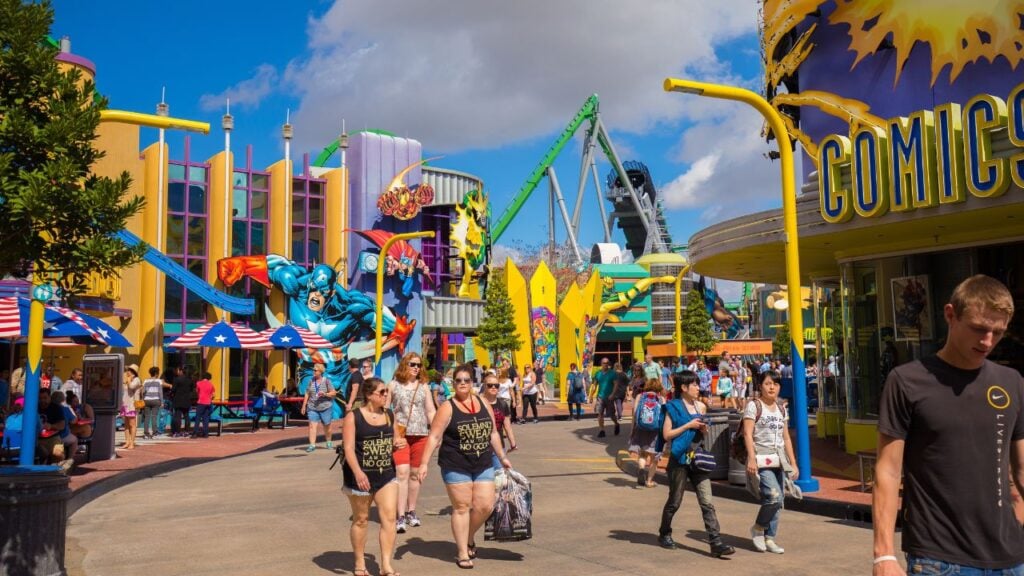
Florida's theme parks run on their own unspoken rules, and breaking them gives a visitor away before they reach the first ride.
Cutting it close on parking and fighting a coaster line with a phone in hand are the habits locals spot from a mile off.
13 Florida Theme Park Habits That Instantly Mark You as a Tourist
13 Habits Florida Transplants Have That Never Fool Lifelong Residents
A year in Florida convinces many transplants they've gone native.
Lifelong residents watch them skip the winter coat and brag about it, and they know exactly how long that confidence lasts.
13 Habits Florida Transplants Have That Never Fool Lifelong Residents
