
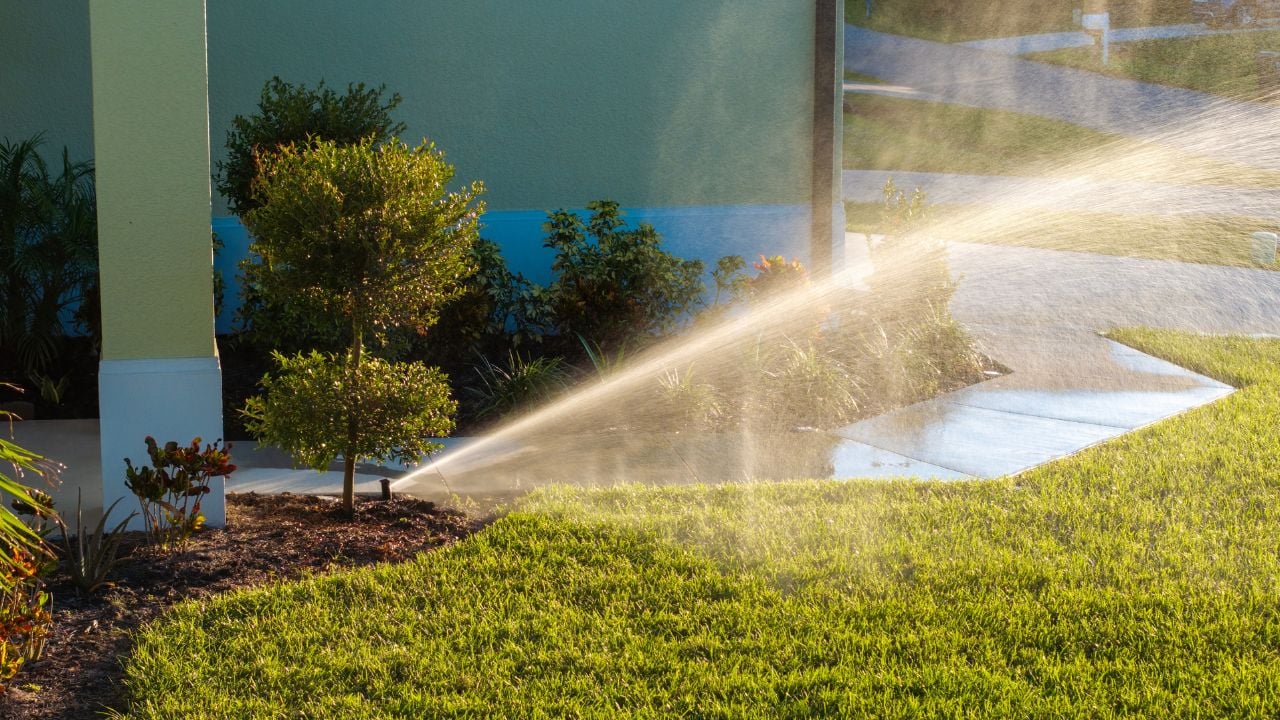
6 Georgia Watering Mistakes That Can Cost Homeowners a Fine

Think a green lawn is worth whatever it takes in late August?
The Georgia Water Stewardship Act says otherwise.
The state put a legal watering schedule on every home tied to a public water system back in 2010, and Georgia’s water utilities still write up homeowners over it every summer.
These are the Georgia watering mistakes that can cost homeowners a fine.
Note: This is general information, not legal advice. Watering schedules and penalty amounts vary by local utility and are subject to change, so confirm the current rules with your county or city water provider.
1. Running Sprinklers Outside Legal Hours
Georgia’s outdoor watering schedule isn’t a drought-only rule.
Under Georgia’s Water Stewardship Act of 2010, anyone served by a public water system can only irrigate established grass, trees, or shrubs between 4 p.m. and 10 a.m., every day of the year, drought or not.
Set a sprinkler timer for 7 a.m. and let it run past 10, or fire it up at 2 p.m. to beat an afternoon storm, and that’s already a violation.
Caught it.
Georgia’s Environmental Protection Division (EPD) declared a statewide Drought Response Level 1 on April 27, 2026, but even with no drought declared at all, that 4-to-10 window still applies statewide, year-round.
A first offense usually draws a written warning from the local water utility.
Get caught again, though, and Cobb County’s own penalty schedule rises to a $100 fine, then $250, then $500, with a possible service disconnection on a fourth violation.
The Math Behind Georgia’s Watering Fines
Watering fines in Georgia don’t start big.
A first violation typically earns a homeowner a written warning and nothing more.
A second violation is where the money starts, commonly $100.
A third violation runs $250, and Cobb County’s fourth-offense penalty hits $500 with the water utility able to disconnect service.
2. Hand-Watering Without a Shutoff Nozzle
Georgia carves out one everyday exception to its 4-to-10 rule, hand watering.
A homeowner can water by hand any time of day, but only with a hose that carries an automatic cutoff nozzle, or with a handheld container like a watering can.
Drop that nozzle for a plain open hose, and the exemption disappears.
Cobb County’s Water System lists it by name as an example of water waste, right alongside a leak nobody’s fixed.
Water utilities log it the same way they log a daytime sprinkler run, and it follows the same warning-to-$500 fine ladder.
A $6 shutoff nozzle from any Georgia hardware store closes the gap.
3. Letting Sprinklers Soak the Driveway
Georgia’s outdoor watering rules don’t stop at the clock.
A sprinkler head can drift a few degrees off its original aim without anyone noticing.
The zone that used to land squarely on the lawn starts spraying the driveway, the sidewalk, or the street instead.
Grass doesn’t drink any of that.
Cobb County’s water conservation office names “misdirected sprinklers watering pavement and impermeable objects” as one of its four listed examples of reportable water waste, the same category that draws a written warning first and a bigger fine each time after that.
Neighbors report it, too.
A phone call to the water utility’s customer service line is usually all a report takes, and a puddle running off the driveway is easy for a neighbor to describe.
Walk your zones once a season and nudge the heads back toward the grass.
4. Ignoring a Broken Sprinkler Head
Georgia treats a broken sprinkler head as its own violation, aim aside.
A cracked or missing sprinkler head can send water shooting straight up or pooling into the street.
It’s a separate violation from a misdirected sprinkler because nothing’s irrigating anything at all.
A different failure, same fine.
Cobb County lists “broken or missing sprinkler heads causing excessive runoff” as its own example of water waste on the county’s outdoor water use page, right next to visible leaks.
Both violations follow the same ladder as a daytime sprinkler run: A warning first, then $100, then $250, then $500, with a possible disconnection.
A homeowner mowing over a head every spring and never checking the zone afterward is the most common way this happens, and the fine schedule doesn’t care whether the damage was an accident.
Psst! How water-wise is your Georgia yard? Run through this checklist and see where you stand.
5. Skipping the Rain Sensor on a New System
Georgia law goes further than scheduling for homeowners inside the 15-county metro Atlanta water district.
Since 2005, anyone installing a new landscape irrigation system with an electronic controller inside the Metropolitan North Georgia Water Planning District has to include a working rain sensor shut-off switch, the kind of device that automatically halts a watering cycle once enough rain has already fallen.
Skip it during installation.
No sensor, no excuse.
Georgia law sets a civil penalty of up to $100 per violation, enforceable in magistrate or municipal court.
That covers Cobb, DeKalb, Fulton, Gwinnett, and eleven other metro counties.
Homeowners who hire a contractor to swap an old, dumb timer for a new smart controller, without asking about the sensor, are exactly who this law catches, since it’s easy to assume a modern controller already includes a sensor.
Without that sensor, the system keeps running full cycles straight through a downpour, piling onto the same over-watering the rest of this list is built to catch.
6. Watering New Sod Past Its 30 Days
Georgia gives new grass a genuine head start.
Freshly installed sod, seed, or landscape plants can be watered any day, any hour, for exactly 30 days after installation, no matter what the rest of the schedule says.
That grace period has a hard stop.
Many Georgia homeowners keep the sprinkler on the same anytime routine well past day 30, still treating the yard like it’s establishing itself months after the receipt date.
Once that window closes, the lawn is legally “established,” and watering it at 11 a.m. is the exact same violation as running an old zone at that hour, fines and all.
Keep the installer’s receipt.
It’s the easiest way to know when your grace period ends.
How a Drought Declaration Changes the Math
Georgia’s rules don’t sit still once the state declares a drought.
Georgia’s EPD Director can call three levels of drought response, and each level adds restrictions on top of the last.
Georgia moved to a statewide Drought Response Level 1 on April 27, 2026, its first formal drought declaration since 2012, and that level mostly just requires water utilities to run public awareness campaigns.
EPD still listed that Level 1 declaration as active as of this writing, so check its drought management page for the current status before you plan around it.
Level 2 is where the restrictions tighten for homeowners.
Landscape watering drops to two days a week, split by odd and even street addresses, and Georgia bans washing hard surfaces, filling ornamental fountains, and running fundraising car washes for the duration.
Level 3 bans landscape irrigation almost entirely.
Almost, not entirely.
A homeowner who learned the rules back during the last drought and never checked again is often violating a schedule that’s since eased, or missing a restriction that’s since tightened.
What Georgia Always Lets You Water
Georgia sounds stricter on watering than it turns out to be once you know the exceptions.
Drip irrigation and soaker hoses are exempt from the time restriction entirely, any day, any hour because so little of that water evaporates before it reaches the roots.
Personal food gardens get the same free pass.
So does water pulled from a private well or a homeowner’s own pond, captured air conditioner condensate, and stormwater collected and reused on-site.
A homeowner with a rain barrel under the gutter downspout can empty it onto a flower bed at noon without breaking any rule at all.
No paperwork needed.
Georgia built the whole schedule around one goal, cutting evaporation loss from sprinklers, not around punishing every drop that touches a Georgia yard in daylight.
A neighbor running drip line under the mulch at 2 p.m. isn’t breaking anything, even while the sprinkler two doors down racks up a warning.
A landscaper calibrating or repairing that same irrigation system at noon breaks nothing either, since installing, maintaining, or calibrating a system carries its own exemption from the schedule.
7 Georgia State Parks Locals Keep to Themselves (and 3 Everyone Swarms)
Every fall, a line forms at the base of Amicalola Falls before the leaves even finish turning, phones raised at the same waterfall view.
Meanwhile, at a Georgia lake where the state won’t allow a single private dock, the parking lot never fills at all.
7 Georgia State Parks Locals Keep to Themselves (and 3 Everyone Swarms)
Homestead Exemption Mistakes Costing Georgia Homeowners

In November 2024, 63% of Georgia voters approved a cap on how fast a homesteaded house can be taxed.
Then their own school boards started opting out of it.
The Homestead Exemption Mistakes Costing Georgia Homeowners Every Year
