
10 Things Coloradans Are Told About Their State That Aren’t True

A hiker inside Colorado’s Rocky Mountain National Park points at a distant summit and calls it the tallest peak in the state.
It isn’t.
Colorado has 58 mountains over 14,000 feet, and the tallest of them all isn’t inside that park.
These are the things Coloradans are told about their state that keep turning out to be off.
1. Not Named for Its Colors
Colorado’s own tourism board brands the place “Colorful Colorado,” so it’s an easy leap to assume the state’s actual name means the same thing.
Wrong leap.
Congress pulled the name from Spanish explorers, who called the muddy river running through the territory colored red for its rust-tinted silt.
That’s the literal meaning, and it had nothing to do with mountains, sunsets, or fall foliage.
The state got its name from a river’s dirty water, not its scenery.
2. 300 Days of Sunshine?
Colorado’s tourism campaigns and countless real estate listings repeat the same boast about the state’s weather: 300 days of sunshine a year.
Denver’s own numbers don’t add up to that.
The state’s own climatologists put Denver at about 252 days a year with measurable sunshine, based on 46 years of climate data, nowhere near the marketed figure.
Fifty days short.
The Math Behind Denver’s Sunshine Claim
Denver earns credit for “sunshine” on about 252 days a year, roughly 69% of the calendar, according to state climate data spanning 46 years.
One recent full year broke down to 115 days with mostly clear skies, 208 partly cloudy days, and just 43 days entirely overcast.
Stack every partly sunny afternoon into the total.
The count still lands about 50 days short of the 300 printed on so many brochures.
3. Wall-to-Wall Mountains?
The Rocky Mountains cover Colorado’s middle stretch, and the state’s eastern reach flattens into the Great Plains, wheat fields and cattle country running flat toward the Kansas line.
Colorado’s postcards make it easy to forget that, since they feature nothing but jagged summits.
Denver itself sits at the edge of that plains region, not tucked inside the mountains outsiders picture when they hear the city’s name.
It’s half plains.
4. Not America’s Busiest Airport
People call Denver International Airport the country’s biggest, busiest hub often enough that Coloradans repeat it as settled fact.
Half of that is right.
The airport covers 53 square miles, more ground than Manhattan holds twice over, which makes it the largest airport site in the country.
Passenger traffic tells a different story.
Atlanta’s Hartsfield-Jackson carries more travelers than any other American airport, and Denver ranks fourth nationally, behind Atlanta, Dallas-Fort Worth, and Chicago O’Hare.
Just not the busiest.
5. Colorado’s Craft Beer?
Coloradans grow up hearing that Coors built their state’s reputation as a craft-beer capital.
Coors isn’t craft.
The Golden plant is the largest single-site brewery on the planet, owned by Molson Coors, a company that ships beer by the truckload to every state in the country.
Colorado’s actual craft scene runs through smaller operations like New Belgium, Odell, and Great Divide, breweries built on a fraction of Coors’ output.
Big beer, not craft beer.
6. Colorado’s Tallest Peak Isn’t Here
Mount Elbert, at 14,440 feet, rises in the Sawatch Range near Leadville as Colorado’s actual tallest peak.
Coloradans often repeat that their tallest peak stands inside Rocky Mountain National Park, one of Colorado’s most-visited parks.
It doesn’t come close.
Longs Peak, the park’s own fourteener, only ranks 15th tallest among Colorado’s 58 mountains over 14,000 feet.
Wrong park entirely.
7. Light Up Anywhere?
Colorado legalized recreational marijuana years ago.
Many Coloradans still take that to mean lighting up anywhere in the state is fair game.
It isn’t.
State law bans public consumption outright.
Smoking, vaping, or eating an edible on a sidewalk, in a park, or at a ski resort all draw the same violation.
Legal use stays limited to private property, and only if whoever owns it allows it.
National forests and national parks stay off-limits entirely, since marijuana is still illegal under federal law no matter what Colorado allows on its own ground.
Your yard, not the trail.
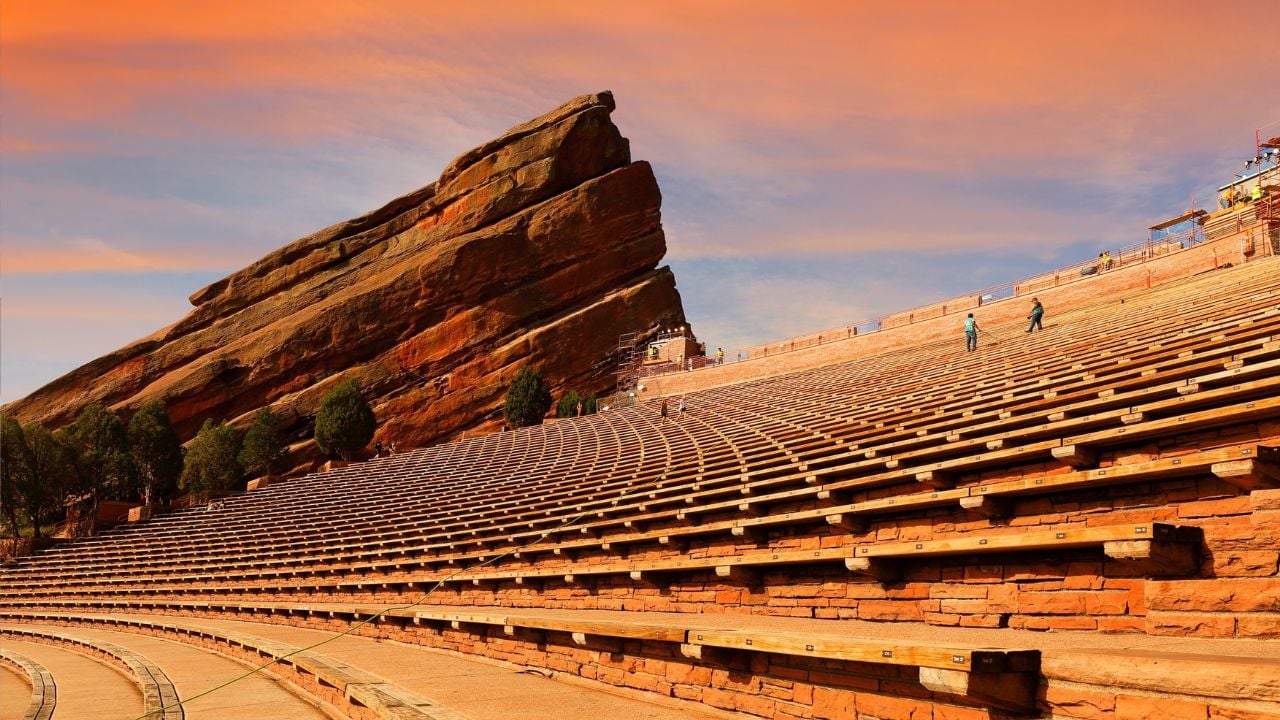
8. Red Rocks Wasn’t Built for the Show
Coloradans pass along the story that crews carved Red Rocks Amphitheatre’s towering walls to build the stage, since the rock looks too perfectly shaped to be an accident.
The rock came first.
Those sandstone walls formed somewhere between 65 and 250 million years ago, long before Colorado had a name, let alone a concert calendar.
The Civilian Conservation Corps built the actual seating and stage into that natural bowl during the Depression, finishing the venue in 1941.
Millions of years, not decades.
9. Exact Four Corners?
Surveys show the Four Corners monument sits roughly 1,800 feet from the true mathematical point where Colorado, Utah, Arizona, and New Mexico meet, a gap left by 19th-century tools rather than any recent mistake.
Coloradans still call it the country’s only perfectly square corner and send visitors to stand on the exact spot.
They’re standing close, not exact.
The marker still counts as official because a boundary belongs wherever the accepted monument sits, not wherever a modern GPS reading says it should.
10. Not Buried in Snow All Winter
Colorado’s ski towns feed the assumption that the whole state disappears under snow from November through March.
Denver breaks that pattern.
The city’s average January high sits around 44 degrees, close to double what outsiders picture for a Rocky Mountain capital.
Chinook winds spilling off the Front Range can push a January afternoon into the 60s within a day of a snowstorm.
Snow that falls on a Tuesday is often gone by the weekend, melted by strong sun at a mile of elevation instead of piling up for months the way outsiders picture.
Melted, not buried.
Psst! How much do you know about Colorado? Flip these cards and see how many you get right.
18 Disturbing Facts You’ll Wish You Never Learned

Some facts make people smile. These are the kind that make you set your coffee down and stare at the wall for a second.
None of them are made up, and none are the exaggerated hoaxes that circulate online.
