
9 Things That Change the Second You Cross From Ohio Into Kentucky

Drive across the Roebling Suspension Bridge from Cincinnati, Ohio, and Covington, Kentucky appears on the other side.
The bridge opened in 1867 as the longest suspension bridge on Earth, a test run for the same engineer’s Brooklyn Bridge.
Nothing about the crossing seems extraordinary.
But the tax on your receipt, the price at the pump, and what’s legal in your glovebox all change.
These are the things that change the second you cross from Ohio into Kentucky.
Note: This is general information, not legal or tax advice. Tax rates and state laws are subject to change.
1. Whether Police Can Stop You for a Seatbelt
Kentucky troopers can stop a driver for a seatbelt violation and nothing else, since Kentucky runs a primary seatbelt law.
Ohio doesn’t work that way.
Ohio’s seatbelt law is secondary enforcement, so an officer needs another reason first, like speeding or a broken taillight, before adding the seatbelt ticket.
Only Kentucky can stop you for it alone.
2. What Your Receipt Adds up To
Ohio’s state sales tax runs 5.75%, and every county piles its own rate on top, pushing the average combined rate to 7.29%.
Kentucky’s flat 6% rate never picks up a county add-on.
A $100 cart rings up around $107 on the Ohio side of the average county and a flat $106 across the Kentucky line.
It’s a small gap.
It shows up on every single checkout screen anyway.
3. What You’re Paying at the Pump
Ohio bakes 38.5 cents of state tax into every gallon of gasoline, one of the higher gas tax rates in the country.
Kentucky’s gas tax runs closer to 25 cents a gallon, a gap of more than 13 cents that exists before either state’s stations post their own price on the sign.
Kentucky’s rate is tied to a formula that moves with wholesale gas prices, so it shifts nearly every year.
Ohio’s rate stays fixed until lawmakers vote to change it.
It adds up fast.
4. Whether You Can Buy a Six-Pack at All
Kentucky still keeps roughly 39 counties completely dry out of its 120, meaning no store, bar, or restaurant there can sell a drop of alcohol.
Ohio’s local-option elections work precinct by precinct instead of county by county, so a single dry corner can sit inside an otherwise wet township, but no whole Ohio county carries that fully dry label.
Crossing the river doesn’t guarantee the six-pack disappears.
Kenton County, home to Covington on the far side of that Roebling bridge from Cincinnati, is wet, and Covington’s city commission has been fine-tuning its alcohol sale hours rather than banning them.
Drive further from the river into Kentucky’s interior, and the odds catch up with you fast.
Roughly one in three Kentucky counties still won’t sell you that six-pack at all.
The odds aren’t a promise.
5. Whose Water Is Under the Bridge
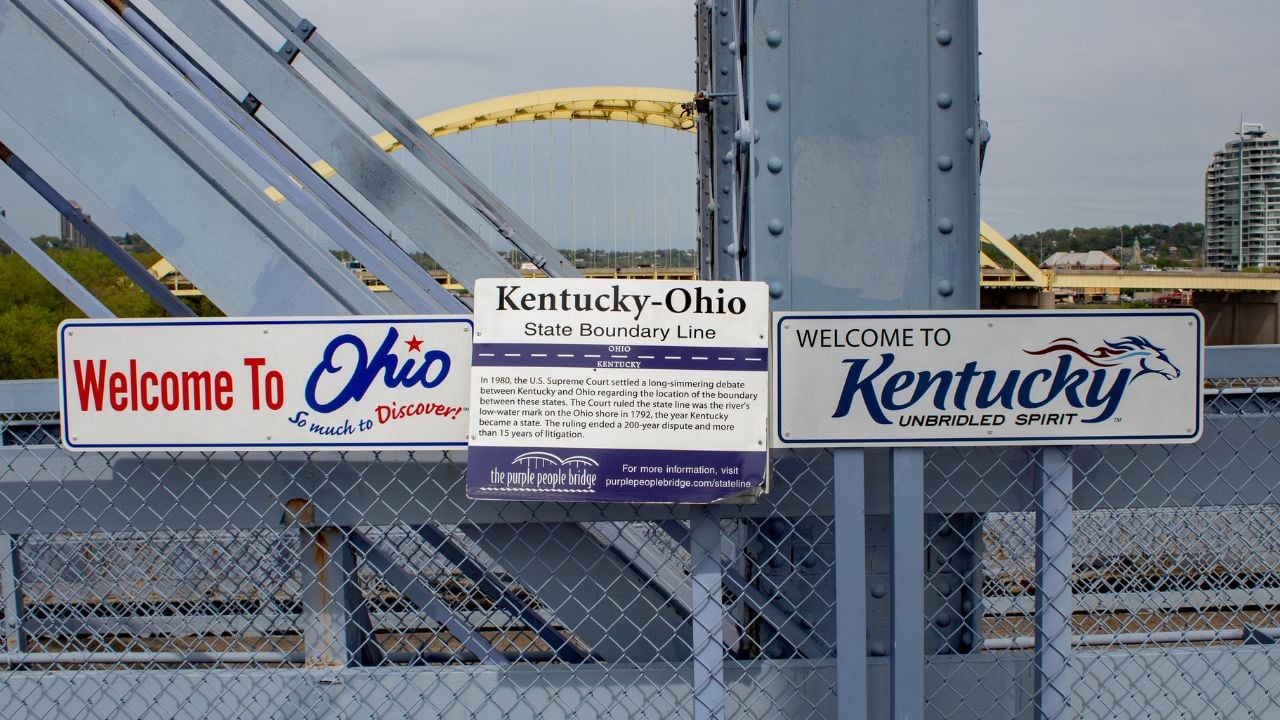
Kentucky owns the entire Ohio River, all the way to the low-water mark on the Ohio shoreline, not just to the middle of the channel.
Cross any bridge over that river, and many drivers assume the state line sits somewhere in the water below them.
It doesn’t.
The Supreme Court upheld Kentucky’s claim to the whole riverbed in 1973, settling a boundary dispute that traced back to Virginia’s original land grant.
Step onto that bridge, and you’re standing over Kentucky before your car ever reaches the far bank.
Why Kentucky Owns the Whole River
Kentucky’s ownership of the river traces back to Virginia, which once claimed land on both banks and kept the water when it ceded the northern territory that became Ohio.
That split fixed Kentucky’s boundary at the river’s low-water mark on the Ohio side, not the center of the channel, as the bank stood back in 1792.
6. Where You’re Even Allowed to Buy a Bottle of Liquor
Ohio treats a bottle of vodka or bourbon completely differently than a six-pack, licensing only certain “contract liquor agencies” as the sole stores allowed to sell spirits at all.
Ohio’s Division of Liquor Control sets the price of every bottle at every one of those stores, the same price whether you’re near Cleveland or standing at the Kentucky line.
Grocery stores and gas stations across Ohio can stock beer and wine, but never a bottle of spirits, unless that store holds the state’s contract.
Kentucky runs it backward.
Kentucky is a license state, letting any grocery store apply for its own wine and spirits license and sell that same bottle a few aisles from the milk, with no state requirement to charge what the store down the road charges.
Ohio prices the bottle.
Kentucky lets the store decide.
7. What’s Legal in Your Glovebox
Ohio voters legalized recreational marijuana for adults 21 and older in 2023, and licensed dispensaries have been selling it ever since.
Kentucky never followed.
Kentucky’s medical marijuana program only started accepting patients on January 1, 2025, and it stays limited to people with a qualifying condition and a state-issued card.
Possession that’s perfectly legal in an Ohio parking lot can still be a criminal charge once you’re parked on the Kentucky side.
The glovebox doesn’t move.
The law around it does.
8. What Kind of Phone Use Gets You Pulled Over
Ohio banned far more than texting when its hands-free law took full effect in 2023, covering social media, video calls, and internet browsing behind the wheel.
An Ohio trooper can stop a driver as a primary offense for holding the phone to scroll or pull up a browser, no other violation required first.
Kentucky’s law stops well short of that.
Kentucky’s texting ban covers only writing, sending, or reading a text message while driving, so scrolling social media or holding the phone for anything besides a text isn’t part of the law.
Ohio pulled the whole phone off the wheel.
Kentucky only pulled the keyboard.
9. Who Has to Wear a Motorcycle Helmet
Ohio requires a motorcycle helmet only for riders 17 and younger, or for anyone still in their first year of licensure, regardless of age.
An 18-year-old who’s held an Ohio license for two years can legally ride the entire state bare-headed.
Kentucky pushes that age line higher.
The Insurance Institute for Highway Safety (IIHS) lists Kentucky’s helmet law as covering every rider 20 and younger, plus instructional permit holders and anyone who’s held a license less than a year.
That same 18-year-old has to buckle the helmet back on before the bike clears the Kentucky line.
The Northwest Ordinance of 1787 banned slavery north of the Ohio River, years before Ohio or Kentucky existed as states.
Can you spot the lie?
Ohio and Kentucky handle their own license plates differently too.
Ohio dropped its front-plate requirement in 2020, decades after Kentucky had already gone rear-only back in 1944.
The plate mounted on the back of your car satisfies either state’s requirement by now, whichever side of the bridge issued it.
8 Diner Foods That Vanished From Ohio Menus (and Locals Still Miss)

A diner regular in Circleville still orders the same roast beef sandwich he’s ordered for decades, at a counter many people across the country have never even heard of.
That regional chain once had more than 500 locations chasing Arby’s across the country, and it’s just one of the menus disappearing from Ohio.
8 Diner Foods That Vanished From Ohio Menus (and Locals Still Miss)
8 Reasons People Are Leaving Ohio in 2026

Ohio’s housing stays cheap compared to much of the country.
That isn’t enough to stop many residents from packing up, and the reasons they give add up to more than a price tag.
