
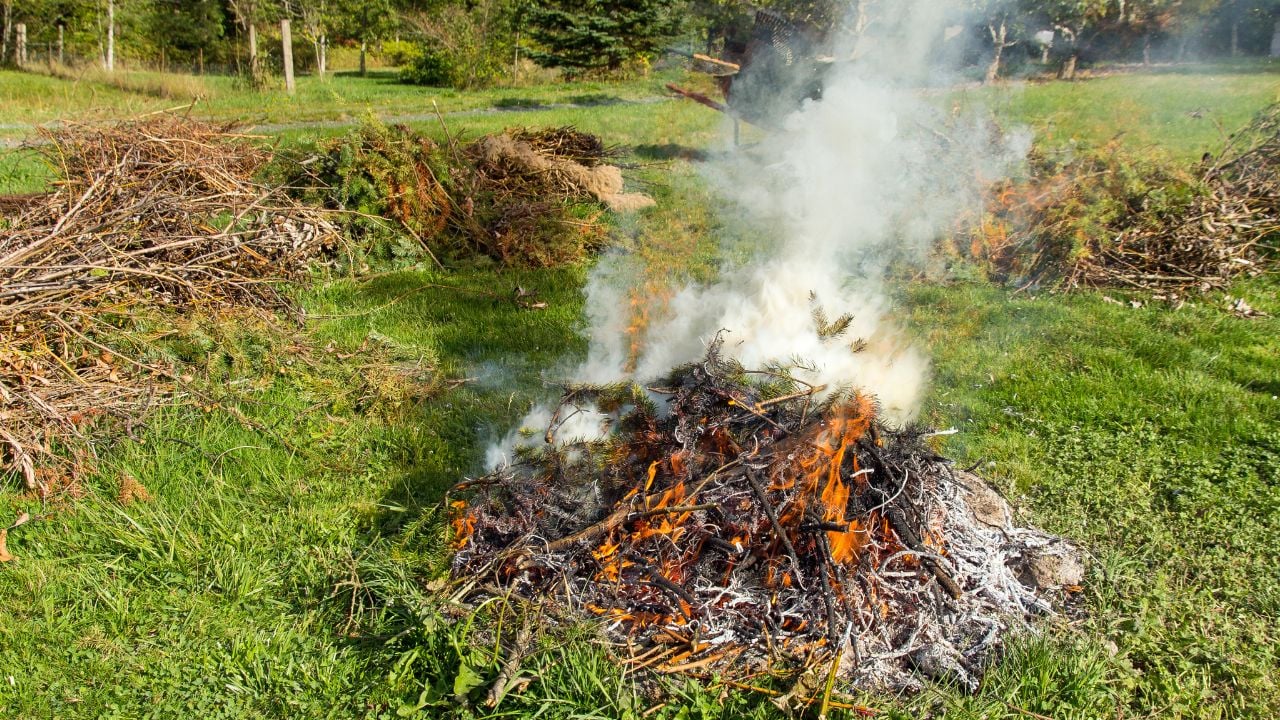
8 Yard Waste Burning Rules That Land Ohio Homeowners in Trouble

Breaking the wrong yard-waste rule in Ohio can mean a misdemeanor, a $500 fine, and up to 60 days in jail.
Some Ohioans find that out the hard way.
State law, your county, and your own township all get a say in when, where, and what you’re allowed to burn.
These are the yard waste burning rules that get Ohio homeowners in trouble.
Note: This is general information, not legal advice. Ohio’s open-burning rules and penalties vary by county and township and are subject to change.
1. Ohio’s 1,000-Foot Rule From Your Neighbor’s House
Ohio’s rule for burning yard waste at home starts with a number many homeowners never expect: The fire has to sit more than 1,000 feet from a neighbor’s inhabited house.
That’s almost three football fields.
The rule covers tree trimmings, stumps, brush, weeds, leaves, grass and shrubbery generated on your own property.
It applies even out in the country, far from any city limit.
Typical suburban lots don’t come close, which means many homeowners in Ohio subdivisions can’t legally burn a single leaf pile in their own backyard no matter the season.
2. No Yard-Waste Burning Inside City or Village Limits
Ohio’s Environmental Protection Agency (EPA) classifies cities and villages as restricted areas.
Inside one, Ohio bans burning yard waste for disposal outright, any time of year.
No permit fixes that.
Franklin Township in Warren County counts as one of those restricted areas.
Nobody there may light an open fire without first calling dispatch or the fire department and getting approval back.
Even with that approval, grass, leaves, tree trimmings and shrubs stay off-limits.
3. Ohio’s Statewide Daytime Burn Season
Ohio Revised Code 1503.18 makes it illegal to burn wood, brush, weeds, grass or rubbish outdoors between 6 a.m. and 6 p.m. during March, April, May, October and November, outside any city or village.
Breaking that window is a crime, not just a warning.
A conviction is a third-degree misdemeanor, carrying up to a $500 fine and 60 days in jail, according to Ohio State University’s agricultural law program.
An Athens County resident found that out this spring, when a backyard brush pile caught the wind and spread across two scorched acres.
Four fire departments and ten trucks spent two hours putting it out.
A mobile home and barn nearby escaped only by luck.
Nobody was hurt.
The Athens County Sheriff’s Office was still investigating as of this spring.
4. What Counts as Legal Yard Waste
Burning the wrong material can turn a yard cleanup into a felony in Ohio.
The state only lets homeowners burn clean, dry, untreated wood and plant debris in an open fire.
Nothing else qualifies.
Garbage, tires, plastics, asphalt shingles and anything containing rubber or petroleum stay illegal to burn anywhere in the state, at any time of year, according to Ohio EPA.
Painted or stained wood counts as treated, not clean.
That distinction trips up homeowners clearing out an old deck or a stack of shipping pallets.
Burn the wrong material, and Ohio can charge it as reckless open burning of solid waste, a felony carrying a fine of $10,000 to $25,000 and two to four years in prison.
5. Notifying Ohio EPA or Your Township First
Ohio EPA requires advance notice before you burn a residential yard-waste pile bigger than 10 feet by 10 feet by 10 feet, even out in the country.
Bigger piles need paperwork.
Inside a restricted area near a city or village, Ohio EPA requires written notice at least ten days before any approved burn, not a same-day phone call.
Local townships add their own layer on top of that.
Franklin Township requires calling the fire department or dispatch at least 24 hours before lighting anything.
A fire prevention officer can still show up to check the pile.
Skip that call.
An otherwise legal burn turns into a code violation.
Psst! How close does your Ohio burn come to the rules? Run through this checklist and see where you stand.
6. No Burning During an Air Quality Alert or High Wind
Under Ohio EPA rules, open burning stops statewide whenever an air quality alert is in effect, no matter what the calendar says.
State law also bars any fire that blocks visibility on a roadway, a railroad track or an airfield.
Franklin Township goes further and caps its permitted burns at wind gusts of 5 mph.
That’s barely a breeze.
The same township rule bars any burn that lets smoke drift onto a neighbor’s property as a nuisance, permit or no permit.
7. Drought Can Cancel a Legal Burn Day
Ohio’s state fire marshal can override the entire burn calendar during a drought, banning open burning county by county with a single order.
No warning is required.
In September 2024, the state fire marshal’s drought order covered 37 counties, including Athens County.
It banned campfires, bonfires and leaf-pile burning alike, not just farm fires.
Violating that order carries its own separate misdemeanor charge, on top of anything else already owed for burning during the seasonal window.
A legal Tuesday can turn illegal by Wednesday if your county drops into extreme drought.
How to Check Ohio’s Two Burn-Ban Systems
Ohio runs two separate systems that can both cancel a burn on the same day.
The seasonal calendar ban is fixed by state law every year, so the March-through-May and October-through-November dates never change and need no daily check.
A drought order is different, since the state fire marshal adds and drops counties week to week based on federal drought data, so a burn that’s legal on Monday can be banned by Friday.
The Ohio Department of Natural Resources posts active burn bans by county on its website.
A county emergency management office can also confirm a local order the same day.
8. Leaving a Lit Pile Unattended
Ohio law makes it illegal to leave any outdoor fire until it’s completely extinguished or safely covered, the same statute that sets the seasonal burn calendar.
Five minutes is too long.
State law also requires clearing leaves, grass and other flammable material away from the fire before it’s ever lit, not after it starts spreading.
Franklin Township spells out the same expectation in plain language: Keep a hose or extinguisher close, and make sure the fire is completely out before you leave it.
A fire that escapes your control carries its own separate charge under Ohio’s negligent-fire law, a fourth-degree misdemeanor layered on top of any burn-ban violation already in play.
An unattended pile, one gust of wind and a call to 911 turn a single citation into two.
Whose Yard Waste You’re Allowed to Burn
Ohio ties every legal yard-waste fire to the property where the debris grew, not to the size of the pile or who’s holding the match.
Not your neighbor’s brush pile.
That rule plays out differently depending on who’s doing the burning. A landscaper or tree-trimming crew can’t legally haul branches and limbs to a different address to burn them either, according to Ohio EPA.
Receiving someone else’s yard waste to burn counts as its own violation, even if the material itself would have been legal to burn on its original property.
Where that property sits changes the picture, too. Inside a restricted city or village, the debris’s origin stops mattering at all, since Ohio bans burning yard waste there for disposal outright.
Outside one, a homeowner can legally burn brush cut on their own rural lot during burn season.
But a truckload hauled in from a job site down the road turns that same fire illegal.
8 Lease Mistakes Costing Ohio Renters Hundreds of Dollars

Ohio hands renters legal protections many leases never spell out, and many tenants never cash in on a single one.
The deadlines and the fine print only pay off if you know they exist before you need them.
8 Lease Mistakes Costing Ohio Renters Hundreds of Dollars
The States With the Worst Drivers, Ranked. Here’s Where Ohio Falls

Ohio recorded 1,125 traffic deaths last year, the fourth straight year that number has dropped.
A nationwide study measured something else entirely: Not how many people died, but how a state’s drivers behave behind the wheel.
The States With the Worst Drivers, Ranked. Here’s Where Ohio Falls
