
8 Dashboard Accessories That Can Get You Pulled Over in California

Some drivers figure anything that isn’t touching their windshield is fair game to have on their dashboard.
California disagrees.
The state’s rulebook for windshields and dashboards runs longer and stricter than many drivers realize.
These are the dashboard accessories that can get a driver pulled over in California.
Note: This is general information, not legal advice. Vehicle Code enforcement and fix-it ticket procedures are subject to change, so confirm current requirements with the California Highway Patrol.
1. Little Trees Air Freshener
Your pine-tree-shaped air freshener swinging off the mirror counts as a code violation in California.
The little cardboard tree traces back to 1952, when a chemist in Watertown, New York, designed it after a milk truck driver complained about the smell of his cab.
It’s been swinging from mirrors ever since.
California Vehicle Code Section 26708 bans any object placed in or on a vehicle that blocks a driver’s clear view through the windshield, and nothing in the law carves out an exception for air fresheners.
Nothing carved out.
A California Highway Patrol officer can stop a driver for exactly this, and the state’s own driver handbook tells drivers plainly not to hang objects on the mirror in the first place.
2. Fuzzy Dice on the Mirror
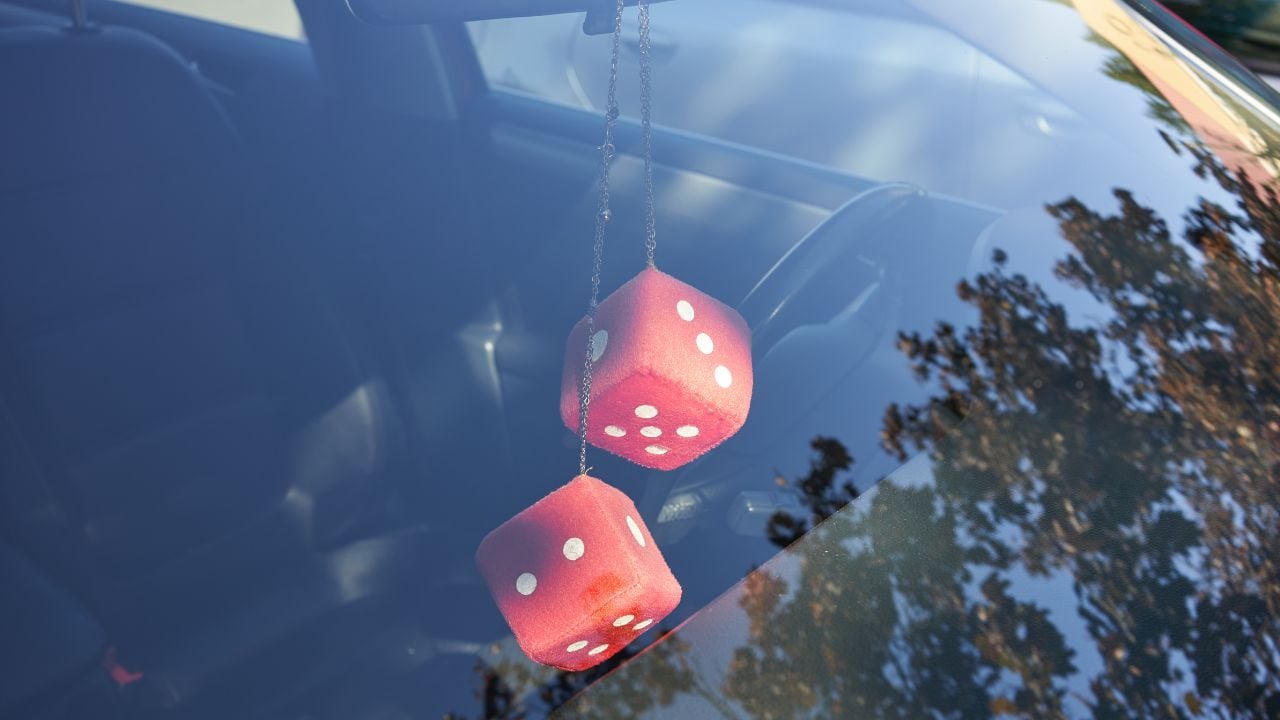
California Highway Patrol officers call out fuzzy dice by name when they explain what draws a stop under the windshield rule.
Officer Jacob Sanchez, with the California Highway Patrol’s Border Division near San Diego, told Fox 5 that “big fuzzy dice” are exactly the kind of item that earns a driver a warning, or worse, a citation.
Not a myth.
A pair of dice big enough to look good swinging from a mirror is also big enough to block a slice of the road right where a driver needs to see it, a child stepping off a curb or a car braking short.
California doesn’t measure how much of your view a dangling object blocks before an officer decides to write the ticket.
The officer does that part.
3. Graduation Tassel
California’s graduation season ends in June, but the tassels keep riding around on rearview mirrors well into fall.
Just a habit.
The same broad language in Vehicle Code 26708 that catches an air freshener catches a tassel, too: Any object hung where it can block the driver’s view through the windshield qualifies, and the statute draws no line for sentimental value.
A diploma doesn’t buy an exemption.
Many drivers stopped for this walk away with a warning and a request to move the tassel to the glove box, not a fine, since officers generally treat a first offense as correctable.
4. Phone Mount in the Middle
California lets a phone mount ride on the windshield, just not anywhere a driver feels like sticking it.
Vehicle Code 23123.5 only protects a mount placed in the same small corner squares set aside for a portable Global Positioning System (GPS) unit, or one attached to the dashboard or center console where it doesn’t block the driver’s view.
Stick the mount in the center of the glass, dead ahead of the steering wheel, and it loses that protection entirely.
Wrong spot, still a ticket.
Many drivers mount a phone dead center because that’s where their eyes naturally land, which is precisely the sightline California wants kept clear.
Where California Lets You Mount Things
California’s windshield rules boil down to a few exact measurements, not a general “keep it small” guideline.
A GPS or phone mount is only protected in a seven-inch square in the lower corner farthest from the driver, or a five-inch square in the lower corner closest to the driver.
Either corner also has to sit clear of the airbag’s path.
A dash cam gets those same two corners, or a five-inch square at the very top center of the glass.
An electronic toll tag only gets a narrow strip at the very top of the glass, dead center, and nowhere else.
Move any of them a few inches outside their box, and California’s own driver handbook no longer protects the placement.
5. Dash Cam in the Wrong Spot
A dash cam counts as legal safety gear under California law, right up until it’s mounted somewhere the statute didn’t set aside for it.
The exemption only covers a video event recorder that continuously loops footage and saves it when triggered by a crash or hard stop, and only when it’s mounted inside one of the law’s approved corners.
Center it too wide, or mount it too low, and the exemption disappears.
Gone.
A dash cam that size, stuck in the wrong place, gives an officer the same obstruction call as a stack of dice.
Psst! How legal is your dashboard right now? Run through this checklist and see where you stand.
6. Phone Stand Piled on the Dashboard
A phone stand stacked on your dashboard looks harmless in California, right up until it climbs tall enough to block your view over the wheel.
Vehicle Code 26708 doesn’t require an object to touch the windshield at all: The law bans anything “placed, displayed, installed, affixed, or applied in or upon the vehicle” that obstructs or reduces the driver’s clear view through the glass.
California defense attorneys who walk drivers through this exact statute point to a nearly identical case: A driver who props a tall sign on the dashboard and blocks the view through the windshield violates the law the same way tinted glass does, according to Shouse Law Group.
Never the test.
A stand loaded with a bulky case, a coiled charger cord, and a phone standing upright can climb past the top of the steering wheel fast, and once it blocks that sightline, an officer has the same obstruction call whether the item hangs from the mirror or sits on the dash.
7. Toll Tag in the Wrong Corner
An electronic toll device like FasTrak gets exactly one legal spot on a California windshield, and it’s not wherever the sticker happens to land.
The state’s own driver handbook limits an electronic toll device to one narrow strip dead center at the top of the glass, and nowhere else on the windshield.
Doesn’t count.
A parking permit sticker or a resident decal follows the same tight rule, confined to that same handful of small squares the state carved out for everything else on this list.
8. Radar Detector on the Glass
Running a radar detector in an ordinary passenger car is legal in California, and many drivers assume that settles the matter.
It settles nothing.
Owning and running the device is legal.
Suction-cupping it straight to the windshield is a separate problem, since that mount falls outside every one of the small corner squares the law protects.
The federal rule banning radar detectors only reaches commercial trucks regulated by the Federal Motor Carrier Safety Administration (FMCSA), not the passenger cars many California drivers take to work.
A dashboard mount, not the glass, keeps both the device and the driver legal.
How California Decides What Counts as an Obstruction
California leaves the call on several of these items to whichever officer pulls up behind a driver, not to a strict measurement written into the ticket book.
Officer Sanchez told Fox 5 San Diego that a driver with something dangling from the mirror usually gets a warning first, a chance to pull the item down on the spot.
Tinted material stuck directly to the glass is different.
Tinted glass, he said, usually turns into a fix-it ticket right away, since it’s harder to peel off in the middle of a traffic stop.
A fix-it ticket lets a driver correct the problem, get it signed off, and send proof to the court instead of paying a straight fine.
Warning first, ticket second.
The Rule Covers More Than the Windshield
California’s obstruction rule doesn’t stop at the glass, and that catches drivers who assume a clean windshield means a clean citation.
Vehicle Code 26708’s broader clause reaches anything “placed, displayed, installed, affixed, or applied in or upon the vehicle” that blocks the driver’s view, language wide enough to cover a tissue box propped against the wheel or a stack of mail piled in front of it.
Nothing touches glass.
California’s obstruction law does carve out one exception, and it runs through a doctor’s office rather than a body shop.
Vehicle Code 26708.2 lets a driver install a sun-screening device on the front side windows with a signed letter from a physician, optometrist, or dermatologist documenting a medical need for the shade, the one place in this rule where paperwork outranks an officer’s judgment call.
10 Things California Residents Can’t Legally Toss in a Household Garbage Bin

Toss the wrong thing in a California curbside bin, and it isn’t just messy. It can break the law.
These are the everyday items California bans from an ordinary household trash can.
10 Things California Residents Can’t Legally Toss in a Household Garbage Bin
10 Things Californians Refuse to Do in Late Summer No Matter What

A heat wave isn’t the hardest part of a California August.
Long before Labor Day, these are the things Californians flatly refuse to do once late summer sets in.
10 Things Californians Refuse to Do in Late Summer No Matter What
