
6 Publix Clearance Tags Georgia Shoppers Never Learn to Read

Since 2009, Publix has donated more than 1 billion pounds of food that never made it anywhere near a clearance shelf.
That number alone rewrites how a shopper should be reading Publix’s tags.
Every mark printed on those tags carries its own meaning, and almost none of it means what a shopper assumes walking up to the shelf.
These are the Publix clearance tags that many Georgia shoppers never learn to read, no matter how many trips they’ve made.
1. Corner Color Trick
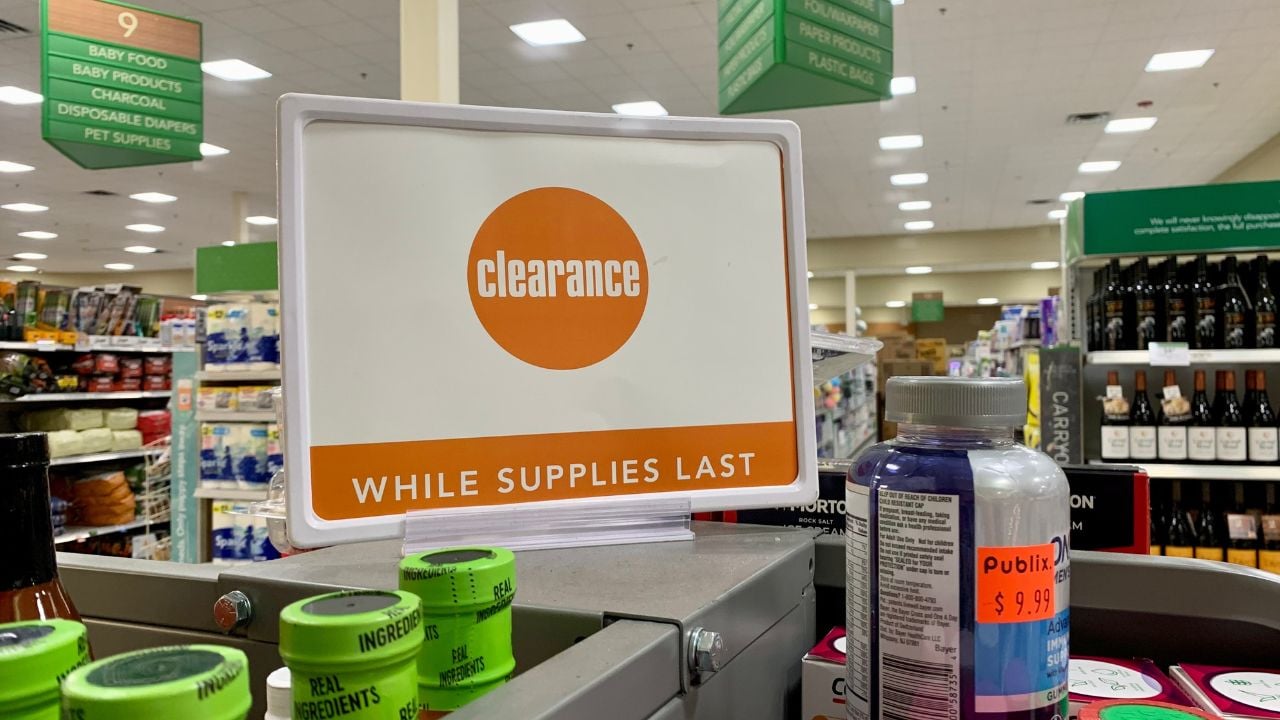
Publix stamps a tiny colored square in the corner of almost every price tag in the store, including the tags carrying its Clearance icon, and Georgia shoppers routinely misread what that square means.
Many assume yellow signals a steeper markdown than green.
It doesn’t.
Publix runs two ad cycles company-wide. One flips its ad on Wednesday and runs through Tuesday. A second flips on Thursday and runs through Wednesday.
The corner color simply alternates between green and yellow to mark which cycle is currently live, not how steep any discount runs.
Georgia’s 219 stores don’t all sit on the same cycle, so it’s worth checking which one a store follows before assuming two Publix locations in the same metro area are showing the same week’s color.
That corner color marks only which ad cycle is live, even on a tag stamped with the Clearance icon. The size of the markdown itself never shows up in that square: Only the Clearance icon does that job.
2. Corner’s Digit Code
Publix tucks a second clue into that same corner: A four-digit number sitting in parentheses beneath the price, printed there whether or not the tag also carries the Clearance icon.
Many shoppers miss it completely.
That code marks the exact start date of the sale printed above it, and a Publix worker who broke down her own store’s tag showed a code reading “0904” lined up with a sale that started Sept. 4.
On a genuine Clearance tag, that same code only confirms when the current price took effect. It doesn’t confirm how much has been cut from the original price, and the identical code would sit on an ordinary BOGO tag just as easily.
A Georgia shopper comparing two Publix stores in the same city can use it to confirm whether both are running the same clearance cycle, or whether one location is a few days behind the other.
How Publix’s Four-Digit Code Breaks Down
Publix’s four-digit code reads as month first, then day, the same order a Publix worker matched to her own tag’s sale date.
The code marks only the start of that sale. Count six days forward from it to find the last day the price holds, whether the store runs a Wednesday-to-Tuesday cycle or a Thursday-to-Wednesday cycle.
3. Two Icons, Opposite Meanings
Publix keeps two nearly identical-looking icons in its official shelf tag guide, and mixing them up costs shoppers information they need.
One says “Save.”
The other says “Clearance.”
Publix’s own guide defines the Save icon as a price that’s only reduced temporarily: That item is coming right back to its regular price once the promotion ends.
The Clearance icon means something else entirely: The product will soon be unavailable, for good.
Same shelf, same size tag, completely different futures for what’s sitting behind it.
4. Oversized Orange Banner
Publix’s standard tag only has room for one icon at a time, and that creates a workaround Georgia shoppers rarely notice.
When a clearance item also happens to carry a second badge, like vegan or gluten-free, the small icon disappears.
In its place, food writers have documented Publix swapping in an oversized orange banner tag instead, still marking the same going-away-for-good status, just in a bigger, harder-to-miss format.
It looks like a different kind of markdown.
It isn’t.
It’s the exact same Clearance signal, just re-sized because the tiny version ran out of space.
Psst! How much do you know about Publix’s roots in Georgia? Take our quiz and see if you can ace it.
Quiz
Publix Georgia Trivia
Answer these questions about Publix’s roots in Georgia and its wider history. We bet you can’t get them all right. Prove us wrong?
How does someone get shares of Publix stock?
5. Leftover Tag
Publix reminds every cashier that a leftover tag in last week's color still counts at checkout, according to an employee's cashiering explanation on the Publix subreddit.
That includes a Clearance tag.
A store is supposed to swap every tag the moment a new ad cycle starts, corner color and all, but a Clearance tag still showing last week's color is a sign the associate hasn't gotten to that tag yet, not proof the item stopped being on clearance.
Checking that corner color against the cycle currently posted in the store is the fastest way to confirm a Clearance tag is still showing the current price, before an associate catches the mismatch first.
That old tag still pays off either way, since Publix honors the price it shows.
6. Sticker That Isn't There
Publix skips the yellow "reduced for quick sale" stickers that shoppers might expect on meat, deli or produce as the sell-by date closes in.
That's policy, not an oversight.
Instead of marking those items down, Publix pulls what's still safe to eat and reroutes it to local food banks through its Good Together donation program, which has shipped more than 1 billion pounds of food to partners since 2009.
A shopper hunting for that reduced-for-quick-sale sticker at a Georgia Publix will check every case in the store and never spot it.
Blue Appears Twice on the Tag
Publix prints blue in two different spots on its price tags, and the two uses have nothing to do with each other.
Same color, different job.
The first sits in that same alternating corner, and it flags a certified organic product.
Unlike the green and yellow squares that flip weekly with the ad cycle, that blue marker stays put on an organic item all year, whether the product is on sale, at full price, or untouched on the shelf for months.
A second blue marker shows up lower on some tags, printed beside a dollar figure like "Save $5."
That second blue marker has nothing to do with organic certification. It tells a shopper exactly how much a temporary price cut is worth, the same dollar amount the Save icon backs up elsewhere on the shelf.
7 Aldi Habits Costing Georgia Shoppers Money
Aldi built its whole reputation on a low sticker price, and Georgia shoppers pack the parking lots off I-285 for exactly that.
Those savings disappear fast once a few small habits creep in from the middle aisle to the checkout belt.
7 Aldi Habits Costing Georgia Shoppers Money
11 Habits That Instantly Give Away a Lifelong Georgian
A lifelong Georgian can recite the day's pollen count without checking a single app.
Tourists just wonder why their black rental car turned green overnight.
