
8 California Habits Americans Judge the Moment Californians Leave the State

A new coworker in Nashville guesses California within five minutes of small talk, before the Californian says a word about where they grew up.
Their accent wasn’t the tell.
These are the small, dead-giveaway habits that get a Californian noticed the moment they cross state lines.
1. Ordering a Soda, Not a Pop
Californians order a soda without a second thought, wherever they happen to be standing.
That word choice isn’t random.
California sits in soda territory on the dialect map researchers built from Harvard’s 2003 survey of how Americans talk, and no other state leaned on the word harder.
Nearly four out of five surveyed Californians said soda instead of pop or coke, the highest share of any state in the country.
New York and pockets of coastal New England lean the same way, just not as hard.
Pop rules the Midwest instead, in states like Wisconsin, Ohio, and Minnesota.
Order a soda at a diner counter in Milwaukee, and the server repeats it back as “pop” before ringing it up.
It happens on almost every order.
A Californian keeps saying it anyway, the same word they’ve used their whole life.
2. Creeping Along at the First Drop of Rain
California drivers slow to a crawl the moment the first drops hit the windshield, and it isn’t pure caution talking.
Months of dry weather leave oil and grime baked into the pavement.
The first rain of the season lifts all of it to the surface at once.
The California Highway Patrol warns drivers ahead of nearly every major storm because of it.
Los Angeles only sees rain on about three dozen days a year, so the skill never gets much practice.
Move a Californian to Seattle or Atlanta, where rain falls on a normal schedule, and the crawling habit doesn’t fade.
This time is no different.
Local drivers behind them lean on the horn, confused why someone is braking hard for a light drizzle.
3. Zipping a Parka at 55 Degrees
A Californian’s jacket comes out at 55 degrees, and to someone from Minnesota, it looks like a costume.
Downtown Los Angeles’ January high still climbs into the 60s on many days, and the mercury drops into the 40s only about one night a month.
Growing up without a hard winter means the body never calibrates to an actual freezing day.
Fly that Californian into Chicago in November, and they’re already buttoned up while locals are still in short sleeves.
Coats zipped tight.
The same scene plays out on almost every winter trip.
Their tolerance for cold never had a reason to build up.
4. Side-Eyeing a Lush Green Lawn
A Californian who moves to a state with normal rainfall still can’t help commenting on a neighbor’s lush green lawn, and it rarely comes across as a compliment.
Water districts across California have paid residents to rip out grass for over a decade, with the Los Angeles water utility now offering $5 a square foot to single-family homeowners who swap turf for drought-friendly landscaping.
That rebate followed years of mandatory water cuts during the last drought, and many Californians never let go of the instinct to eye a lawn with suspicion, even after the cuts ended.
Grass reads as wasteful now.
Neighbors in Georgia or Tennessee notice fast, and more than one has told a California transplant that nobody asked for a lecture about their water bill.
5. Giving Directions in Minutes, Not Miles
A Californian’s directions run in minutes, not miles, a habit that runs deep enough that many can’t say how far two places are in actual mileage.
Los Angeles drivers alone lost about 87 hours to traffic congestion in 2025, according to the Global Traffic Scorecard from INRIX, a transportation analytics firm, enough delay to make a clock a far more useful measurement than a map.
Ask a Californian how far the airport is, and the answer comes back as “25 minutes, maybe 40 if it’s Friday.”
Not the mileage.
Give those same directions in a small town in Kansas or Nebraska, where twenty miles just means twenty miles, and the local just stares.
Nobody there measures a grocery run in minutes of merge lanes and brake lights.
Psst! How much do you know about California beyond the stereotypes? Flip these cards and see how many you get right.
6. Sorting Food Scraps Into a Green Bin
California residents have had to sort food scraps into a separate bin since January 2022, when the state’s organic waste law, Senate Bill 1383 (SB 1383), took full effect.
The rule reaches every household, not just businesses.
Banana peels, coffee grounds, chicken bones, even greasy pizza boxes all go in the green bin instead of the regular trash now, statewide.
The goal is a 75% cut in organic waste sent to landfills by 2025, compared with 2014 levels.
Big target.
Move a Californian to a state with no organics program, and the sorting habit doesn’t stop. They keep a bowl of scraps on the counter out of pure reflex.
A new roommate usually asks what it’s for within the first week.
7. Expecting a Nickel Back on Every Can
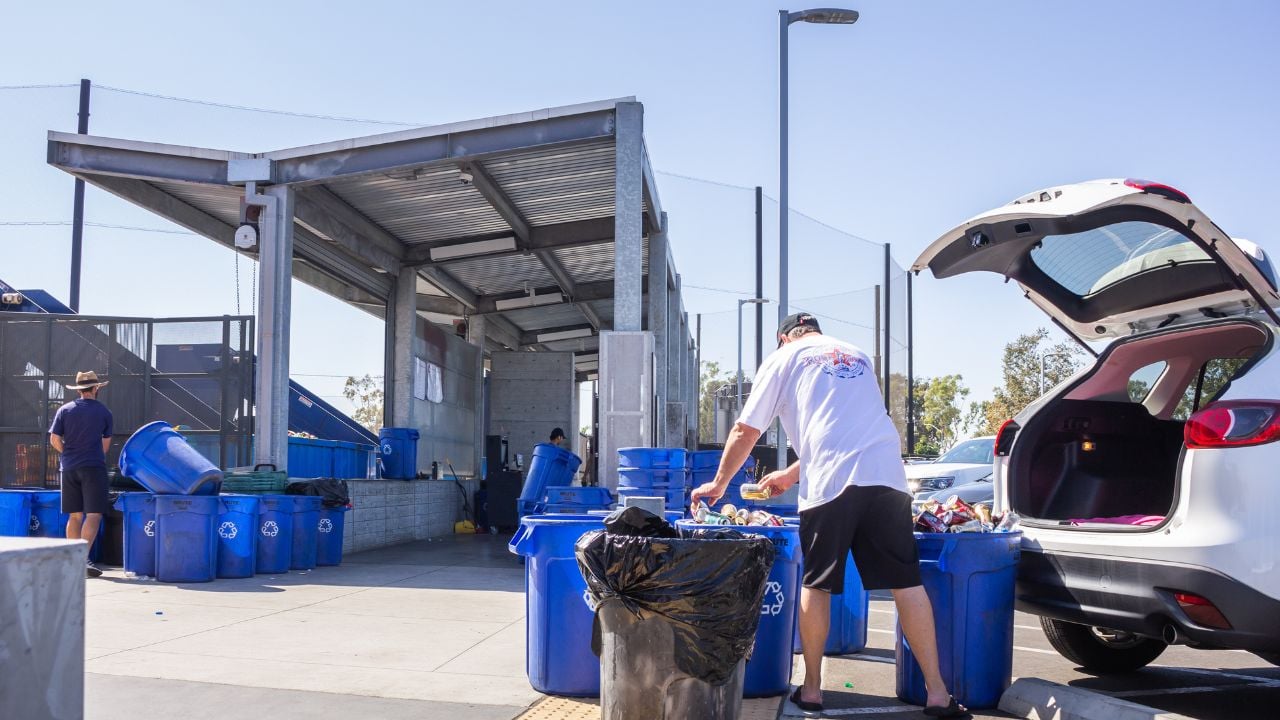
Californians expect a little cash back every time they toss an aluminum can or a plastic bottle, thanks to the state’s California Redemption Value (CRV) refund.
Containers under 24 ounces pay back 5 cents, and anything larger pays back 10 cents, money built right into the price at checkout and recoverable at a recycling center.
California is one of only about ten states with a bottle-deposit law like it.
Not universal.
A Californian who moves to Ohio or Indiana keeps rinsing out cans and setting them aside anyway, waiting on money that was never coming.
A roommate eventually asks why there’s a garbage bag of empty cans by the door.
What California’s Nickel Depends On
California’s CRV refund isn’t a flat nickel across the board. Anything under 24 ounces pays 5 cents, and anything 24 ounces or larger pays 10 cents.
Wine boxes, pouches, and bladders joined the program in 2024, and each one refunds 25 cents.
Only nine other states run anything similar: Connecticut, Hawaii, Iowa, Maine, Massachusetts, Michigan, New York, Oregon, and Vermont. Everywhere else, a bag of saved cans is just recycling with no register to redeem it at.
8. Checking the Air Quality App on Reflex
A Californian’s first move many wildfire seasons is checking an air quality app before the weather.
Apps like AirNow and the state’s own Smoke Spotter tool let residents track air quality index (AQI) swings that can double or triple within a few hours as wind shifts.
Transplanted Californians carried that habit across the country in 2023, when wildfire smoke gave New York City some of the worst air on the planet for a few days, and they already knew the drill while their neighbors scrambled.
Old habit, new city.
A Californian who’s lived through fire season keeps a KN95 mask in a bag or a glovebox long after moving somewhere with clean air, and a coworker eventually asks what it’s for.
How Many Californians Leave Every Year
California lost about 661,000 residents to other states in 2024, the largest single-state departure total in the country that year.
About 1 in 60 residents.
Texas took the largest single share of that group, pulling in roughly 77,000 former Californians in one year alone.
Arizona and Florida rounded out the top destinations.
That’s not a trickle of people leaving.
California also gained about 406,900 residents from other states that same year, arriving for jobs, family, or a shot at the coastline everyone else was leaving.
International migration made up the rest of the gap, arriving in numbers large enough that the state’s population still crept up despite years of domestic losses.
8 Things California Retirees Regret Not Doing Before Their Final Paycheck

California’s top income tax rate runs as high as 13.3%, the steepest of any state in the country, and it doesn’t stop just because someone stops working.
Retirement in California comes with deadlines and decisions that land in the weeks around a last paycheck, not after it.
8 Things California Retirees Regret Not Doing Before Their Final Paycheck
9 Trader Joe’s Favorites California Shoppers Race the Clock to Buy

A $2.99 canvas tote at Trader Joe’s once turned into a line out the door the week the store restocked its mini totes, with a four-bag limit per shopper just to keep things moving.
Shoppers who missed that restock started watching the store’s Instagram account for the next drop instead of leaving it to chance.
9 Trader Joe’s Favorites California Shoppers Race the Clock to Buy
