
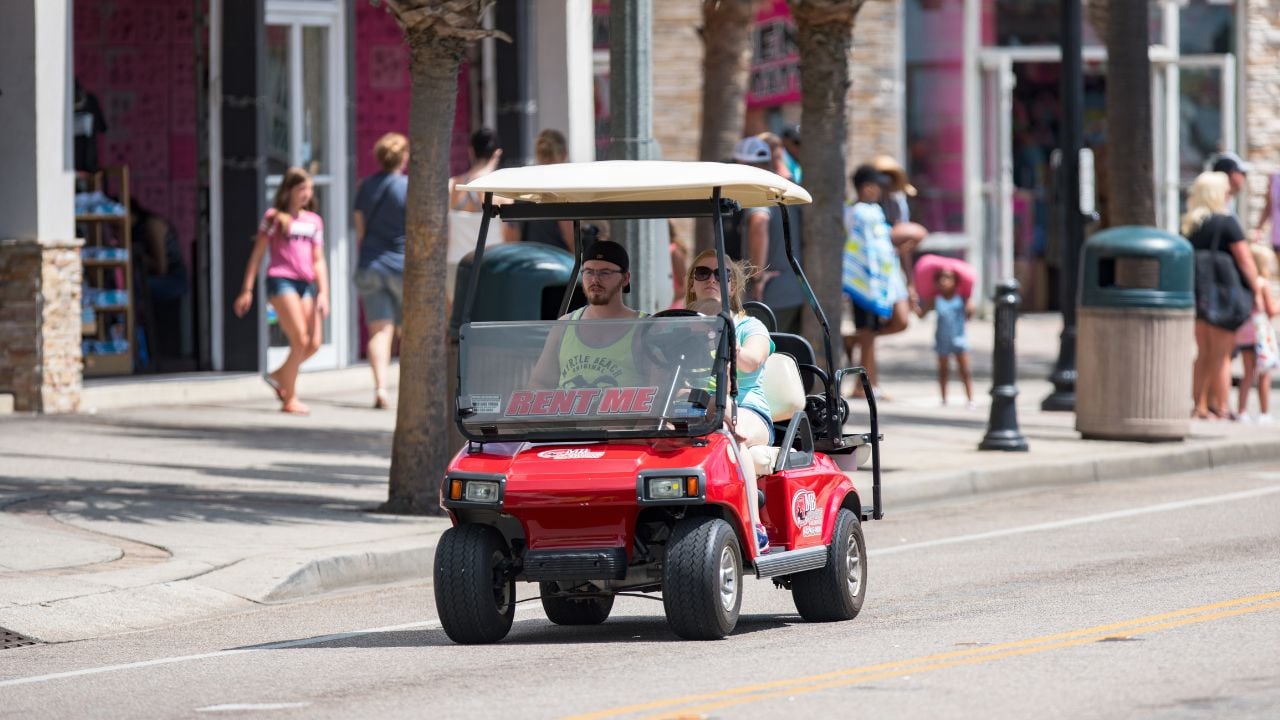
8 Golf Cart Rules South Carolinians Break Without Knowing

Governor Henry McMaster signed House Bill 3292 into law on May 22, 2025, rewriting South Carolina’s golf cart rules from top to bottom.
Every part of it changed that day, from who can get behind the wheel to where the cart can legally go.
Many people missed it.
Here’s where South Carolina’s rewritten golf cart law catches drivers who never read past the headline.
Note: This is general information, not legal advice. Golf cart laws and local ordinances are subject to change, so confirm the current requirements with the South Carolina Department of Motor Vehicles.
1. Skipping the SCDMV Permit Decal
South Carolina asks for more than a bumper sticker before a golf cart earns a spot on a public street.
State law requires an owner to get a permit decal and registration certificate from the South Carolina Department of Motor Vehicles (SCDMV) before the cart leaves the driveway for a public road, backed by proof of ownership, proof of liability insurance, and a five-dollar fee.
That decal isn’t permanent, either.
It expires every five years, or sooner if the owner’s address changes.
Myrtle Beach alone has issued nearly 3,000 of these decals, and that’s a single city on a coastline full of them.
Many new owners drive off the lot treating a golf cart more like a toy than a titled vehicle.
South Carolina disagrees.
2. Leaving Your Paperwork at Home
A golf cart owner in South Carolina can’t just own the registration and insurance paperwork and call it done.
The driver has to physically carry three things every time the cart rolls onto a public street: The registration certificate, proof of liability insurance, and a valid driver’s license.
That applies the moment the tires touch pavement, not just when someone happens to ask.
A lot of neighborhoods treat a golf cart like a bicycle with a roof.
State law says otherwise.
South Carolina requires the driver to be at least 16 years old with an actual license, no exception for a confident 14-year-old who’s “basically driven it for years” around the cul-de-sac.
3. Blowing Past the Four-Mile Line
South Carolina’s cap on how far a permitted golf cart can travel from home catches almost everyone who’s never read the fine print.
The default limit sits at four miles from the address on the registration certificate, or four miles from the gate if that address sits inside a gated community.
That’s tight enough to matter.
It covers a trip to the neighborhood pool without a second thought.
It often doesn’t cover a cart ride to a restaurant three neighborhoods over, or a marina clear across town.
A cart that’s perfectly legal for Tuesday’s farmers market can sit outside the line by Friday’s dinner reservation.
Local ordinances can reroute or restrict where a cart goes under the 2025 rewrite, but the four-mile line is still the number every South Carolina golf cart owner needs to know by heart.
A Friend’s Driveway Doesn’t Reset South Carolina’s Four-Mile Line
Drive a permitted golf cart to a friend’s driveway first, and South Carolina’s four-mile radius doesn’t reset from that new spot.
It still radiates out from the address printed on the cart’s own state registration certificate, not from wherever the cart happens to be parked when a trip starts.
Move to a new house without updating that address, and the legal radius stays anchored to the old one until the paperwork catches up.
4. Driving on the Wrong Road
Not every road in South Carolina welcomes a permitted golf cart, and the posted speed limit decides which ones do.
A cart may only travel on a secondary highway or street posted 35 mph or under.
That’s the hard ceiling.
It can cross a busier road at an intersection, but it can’t turn onto that road and ride the shoulder home.
That’s exactly the shortcut a lot of golf cart owners take without a second thought, cutting across a fast road to save two minutes on the way to the beach.
Law enforcement doesn’t measure that shortcut in minutes saved.
They measure the cart against the posted speed limit, and a cart on a 45-mph road fails that test every time.
5. Driving After Dark
South Carolina limits a permitted golf cart to daylight hours by default, full stop.
Once the sun goes down, the cart is supposed to stay parked unless the local city or county has passed its own ordinance allowing night driving.
Even then, the cart needs working headlights and taillights installed before it’s legal after dark.
Many never get them.
They’re built for a sunny afternoon loop to the clubhouse, not a nighttime run for ice cream.
Drive that same loop after dinner without checking the local ordinance first, and the cart that was perfectly legal at 3 p.m. isn’t legal at 9.
6. Skipping the Seat Belt for Kids
Every golf cart passenger under 12 in South Carolina has to wear a fastened seat belt anytime the cart is out on a public street.
South Carolina wrote that rule into the same 2025 law that rewrote the rest of the golf cart law, so it carries the same weight as every other requirement in it.
The catch is that many golf carts, especially older ones or the rear-facing bench seat models, were never built with belts back there in the first place.
The requirement stands either way.
An owner still can’t legally carry an unbelted child under 12 on a public street, belt or no belt.
Psst! How much do you know about golf cart history and South Carolina’s golf roots? Take our quiz and see how many you can get right.
Quiz
South Carolina Golf Cart IQ
Answer these questions on golf cart history and South Carolina’s own golf roots. We bet you can’t get them all right. Prove us wrong?
A disabled golfer built the very first golf cart in 1932 so he could keep playing without walking the course. Who was he?
7. Treating a Golf Cart Like It's DUI-Proof
A golf cart in South Carolina answers to the same alcohol rules as a car the moment alcohol enters the picture.
State law defines a motor vehicle as any self-propelled vehicle, and South Carolina doesn't carve out an exception in its driving-under-the-influence (DUI) statute for anything with a canopy top and a 15-mph engine.
A blood alcohol content of .08% or higher on a public street earns the same charge and license suspension as a DUI behind the wheel of a sedan, plus a fine that can run close to a thousand dollars with assessments and surcharges on a first offense.
Open containers count too.
South Carolina's open container exemption covers a trunk or a separate luggage compartment, and it's unclear whether a golf cart's open-air back bench or cargo bed qualifies as either one.
A cooler riding back there sits in a gray area, not a guaranteed safe harbor.
Passing a drink around while the cart's still moving on a public road is a clear violation either way.
Many neighborhood parties end with someone grabbing golf cart keys instead of car keys, assuming the switch makes the risk disappear.
It doesn't.
8. Assuming One Set of Rules Covers the Whole State
Local rules stack on top of South Carolina's state golf cart law, and that trips up drivers who assume the rules they learned in one town travel with them everywhere.
Cities and counties can pass their own ordinances setting the hours, methods, and locations golf carts are allowed to use, as long as the road's speed limit still tops out at 35 mph.
Pawleys Island shows how far a town can push past that floor: Golf carts there need a Pawleys Island sticker in addition to the state-issued decal before they can legally use the town's streets.
Pawleys Island wants both.
The town also narrows who qualifies: The registered address has to sit within two miles of the town limits, half the reach South Carolina's own four-mile rule allows everywhere else.
Pawleys Island also grounds golf carts entirely in the rain, a restriction the state law never mentions at all.
Check the local ordinance before assuming the state's default rules are the only rules that apply.
Isle of Palms adds a rule of its own: Golf carts are banned outright from Palm Boulevard (SC-703) and the Isle of Palms Connector (SC-517), no matter how slow the cart drives or how current its registration is.
Nobody hands a new golf cart owner a copy of the local ordinance at the motor vehicle counter, so it falls on the owner to go find it.
9 South Carolina Small Towns Worth the Detour

The most interesting hour in South Carolina rarely happens where the tour buses park.
It happens down a two-lane road, in a town of 300 or 3,000, well outside any golf cart's four-mile line.
9 South Carolina Small Towns Worth the Detour
11 Culture Shocks People Experience When Moving to South Carolina
A neighbor mentions, almost offhand, that the alligator in the retention pond behind the cul-de-sac has been there since spring.
Nobody warns a new homeowner about that before closing, any more than they warn about the golf cart parked in the garage that came with a rulebook nobody handed over.
11 Culture Shocks People Experience When Moving to South Carolina
