
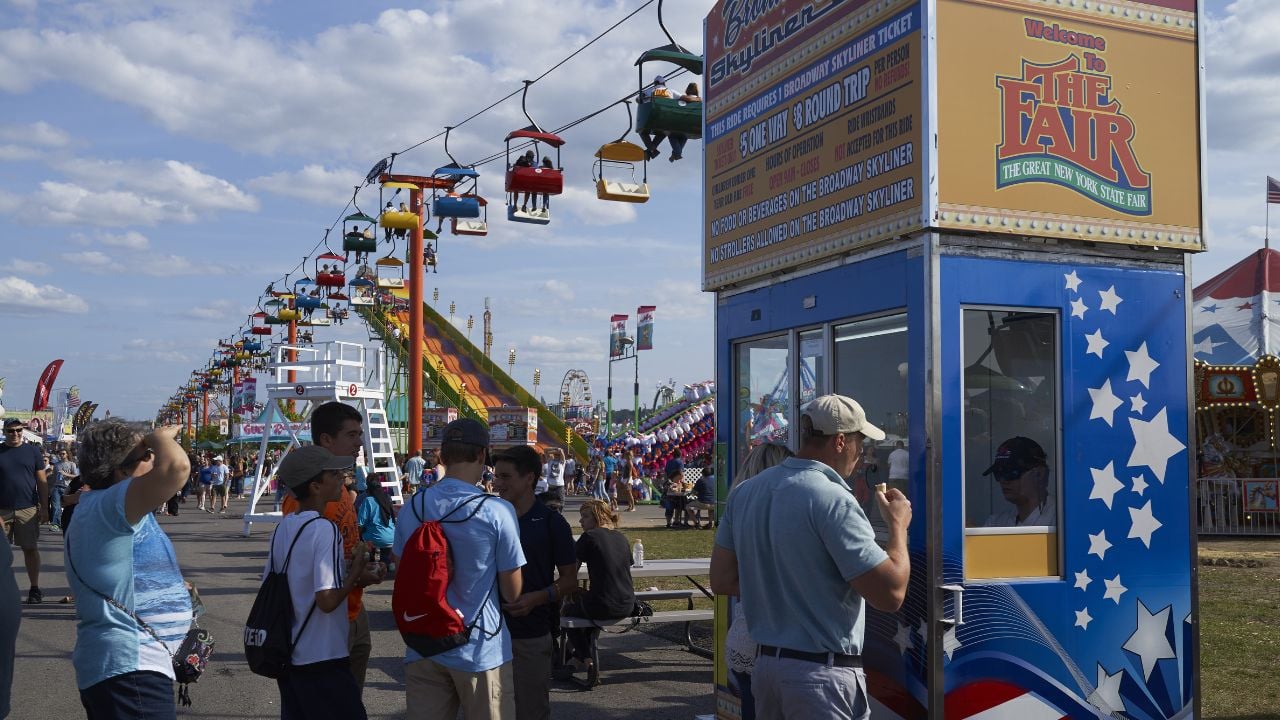
8 New York State Fair Mistakes First-Timers Make Every Year

New York held the nation’s first state fair in 1841. That’s twenty years before Kansas became a state.
Nevertheless, it still hasn’t figured out how to make parking simple.
Upwards of 100,000 people a day pack into the fairgrounds outside Syracuse on its busiest days.
The first-timers among them keep making the same handful of mistakes.
These are the New York State Fair mistakes first-timers make every year, the kind that are easy to skip once you know they’re coming.
1. Skipping the Park-N-Ride Shuttle
The New York State Fair charges $12.41 for a parking voucher at its public lots, fees included.
First-timers pay it without checking their other option first.
Centro runs a Park-N-Ride shuttle from the Downtown Transit Hub, Long Branch Park, and Destiny USA.
Parking runs free there.
The shuttle itself runs $1 each way for adults, and 50 cents for seniors, kids six to nine, and riders with disabilities.
A family of four skips the $12.41 lot fee and pays $4 or less to ride in instead.
Buses run continuously from morning until well past 9 p.m., so missing one costs a few minutes, not the whole trip.
2. Showing up With Only Cash
The New York State Fair sells tickets at the gate through kiosks and smartphone QR codes, not a cash register.
Reverse ATMs on site convert paper bills into a usable card.
That’s an extra stop.
First-timers who show up with only bills spend their first ten minutes at the fair hunting for a machine instead of walking through the gate.
A card or a phone wallet in hand skips that line entirely.
3. Paying for Family Who Get in Free
Anyone 65 or older enters the New York State Fair for free, along with any kid 12 or under.
Admission for everyone else runs $8.32 with fees.
Ages matter today.
First-timers who don’t check ages ahead of time buy tickets nobody in their group needed.
Check the birthdates before you check out.
New York’s Free Admission Math
The New York State Fair’s free admission for anyone 65 and older or 12 and under can cut a group’s ticket cost by half or more, depending on who’s along.
A group of two working-age adults and two kids 12 and under only pays for the two adults, $8.32 each for $16.64 total, instead of $33.28 for four full-price tickets.
4. Bringing the Family Dog
New York’s state fair bans pets from the fairgrounds, service animals excepted.
That rule catches first-timers who assume a state fair means dogs are welcome too.
It doesn’t.
A dog left in a parking lot car on a hot Syracuse afternoon isn’t a backup plan.
Leave the leash at home, or leave the pet with someone else for the day.
Psst! How fair-ready are you before your first trip to the New York State Fair? Run through this checklist and see where you stand.
5. Not Checking This Year’s Rules
New York’s state fair added a new rule for 2026: face coverings and masks aren’t allowed at the gate unless worn for a documented medical reason.
That’s the whole rule.
It’s a change from years past, not a rule this fair has always run.
Security checks for it at the bag check, the same stop that checks coolers and backpacks.
A first-timer relying on last year’s assumptions runs into this one at the gate.
6. Buying a Wristband on the Wrong Day
A Ride All Day wristband at the New York State Fair costs $37 on a weekday and $47 on a weekend, once the advance sale ends.
That’s a $10 gap.
It buys the exact same rides.
First-timers who plan a Saturday trip pay the higher price without ever comparing it to a weekday visit.
Riding more than a couple of days works out cheaper on the $97 Mega Pass, good for unlimited rides across the entire 13-day run.
7. Skipping the Fairgrounds Map
New York’s state fairgrounds cover 375 acres, with 11 permanent buildings holding more than 300,000 square feet of exhibits.
That’s a lot of ground.
Nearly 100,000 people a day walk that same ground during a busy stretch of the fair.
First-timers who skip the map end up crossing the same path twice, or missing a whole building they never knew was there.
Two or three planned stops turn all that ground into an easy route instead of a maze.
8. Packing a Cooler Full of Outside Alcohol
The New York State Fair welcomes coolers of food and drink through the gates, no separate fee, no complicated rule.
Alcohol is the exception.
Staff at the bag check turn away any alcoholic beverage not bought on site.
There’s no claim check or storage lockers for anything confiscated, either.
The sandwiches and the juice boxes make it through the gate.
Anything stronger waits until it’s bought inside.
185 Years and Counting
New York held the country’s first state fair in Syracuse back in 1841.
The event has run almost every year since.
The fairgrounds have stood on the same spot in Geddes since 1890, a plot the state didn’t even own until 1899.
That’s a long run.
That history still makes it the country’s oldest state fair.
Governor Hochul’s office also counts it among the top five state fairs in the nation.
Nearly 100,000 people now walk through the gates on a single busy day, more than attended the entire first fair back in 1841.
24 Sculptures and 800 Pounds of Butter
New York’s state fair reveals a brand new butter sculpture every year before a single gate opens to the public.
This year’s version used more than 800 pounds of butter for the fair’s 58th annual sculpture, the 24th built in a row by sculptors Jim Vector and Marie Pelton.
It takes eleven days.
That butter comes from a Batavia dairy plant, pulled from the retail line for reasons that have nothing to do with taste.
Once the fair packs up, a Pavilion farm runs the leftover butter through a digester that turns it into enough renewable energy to power a home for three days.
10 Words New Yorkers Use That Confuse Everyone Else

New York’s accent changes at the county line, and so does its vocabulary.
These are the words that mark someone as a true New Yorker, whether they grew up on Long Island or somewhere upstate.
10 Words New Yorkers Use That Confuse Everyone Else
8 Reasons People Are Leaving New York in 2026
More than 400,000 people left New York for another state in a single year, a group the size of a mid-sized city walking out the door.
These are the reasons New Yorkers keep giving for packing up and heading somewhere else.
