
7 Weeds Georgia Gardeners Kill on Sight That Are Worth Keeping

Americans spray an estimated 80 million pounds of pesticide across home lawns every year.
That’s roughly ten times what a farmer spreads on a similar-sized field of actual crops.
Some of what Georgia gardeners pull or spray on sight are edible, medicinal, or what local wildlife wants to eat.
These are the weeds worth pausing over before you bring out the sprayer.
Note: This is general information, not medical advice. Reactions to herbicide residue and to oxalic acid vary by person, so talk to a doctor about your situation before eating wild plants from a treated yard.
1. Common Blue Violet
Common blue violet turns up in shady, damp corners of Georgia lawns every spring, and the University of Georgia (UGA) Extension ranks wild violets among the toughest lawn weeds to control.
Pulling the plant only spreads it further.
Its rhizomes snap off underground when yanked, and each leftover piece regrows into a new plant, so a single afternoon of weeding barely dents a patch.
The flowers and young leaves are edible, though.
UGA’s own food research found the foliage carries salicylic acid, the same compound found in aspirin, plus a solid dose of beta-carotene.
People toss the purple blooms into salads or freeze them into ice cubes as a garnish.
Nobody sprays aspirin.
2. Henbit
Henbit blankets bare patches of Georgia lawn every late winter, its small purple flowers opening before almost anything else in the yard stirs.
Georgia gardeners who spot that purple haze reach for the sprayer immediately.
By the time henbit is blooming, the fall pre-emergent window that would have stopped it before it ever broke the surface has already closed.
UGA Extension’s Lincoln County office tells homeowners who missed that window to expect spot treatments, or repeat rounds of herbicide spaced weeks apart, just to knock back the henbit already growing in the lawn.
Henbit ranks among the first flowers open in late winter, and North Carolina State University’s Extension program (NC State Extension) calls it an early nectar source for honeybees waking up from a long, hungry stretch.
Bees notice before anyone else does.
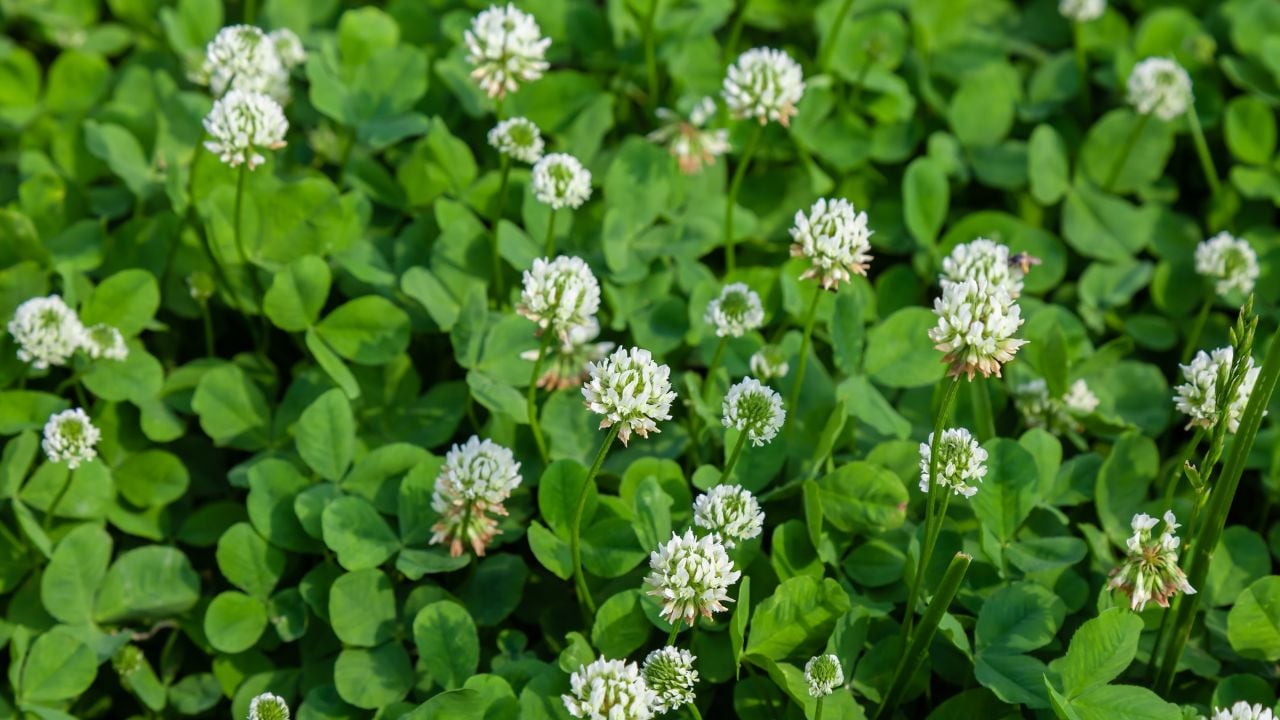
3. White Clover
White clover creeps into Georgia lawns wherever the turf thins out, and Georgia gardeners reach for a weed-and-feed the moment they spot it, since many of those products are built to wipe out every broadleaf plant they touch, clover included.
One pass and it’s gone.
But clover is a legume, and its roots team up with rhizobium bacteria to pull nitrogen straight out of the air and feed it into the soil for free, according to UGA Extension’s forage research.
That’s free fertilizer for the grass growing right next to it.
No fertilizer bag needed.
4. Broadleaf Plantain
Broadleaf plantain forms a low rosette of wide, ribbed leaves in Georgia lawns and garden beds, and it’s one of the broadleaf weeds UGA Extension’s turf program tracks and homeowners routinely spray out.
Not exactly a showpiece.
Foragers and herbalists have relied on crushed or chewed plantain leaves for generations as an on-the-spot poultice for bee stings and bug bites, and Minnesota Extension confirms the plant’s long history in traditional medicine.
Free first aid underfoot.
5. Purslane
Purslane thrives in Georgia’s summer heat, creeping fast across bare soil in vegetable gardens and flower beds.
Its fleshy reddish stems can smother a new planting within days.
Gardeners pull it by the handful all season.
A single missed patch reseeds itself before the next weekend rolls around.
That same plant is, per NC State Extension, one of the most nutritious weeds around, packed with omega-3 fatty acids and vitamins A and C.
It also shrugs off drought better than many of the vegetables planted right next to it.
Purslane works raw, straight off the stem, no dressing required.
Before Georgia Gardeners Eat Anything on This List
These seven Georgia weeds are safe to eat only in a yard that has never seen a chemical treatment.
Georgia gardeners who spray a broadleaf herbicide on the lawn, even once a season, should skip harvesting from that patch entirely.
Herbicide residue can linger on leaves and in the soil well past the point where the plant looks healthy again, so a treated patch belongs in the compost pile, not on the dinner table.
Wood sorrel and purslane both carry oxalic acid, the same compound found in spinach and rhubarb, and it’s harmless to many people in the small servings a garnish or salad adds.
Skip both plants if you have kidney stones or gout, since oxalic acid can make either condition worse.
6. Yellow Wood Sorrel
Yellow wood sorrel pops up in Georgia flower beds and cracks in the driveway with cheerful little yellow blooms and clover-like leaves.
NC State Extension warns that once it’s established, wood sorrel is nearly impossible to completely remove, since broken-off rhizomes just grow into new plants.
Every gardener has a losing streak with this plant.
The upside is that every part of it is edible.
NC State Extension describes the taste as sour and tangy, the same lemony bite foragers prize it for.
That lemony bite comes from a high dose of vitamin C: The Missouri Department of Conservation’s field guide notes wood sorrel has long been used to fight off scurvy, long before vitamin pills existed.
A free salad topper.
7. Yellow Nutsedge
Yellow nutsedge shoots up faster than the surrounding grass in Georgia lawns, and UGA Extension puts it in the genus that holds the worst weeds of the entire sedge family.
Killing it usually takes an herbicide made just for nutsedge, since ordinary weed killers barely slow it down.
The tubers underground, though, are chufa, a food considered a delicacy in the Middle East, and UGA notes the species name esculentus means eatable.
Georgia hunters plant chufa on purpose in food plots to draw in game birds, the same tubers a homeowner two properties over pays good money to eradicate.
One state’s wildlife food plot is another yard’s herbicide bill.
Psst! How much do you know about Georgia’s wild plants and invaders? Take our quiz and see how many you can get right.
Quiz
Georgia Wild Plant IQ
Answer these questions on Georgia’s wild plants, invaders, and state symbols. We bet you can’t get them all right. Prove us wrong?
Georgia’s official state flower, adopted in 1916, is which plant?
Georgia's Pesticide Habit, by the Numbers
Georgia's frogs are the canary in the coal mine for backyard chemical overuse, according to the state's Department of Natural Resources: A healthy hop count in the flower beds is one of the surest signs a yard isn't drenched in pesticide.
Frog skin takes in contaminants directly on contact, so amphibian die-offs tend to rise right along with herbicide and insecticide use nearby.
Georgia homeowners help drive that exposure.
An Environmental Protection Agency estimate cited by the Georgia Department of Natural Resources puts the national lawn total at an estimated 80 million pounds of pesticide a year, roughly ten times the rate farmers apply to actual cropland.
That volume helps explain the reflex: Spot anything unfamiliar in the yard, and the sprayer comes out before anyone checks what the plant is.
Guilty until proven otherwise.
The Georgia Department of Natural Resources notes that many pesticides don't discriminate. They wipe out the beneficial insects and frogs living nearby along with whatever weed prompted the spraying in the first place.
Precision beats volume.
Not Every Weed Gets a Pass
Georgia's kudzu shows what happens when a "weed worth keeping" argument stops holding up.
Georgia farmers were paid to plant kudzu in the early 1900s for erosion control, and by 1946, plantings across the South covered around 3 million acres.
It never stopped growing.
Kudzu's leaves are edible battered and fried.
UGA's own food research says the flowers turn out well boiled or pickled, and the root starch can be dried into a cooking flour.
None of that offsets the damage.
Kudzu still climbs over whole trees and smothers native forest, and Georgia has spent decades and serious money just trying to slow it down.
That's a debt no amount of fried leaves and pickled flowers pays off.
11 Habits That Instantly Give Away a Lifelong Georgian

A lifelong Georgian can rattle off the day's pollen count without checking a single app.
These are the small habits that give away someone who's never lived anywhere else.
11 Habits That Instantly Give Away a Lifelong Georgian
9 Georgia Foods That Make the Rest of the Country Go, "What?"
Georgia's food reputation stops at peaches and sweet tea for many outsiders.
These are the dishes that make a first-time visitor's fork stop halfway to their mouth.
9 Georgia Foods That Make the Rest of the Country Go, "What?"
