
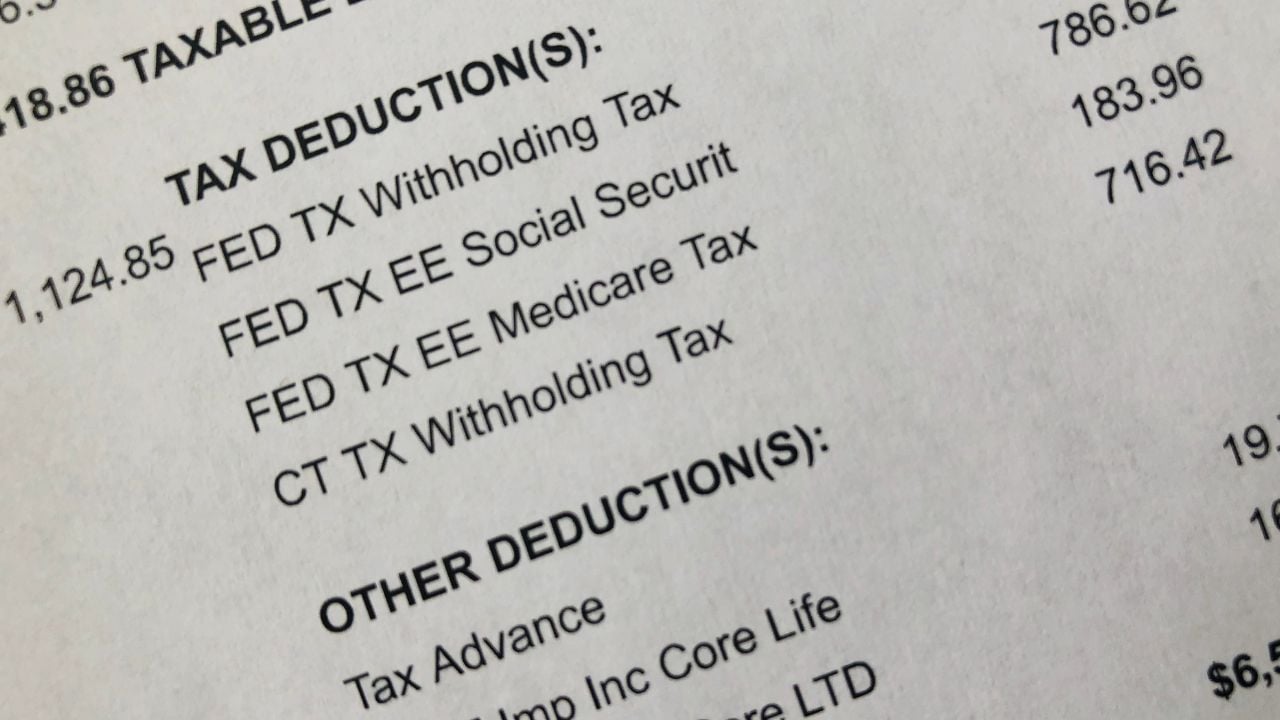
8 Pay Stub Numbers Pennsylvania Workers Never Check Until Something’s Wrong

Do you read every single line on your pay stub?
Many Pennsylvanians glance at the bottom number and stop there.
These are the pay stub numbers Pennsylvania workers never check until something’s wrong.
Note: This is general information, not financial, tax, or legal advice. Payroll withholding rules, local tax rates, and wage laws are subject to change.
1. Your 3.07% Tax Line
Pennsylvania taxes every paycheck at a single flat rate, and that rate holds at 3.07% for every worker in the state.
Everyone pays the same rate.
A $35,000 salary and a $350,000 salary both see the exact same percentage withheld before anything else comes out.
Multiply your gross pay by 0.0307, and that number should match your state tax line exactly.
If it doesn’t, the difference isn’t a rounding quirk.
2. Your Local EIT Line
Pennsylvania stacks a local Earned Income Tax (EIT) on top of that flat state rate, and it’s set town by town, not statewide.
Your employer compares two numbers: What your home municipality and school district charge residents, and what your work municipality charges everyone else.
Whichever rate is higher wins, every time.
Your employer applies that comparison using a six-digit code tied to your home address.
One code decides it all.
Get that code wrong, and the tax either overwithholds or lands with a municipality that never should have seen it.
The Math Behind a Wrong EIT Code
Pennsylvania’s local Earned Income Tax adds up fast when a code is wrong.
Say your home township taxes residents at 1% and your job sits in a township that taxes non-residents at 1.5%.
On a $50,000 salary, that’s a $750 local tax bill instead of $500, a $250 gap many workers never notice.
That gap repeats every paycheck for as long as the code stays wrong.
3. Your $52 LST Cap
A Local Services Tax (LST) also shows up on a Pennsylvania pay stub, a flat municipal fee capped at $52 a year no matter how many employers withhold it.
Many employers take it in small pieces, about a dollar a week.
Anyone earning under $12,000 from that job qualifies for an exemption.
Nobody files the exemption.
Withholding that continues after you hit the cap, or after you’ve filed the exemption, is an error worth a refund.
4. Your UC Withholding
Pennsylvania is one of only three states, alongside New Jersey and Alaska, where employees fund their own unemployment insurance, known as Unemployment Compensation (UC).
The rate is 0.07% of your gross wages, with no wage cap at all, all year long.
Seventy cents per thousand dollars.
Pennsylvania’s employer side of UC stops counting wages once a worker hits a $10,000 taxable wage base each year.
Your 0.07% employee line has no such cutoff.
A payroll system that borrows the employer’s wage base for the employee line will stop withholding it months too early.
Compare your December paycheck against one from earlier in the year.
If the UC line vanished partway through the year while your paychecks kept coming, that’s a payroll error worth flagging, not a raise.
5. Your Reciprocal State Line
Pennsylvania has reciprocal tax agreements with six neighboring states: New Jersey, Maryland, Ohio, West Virginia, Indiana, and Virginia.
A commuter living in one of those states and working in another should see their home state’s tax withheld, not the state where the job sits.
The home state collects.
That mismatch doesn’t correct on its own.
You have to file the right certificate with your employer, or the wrong state keeps taking a cut out of every check.
6. Your Overtime Rate
Overtime on a Pennsylvania paycheck follows a stricter formula than federal law for a salaried worker who still qualifies for it.
Pennsylvania divides weekly salary by 40 hours to set the regular rate line on your stub, always 40, never the hours worked that week.
Federal law allows a shortcut here.
Pennsylvania doesn’t allow it.
Take a $700 weekly salary with 45 hours worked in one week.
Pennsylvania’s regular rate comes out to $17.50 an hour, $700 divided by 40.
The banned federal shortcut would show $15.56 an hour instead, $700 divided by the 45 hours worked.
That gap shrinks the overtime premium on every hour past 40.
It repeats for as long as the payroll system keeps dividing by hours worked instead of 40.
A payroll system defaulting to the federal method can underpay overtime every single week without anyone flagging it.
7. Your Garnishment Red Flag
Wage garnishment barely touches a Pennsylvania paycheck, and state law is the reason why.
A collector chasing an old credit card balance, a medical bill, or a personal loan has no path to your paycheck under this law.
The exceptions are narrow, and § 8127 of state law lists exactly five: Divorce and support orders, unpaid board for four weeks or less, certain landlord judgments on a residential lease, debt owed to the Pennsylvania Higher Education Assistance Agency under its own state law, and restitution, fines, or bail set in a criminal case.
That’s the whole list.
A garnishment for anything else showing up on a Pennsylvania stub is worth questioning immediately.
8. Your Retirement Contribution Line
A 401(k) or 403(b) contribution counts as taxable gross compensation in Pennsylvania the moment it leaves your paycheck, a different approach than the Internal Revenue Service (IRS) takes.
Federal wages, Box 1 on your W-2, and Pennsylvania wages, Box 16, shouldn’t match for anyone putting money into a workplace retirement plan.
Box 16 should run higher, by exactly what you contributed.
Pennsylvania taxes it now.
The flip side holds too: Pennsylvania skips taxing the money once you retire and take it out, so a Box 16 that matches Box 1 exactly usually means whoever ran payroll coded the deduction wrong.
Psst! How much do you know about Pennsylvania’s pay and tax history? Take our quiz and see how many you can get right.
Quiz
Pennsylvania Payroll IQ
Answer these questions on Pennsylvania tax and wage history. We bet you can’t get them all right. Prove us wrong?
About how many separate municipalities does Pennsylvania have, each with the power to set its own local tax rate?
Filing a Wage Complaint in Pennsylvania
Pennsylvania's Wage Payment and Collection Law requires every employer in the state to hand over an itemized statement with the hours worked, the pay rate, and every deduction spelled out.
That's not optional.
A worker who spots a wrong percentage, an illegal garnishment, or a deduction that doesn't add up can file a complaint directly with the Department of Labor & Industry's Bureau of Labor Law Compliance in Harrisburg.
No lawyer required, and the department can order an employer to pay back exactly what a pay stub got wrong.
8 Insurance and Utility Costs Increasing for Pennsylvanians in 2026
Pennsylvania's electric bills jumped by double digits at several utilities this summer, and one default supply price rose almost 12% in a single day.
Water, gas, and heating costs are rising right alongside it, on top of a paycheck that's already stretched thin.
8 Insurance and Utility Costs Increasing for Pennsylvanians in 2026
10 Pennsylvania Yard Sale Rules Sellers Break Without Realizing

Fines for the exact same yard sale mistake range from $50 in Greencastle Borough to $1,000 in Springettsbury Township.
The only difference is which side of the township line the sale sits on, and many sellers never check before they set out a folding table.
10 Pennsylvania Yard Sale Rules Sellers Break Without Realizing
