
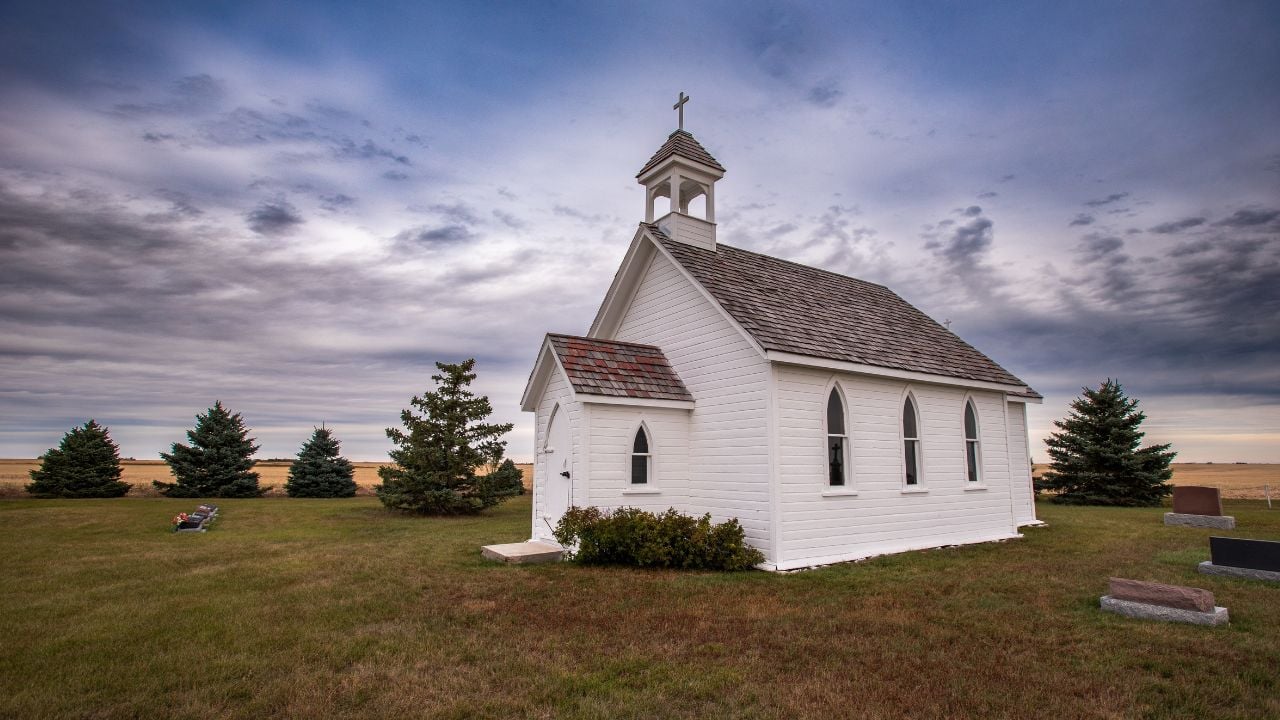
6 Church Homecoming Traditions Alabamians Grew Up With That Are Fading

Sand Mountain in northeast Alabama is one of the last places in the country where a handful of churches still sing straight from the Sacred Harp during a regular Sunday service.
Homecoming season used to fill Alabama’s country churches with the same handful of rituals, year after year.
These are the church homecoming traditions Alabamians grew up with that are fading.
1. Dinner on the Grounds
Dinner on the grounds turned every Alabama homecoming Sunday into a meal nobody had to cook alone.
Families carried their best dishes to church and spread them across long tables under the shade trees, then filled a plate and found a spot on a quilt or a tailgate to eat.
Nobody planned a menu.
Fried chicken, deviled eggs, and a dozen different pound cakes showed up because a dozen different families brought them.
That system depends on a full parking lot, and fewer country churches have one.
Mars Hill Primitive Baptist Church in rural Cleburne County once hosted a monthly gathering for Sacred Harp singing and a dinner-on-the-grounds spread.
The building sits mostly empty now, and the picnic table out front stopped filling up.
2. Graveyard Workday Before Decoration Sunday
Decoration Day, one of Alabama’s oldest homecoming traditions, started with work, not worship.
Families showed up the Saturday before with hoes and rakes to clear brush, scrape the dirt, and mound the graves back into shape before Sunday.
That Saturday scramble had one purpose: Getting the cemetery ready before the homecoming crowd arrived the next morning for the service and the dinner that followed.
DeKalb County’s Verenice Hawkins remembers when that workday was the only maintenance her family cemeteries ever got, and neighbors even pitched in to dig graves.
Not anymore.
Fewer young people show up to swing a hoe, so cemetery committees increasingly hire crews or pay for lawn care instead.
“This used to be an occasion,” Hawkins says.
What “Decoration” Means in Alabama
Alabama churchgoers often use “Decoration Day” and “homecoming” as if they mean the same thing, but the two words point at different traditions.
Decoration Day centers on the cemetery itself: Cleaning the graves, laying out flowers, and holding a short service beside the headstones, a custom especially strong in rural communities across north Alabama.
Homecoming leans a different direction, toward a founding-anniversary service inside the sanctuary, with a former pastor preaching and a meal to follow.
That word shows up more often in south Alabama and in many Black congregations statewide, where the focus sits less on the graveyard and more on the food and the fellowship.
Many churches blend both into one weekend, which explains why the two words blur together in everyday conversation.
3. Handmade Grave Flowers
Handmade grave flowers were part of Alabama’s homecoming season long before plastic flowers took over.
Families curled crepe-paper petals by hand, then wired them onto stems in time for Decoration Sunday.
The flowers had to be ready before the homecoming crowd arrived, since families set them on the graves first, then walked straight into the service and the dinner that followed.
Others just brought what grew in the yard.
Fort Payne’s Hobbie Lankford remembers setting out irises in a mason jar and roses in an old tin can, whatever was blooming that week.
Store-bought plastic flowers have replaced a lot of that work now.
“They hold up so much longer,” Lankford says.
That’s practical, maybe.
A store-bought bouquet skips that whole evening of work.
4. All-Day Sacred Harp Singing
Alabama’s all-day Sacred Harp singing turned homecoming into a full day of music instead of an hour of hymns.
Singers sat facing each other in a hollow square, split by voice part, reading notes shaped like triangles and diamonds instead of the usual round notes.
The singers had no audience.
They sang loud, for each other, straight through a songbook and into the dinner break.
Sand Mountain in northeast Alabama holds onto that practice harder than almost anywhere else, one of the last pockets in the country where a handful of churches still sing straight from the Sacred Harp on a regular Sunday instead of saving it for homecoming.
Elsewhere, the tradition survives only as a once-a-year homecoming event, if it survives at all.
Psst! How much do you know about Alabama church homecoming traditions? Flip these cards and find out.
5. Weeklong Homecoming Revival
Homecoming revivals across Alabama used to run from Sunday morning clear through Wednesday night, sometimes longer.
A visiting preacher led nightly services building toward homecoming Sunday, and whole families showed up after supper to hear him.
That schedule is mostly gone.
Terry Long, a spiritual renewal specialist with the Alabama Baptist State Board of Missions, says churches used to feel “locked in” to a Sunday-through-Wednesday week of nightly preaching before homecoming.
Now, a single night often stands in for what used to fill a whole week.
6. Creek and River Baptisms
Creek and river baptisms tied Alabama’s homecoming season to the water long before indoor pools took over.
Small country churches rarely had an indoor pool, so a preacher walked new believers into moving water instead and baptized them by full immersion.
Many congregations saved those baptisms for homecoming Sunday itself, the one day of the year when visiting family and former members filled the pews to watch new members join the church.
Huntsville’s Bartley Harris built a reputation on it.
He baptized new members of St. Bartley Primitive Baptist Church in the city’s Big Spring for decades, reportedly immersing as many as 300 people in a single day.
Many Alabama congregations built an indoor baptistery by the mid-1900s, and outdoor baptisms grew rare.
That shift wasn’t universal.
A handful of rural churches still walk down to the water when a family asks for it, keeping the practice alive one baptism at a time.
Where the Tradition Survives Strongest
Northeast Alabama still keeps homecoming season going harder than many other corners of the state.
Old Sardis Cemetery near Section draws participants from across the Southeast every Decoration Day, with canopies, folding chairs, and a drone flying overhead to photograph the crowd.
DeKalb County has kept a Sacred Harp singing alive at Council Bluff School every other year since the 1920s, inside the last one-room schoolhouse still standing in the county.
Every other year, like clockwork.
“It’s not hardly time for it,” says Marcell Stiefel, whose extended family fills much of the Old Sardis crowd, when asked why no one brings out iced tea.
Participants start leaving around noon instead, heading out to eat somewhere else once the visiting and remembering are done.
6 Secrets Waffle House Employees Wish Alabama Regulars Knew

A Waffle House regular slides into a booth off I-65 outside Birmingham, orders the usual, and has coffee poured before he says a word.
He’s sure he has the place figured out, but the staff behind the counter know a few things regulars still miss.
6 Secrets Waffle House Employees Wish Alabama Regulars Knew
9 Alabama Small Towns That Outshine Every Big-City Attraction Nearby
A meteorite once crashed through a roof in Sylacauga, Alabama, and struck a napping woman named Ann Hodges, the only documented case of its kind in recorded history.
Birmingham, an hour up the road, doesn’t have a story anywhere close to it.
9 Alabama Small Towns That Outshine Every Big-City Attraction Nearby
