
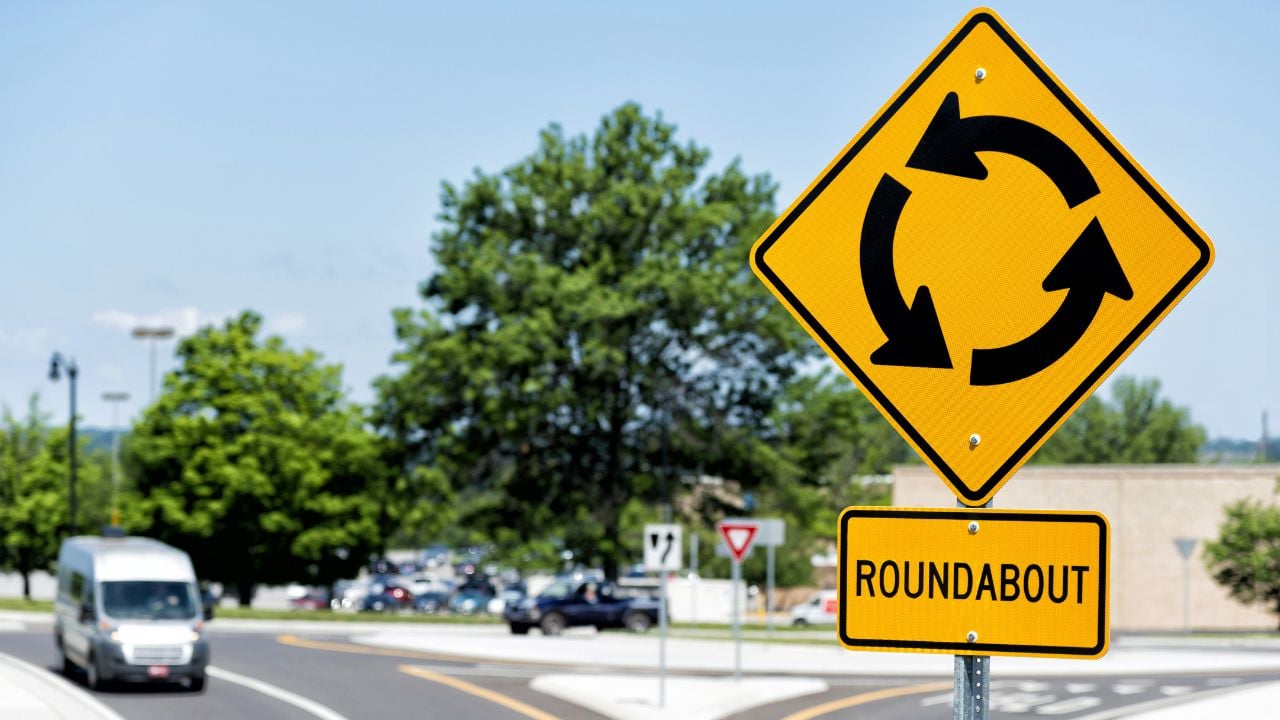
9 Roundabout Mistakes Virginia Drivers Make Every Day

Converting a traffic signal to a roundabout drops severe crashes by 78 percent and overall crashes by 48 percent, according to the Federal Highway Administration.
It only pays off if the driver entering the circle knows what to do, though.
The confusion isn’t unique to Virginia. Drivers second-guess the same circles from Maryland to Florida.
These are the roundabout mistakes that keep showing up on Virginia’s roads, day after day.
Note: This is general information, not legal advice. Roundabout right-of-way rules are subject to change, so confirm the current requirements with the Virginia Department of Motor Vehicles (DMV).
1. Stopping at the Yield Line Instead of Yielding
Virginia’s roundabouts run on one rule: Yield, never stop.
Turning an ordinary intersection into a roundabout cuts fatal and injury crashes by as much as 82%, according to the Federal Highway Administration.
None of that works if a driver treats the yield sign like a stop sign.
That’s when it backs up.
Coming to a full stop when the circle is empty backs up every car behind, and rear-end crashes are one of the most common types roundabouts see, according to a study from the Insurance Institute for Highway Safety (IIHS) of Maryland roundabouts.
Nobody behind you can read your mind.
2. Entering Before the Circle Is Clear
Virginia law hands the right-of-way to whoever’s already circulating, not whoever reached the yield line first.
Code § 46.2-822 says it in one line: Vehicles already in the circle go first.
That’s the opposite instinct from a four-way stop, where whoever arrives first gets to go.
Wrong intersection, wrong habit.
Drivers who carry that four-way habit into a roundabout nose into a gap that isn’t there, and entering-circulating crashes make up the majority of crashes at single-lane roundabouts nationwide, per IIHS research.
What Virginia’s Roundabout Law Covers
Virginia’s right-of-way rule for roundabouts, Code § 46.2-822, only runs one direction: Circulating traffic wins, full stop.
The same law carries one exception many drivers gloss over.
Its exact wording says the rule applies “unless otherwise directed by traffic control devices,” so a sign, signal, or pavement marking can override the yield-to-the-circle default at that roundabout entrance.
Read the signs at each roundabout instead of assuming the same rule plays out identically everywhere.
3. Picking the Wrong Lane Before the Circle
Virginia’s driver’s manual splits multi-lane roundabouts into a simple rule: Right lane for a right turn, left lane for a left turn, either lane if you’re going straight.
Many drivers don’t sort that out until they’re already committed to the wrong lane.
VDOT already learned that lesson.
Crashes at the Gilbert’s Corner roundabout in Loudoun County rose from 11 in 2007, before it was built, to 36 in 2010, the first full year after it opened, and VDOT spent $300,000 tightening every approach down to a single lane to cut the confusion, according to the Washington Post.
Even the engineers gave up on multiple lanes there.
4. Forgetting to Signal the Exit
Virginia expects a turn signal every time a driver changes lanes, turns, or leaves a highway, and exiting a roundabout checks all three boxes at once.
The driver’s manual spells out the roundabout version directly: Use your right turn signal to tell the drivers around you which exit you’re taking.
Skip it, and the car waiting to enter has no idea whether you’re about to leave or keep circulating.
That hesitation is exactly what backs up a roundabout during a busy commute.
Virginia backs that expectation with law, not just courtesy: Code § 46.2-848 requires the signal before the move, not after.
No exceptions inside the circle.
5. Skipping the Blind-Spot Check on the Way Out
Virginia tells drivers not to change lanes or take an exit inside a roundabout without checking for a vehicle beside or behind them first.
That’s harder than it sounds once you’re circling.
A car in the outside lane can look clear for a full second and still have someone tucked in a blind spot, continuing straight through while you’re angling for the exit.
Look twice.
Exiting-circulating crashes make up the majority of crashes at multi-lane roundabouts, the same pattern IIHS research has found nationwide.
6. Squeezing Beside a Big Truck in the Circle
Virginia builds many of its roundabouts with a raised, mountable ring around the center island so a tractor-trailer’s back wheels have somewhere to go.
That ring isn’t for cars.
A passenger vehicle that pulls up beside a tractor-trailer inside the circle is betting the truck won’t need the extra swing room it’s about to take.
More than 40% of drivers surveyed after two Washington state roundabouts opened near Bellingham said the signage left speeds, right-of-way rules, and truck movements through the circle unclear, according to that IIHS study of two-lane roundabouts.
Give the truck the whole lane.
Psst! How much do you know about roundabouts and Virginia’s driving laws? Take our quiz and see how many you can get right.
Quiz
Roundabout Rules IQ
Answer these questions on roundabouts and Virginia driving law. We bet you can’t get them all right. Prove us wrong?
What’s the name for the raised, mountable ring built around a roundabout’s center island so a tractor-trailer’s back wheels have room to swing?
7. Rolling Through the Crosswalk on the Way Out
Virginia requires entering traffic to yield to pedestrians entering the roundabout and to pedestrians already circulating inside it.
Many drivers remember that part on the way in.
They forget it exists on the way out.
It matters more.
Drivers exiting a roundabout are less likely to yield to pedestrians than drivers entering one, according to the same IIHS research, and the gap gets worse at multi-lane roundabouts, where drivers fail to yield to pedestrians two to three times more often than at single-lane ones.
Pedestrians don't get a safer direction.
8. Carrying Too Much Speed into the Circle
Virginia engineers its roundabouts with a sharp entry curve on purpose, forcing a driver to slow down whether they want to or not.
Colliding with the center island accounts for almost half of all single-vehicle run-off-road crashes at roundabouts, according to that same Maryland study.
Drivers who fight that curve instead of slowing into it find out why the hard way, usually because they carried too much speed into the entrance to begin with.
Ease off early.
9. Stopping Inside the Circle for an Emergency Vehicle
Virginia requires drivers to pull to the right edge of the road and stop the moment an ambulance or fire truck comes up behind them with lights and siren on.
That instruction doesn't carve out roundabouts, and it should.
A driver who's already inside the circle when the siren hits and pulls to the right anyway just parks in everyone else's only way through.
Finish your exit first.
Transportation departments across the country, including Florida's, tell drivers already inside a roundabout to finish their exit and pull over once they're clear of it, never to stop inside the circle.
Virginia's emergency vehicles get to break the ordinary rules under § 46.2-920, running red lights and stop signs, and yes, cutting through a stopped roundabout, but only "with due regard for the safety of persons and property."
That provision assumes the ambulance still has a way around the island.
A driver who finishes the exit and pulls over past the crosswalk isn't breaking it.
A driver stopped dead in the middle of the roundabout blocks that path instead.
9 Virginia Property Line Disputes That Turn Neighbors Into Enemies

Many Virginia homeowners are sure they know exactly where their yard ends, right up until a surveyor's stake lands somewhere they didn't expect.
A basic boundary survey in Virginia runs $1,200 to $5,500, and that's often the cheapest part of finding out.
9 Virginia Property Line Disputes That Turn Neighbors Into Enemies
8 Money Mistakes Virginia Homeowners Make Before They Retire

A couple in Roanoke pays off the mortgage, circles a retirement date on the calendar, and figures the hard part is behind them.
Three years later, the numbers from their kitchen-table math stop matching what shows up on paper.
8 Money Mistakes Virginia Homeowners Make Before They Retire
