
7 Driving Rules Floridians Follow That Are Nowhere in the Handbook

Florida’s roads carry more than 18.5 million registered vehicles, according to the state’s count.
No single handbook could ever cover every habit that many drivers pick up.
Local drivers fill the gaps themselves, passing down habits behind the wheel that no class or manual ever mentioned.
These are the driving rules many Floridians follow, some of which aren’t perfectly legal.
Note: This is general information, not driving or legal advice. Traffic laws and regulations are subject to change, so confirm the current rules with the Florida Department of Highway Safety and Motor Vehicles.
1. Flashing Your Lights for a Trooper Ahead
Many Florida drivers flash their headlights to warn oncoming traffic about a trooper ahead, a signal that spread by habit long before any law caught up to it.
A Florida Highway Patrol trooper ticketed Erich Campbell for doing exactly that in December 2009, catching him on Route 589 near Tampa International Airport.
State lawmakers didn’t settle the question until January 2013, about three years later, when a new law made clear nobody could be ticketed just for flashing.
A quick flash from an oncoming car means one thing on a Florida highway: Slow down, something’s ahead.
2. Pausing an Extra Beat on Green
Many Floridians have learned to pause before moving on a fresh green light, a habit passed down because of the state’s red-light-running problem.
A 2019 study from the American Automobile Association (AAA) Foundation for Traffic Safety, covering 2017 crash data, found Florida responsible for roughly one in ten of the nation’s red-light-running deaths.
It was the worst data the state had logged in a decade.
The same analysis ranked Florida’s per-capita rate of those deaths fifth-highest in the country, tied with Colorado.
That combination turned into a defensive habit many local drivers picked up from family, friends, or a near miss of their own.
The habit stuck.
Look both ways before the light even changes.
A driver who checks left and right before hitting the gas on a fresh green can spot a red-light runner blowing through the cross street with time to brake instead of time to react.
Few classes ever taught new drivers to build in that pause.
3. Switching on Hazards in a Downpour
Florida drivers switch on their hazard lights the moment a summer downpour cuts visibility to nothing, a habit that spread across the state long before any law caught up to it.
The custom never waited on the fine print.
State lawmakers only legalized the practice in 2021, and only on roads posted at 55 mph or higher during low visibility.
Drivers flip the same switch on a slower street in the same storm, a case the law never addressed either way.
Florida Highway Patrol still warns against the habit.
Sergeant Steve Gaskins has said hazard lights typically override a car’s turn signals, so a driver flashing them in traffic loses the only way to tell others they’re about to turn or change lanes.
AAA raises a different concern. Mark Jenkins, the group’s Tampa-based spokesman, says an oncoming driver can mistake hazards for a car broken down on the shoulder and swerve to avoid it unnecessarily.
None of that debate keeps a driver from flipping the switch the second the sky opens up.
The One Time Hazard Lights Were Always Legal in Florida
Florida’s hazard-light law used to allow exactly two situations: A car stopped on the shoulder, or a car driving in a funeral procession.
Funeral escorts kept their hazards on the whole way to the cemetery, long before the 2021 law gave storm drivers the same permission.
That’s the one exception locals never had to guess about.
4. Stopping for a Gator, Not Getting Out
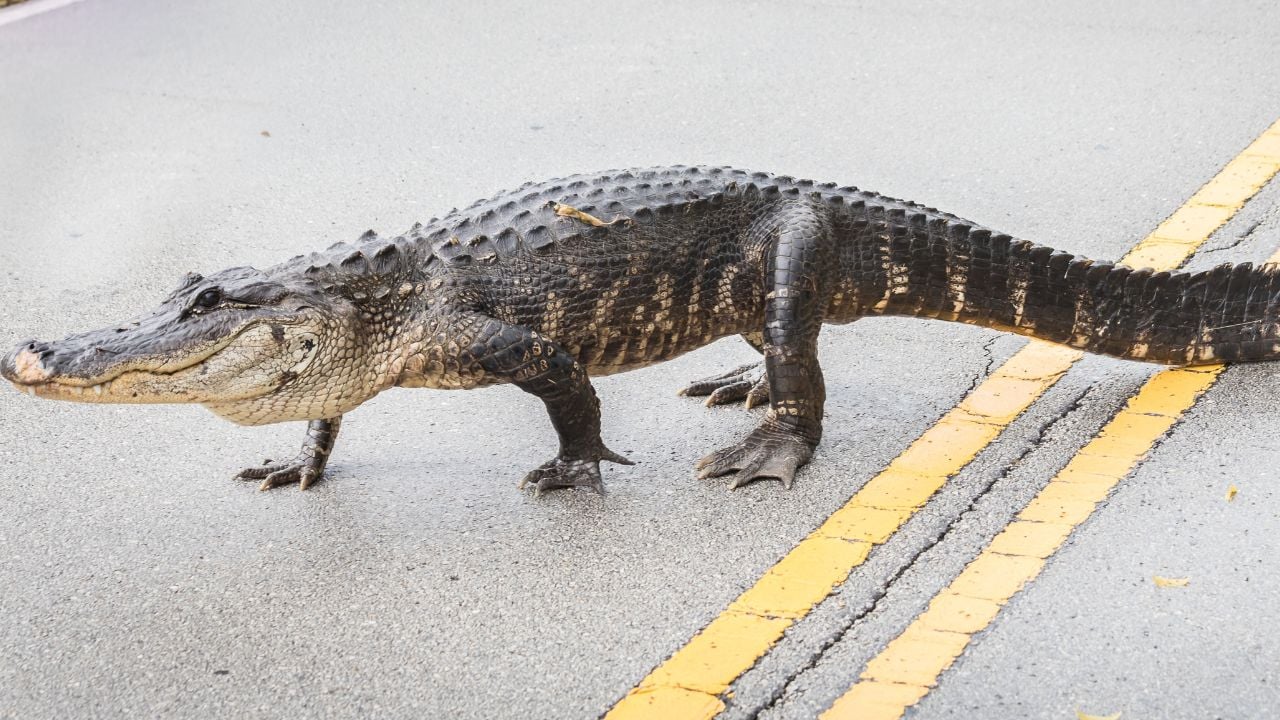
The Florida Fish and Wildlife Conservation Commission (FWC) has one clear answer for a driver who spots an alligator crossing the road: Stay in the car.
FWC’s own guidance says to keep a safe distance and call the state’s nuisance alligator hotline at 866-392-4286 if the animal won’t move on its own.
Florida is home to an estimated 1.3 million alligators, found in all 67 counties, so the agency built that guidance for a problem that comes up constantly.
Alligators are cold-blooded, and warm asphalt holds heat long after the sun goes down, which is exactly why they end up sprawled across a road in the first place.
That’s their spot too.
None of this comes from the driver handbook.
It comes from a wildlife agency that spends every warm season fielding calls from drivers who didn’t know to just wait it out.
5. Driving Past Your Own Left Turn
On Florida’s busiest arterial roads, local drivers know better than to wait in a turn lane that might not exist where they need it.
Florida’s Department of Transportation (FDOT) builds many of those roads with a raised, restrictive median that blocks a direct left turn entirely.
Instead, a driver continues straight past their actual turn, finds the next marked opening, and loops back the way they came.
FDOT’s own design manual has a name for that opening: A directional median opening.
Locals call it doubling back.
Florida’s driver handbook explains medians and U-turns in general terms, but it never mentions that term or walks a new resident through the maneuver.
Transplants sit baffled in the wrong lane the first few times before somebody finally explains it.
6. Watching for the Shoulder, Not a Reversed Lane
Florida is one of the only major hurricane states that refuses to reverse interstate lanes during an evacuation.
State officials point to Hurricane Irma’s 2017 evacuation, the largest in Florida’s history, with about 6.5 million people ordered out.
Traffic counts on I-75 near Lake City ran roughly four times their normal load that week, and reversing the lanes wouldn’t have gotten emergency crews and fuel trucks back in.
Drivers evacuating ahead of a storm shouldn’t expect the opposite lanes to flip in their direction the way some other states handle it.
FDOT opens the paved shoulder as an extra travel lane instead, on stretches like I-75 northbound from Naples to Lake City, where it meets I-10 in Columbia County.
Troopers direct that shoulder use in person, with signs and lights.
Without a trooper waving traffic onto it, that shoulder stays closed.
A driver who doesn’t know to watch for one just sits in a normal lane, confused about the gap opening up beside them.
7. Slowing to a Crawl for a Golf Cart
Florida drivers near the state’s golf-cart communities give a cart far more room than any law requires.
The Villages alone carries tens of thousands of golf carts on ordinary neighborhood streets, and Florida isn’t required to track how many of them exist.
Nobody has an exact count because of that gap, which local reporters have pushed the community to close for years.
A cart can’t out-accelerate a car, and everybody behind the wheel knows it.
The cart wins that standoff.
Locals learn to slow down and hang back well before they’d have to.
Building in Time for a Drawbridge
Dozens of drawbridges along the Florida coast open on a fixed public schedule for passing boats, whether or not any cars are waiting.
Local drivers build extra minutes into a trip the moment their route crosses one.
The schedule doesn’t bend.
The Bridge of Lions in St. Augustine opens on the hour and half hour from 7 a.m. to 6 p.m., federal regulations show, except it skips the 8 a.m., noon, and 5 p.m. openings on weekdays to keep rush-hour traffic moving.
Miss that window by thirty seconds, and the next opening is thirty minutes away.
That gap catches visitors who assume a bridge will simply wait for them.
No single bridge gets a mention by name in the state’s driver handbook, so newcomers learn the hard way, one missed opening at a time.
Psst! How much do you know about Florida’s road history? Take our quiz and see how many you can get right.
Quiz
Florida Roads IQ
Answer these questions on Florida’s roads, plates, and tolls. We bet you can’t get them all right. Prove us wrong?
Starting in 1938, the first digits on a Florida license plate identified what?
12 Giveaways That Prove You Weren't Raised in Florida
Florida elementary schoolers have raised more than $2 million putting their own crayon-and-marker art on state license plates.
Grown adults drive around with a fifth grader's manatee drawing bolted to their bumper, and nobody who grew up there gives it a second look.
12 Giveaways That Prove You Weren't Raised in Florida
9 Florida Car Insurance Rules Drivers Don't Find Out About Until a Claim
Two drivers argue over who had the right-of-way at a Tampa intersection, and an adjuster splits the blame: 51% one way, 49% the other.
One point away from an even split, and Florida law treats those two drivers completely differently, a gap that widened in 2023.
9 Florida Car Insurance Rules Drivers Don't Find Out About Until a Claim
