
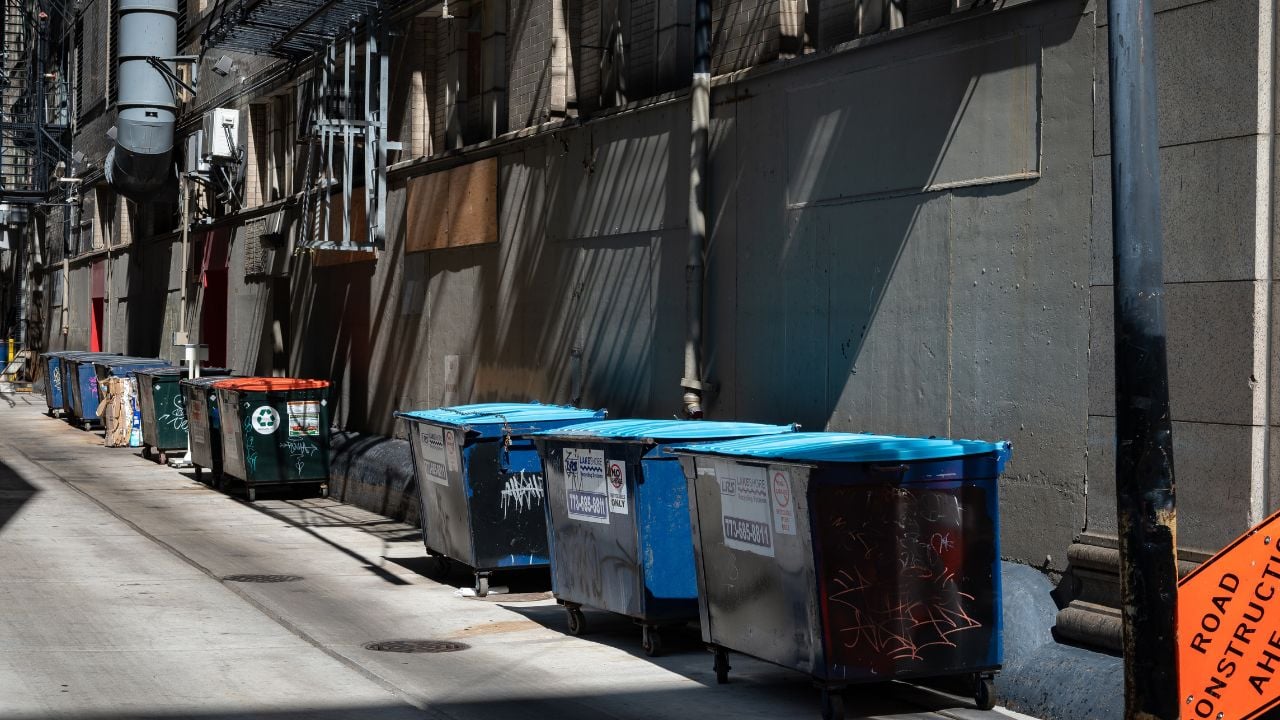
9 Chicago Alley Rules That Illinois Residents and Dumpster Divers Get Wrong

Chicago has a fine on the books that can run into the hundreds of dollars over something many city residents do without a second thought in their alley.
These are the Chicago alley rules Illinois residents and dumpster divers alike get wrong.
Note: This is general information, not legal advice. Chicago’s alley ordinances, fines, and enforcement are subject to change.
1. Trash in the Alley Is Fair Game, Legally Speaking
Chicago’s alleys turn into an open invitation the moment a bag of trash lands in one.
A neighbor down the block can walk over and dig through it, and nothing about that breaks the law.
The U.S. Supreme Court settled the underlying question in a 1988 case, ruling that garbage set out for collection carries no reasonable expectation of privacy.
Chicago courts hold officers to that same standard: A curbside trash bag gets no warrant, no exception, and no special treatment just because it sits in a Chicago alley.
Anyone can search it.
Many people assume digging through someone else’s garbage is automatically illegal, and it isn’t, not on its own.
“Not on its own” is the part that trips up dumpster divers working Chicago’s alleys because the moment a container switches from garbage to recycling, a different Chicago rule takes over.
2. Pulling Cans From the Blue Cart Breaks a Different Rule
Pull something from Chicago’s blue recycling cart, and the rule flips completely from the garbage sitting right next to it.
City code bans removing recyclable material from any container sitting out on the public way, alleys included.
Get caught, and it can cost as much as $500 for a single offense.
That’s serious money over a single can.
That fine applies whether the material is a soda can, a stack of cardboard, or a single water bottle someone tossed in by mistake.
It doesn’t matter which.
How Chicago’s Recycling-Cart Fine Adds Up
Chicago’s recycling-cart fine isn’t a one-time hit.
The ordinance counts every day a violation continues as its own separate offense, with its own separate fine.
Someone caught pulling cans from the same cart on three different collection days isn’t looking at one fine.
They’re looking at three fines. The total can clear $1,500 before a hearing ever happens.
More than one exception exists in that rule.
Whoever originally put the material there can reclaim it. So can a hauler under contract to collect it. Nobody else gets that pass.
3. Scavenger Licenses Cover a Business, Not a Milk Crate
A scavenger license in Chicago covers a company, not someone who spots a good chair.
City code defines a “private scavenger” as a business that removes and hauls recyclable material, construction debris, grease, or garbage on a regular basis.
That business has to carry a license and follow rules on vehicles, containers, and cleanup.
Chicago enforces that rule against companies, not neighbors.
A resident who grabs a nightstand off the curb once needs no permit at all.
The confusion runs the other way just as often because someone running a regular pickup route through Chicago’s alleys, collecting scrap metal or discarded furniture to resell, starts looking a lot like the business the ordinance describes.
One trip is a stroke of luck.
A route is a business.
4. Alleys Cap Your Speed at 15, Not 30
Chicago posts a lower speed limit for its alleys than for its streets, and it catches drivers off guard.
The citywide default sits at 30 miles an hour on ordinary streets, but code sets the alley limit at 15 mph instead.
That’s half the speed many drivers assume.
Few drivers know it.
That lower number exists because alleys pack garage doors, trash carts, kids on bikes, and blind corners into a lane barely wide enough for one car.
Treat a Chicago alley like a shortcut with no stop signs, and the posted number still applies even when no sign is standing there to remind anyone.
5. Alley Parking Comes With a Ten-Foot Rule
For exactly as long as it takes to load or unload, Chicago treats an alley like a driveway.
It doesn’t last one minute longer.
City code bans parking in an alley beyond that window.
It also requires drivers to leave at least 10 feet of the roadway open for other traffic.
Block a garage door or eat up more room than that, and the parked car itself becomes the violation.
Many Chicagoans use their alley as overflow parking on a busy block.
The code was written to stop exactly that habit.
Ten feet isn’t a suggestion.
Psst! How much do you know about Chicago’s alleys? Take our quiz and see how many you can get right.
Quiz
Chicago Alley IQ
Answer these questions on how Chicago’s alleys came to be. We bet you can’t get them all right. Prove us wrong?
Chicago has more alley miles than any other U.S. city. About how many miles of alleys run through the city?
6. Chicago Won't Shovel or Plow Your Alley
Chicago holds property owners responsible for clearing snow off the sidewalk, but nobody holds the alley behind that same building to the same standard.
City rules require clearing a path on the sidewalk in front of a building, with fines running $50 to $500 for skipping it.
The city itself won't plow the alley either.
Chicago's own Streets and Sanitation department has said plowing alleys risks collapsing garage doors, since the snow has nowhere to go in a lane that narrow.
So crews send garbage trucks through instead to pack a rough path.
Nobody's coming to clear it.
Many residents wait all winter for a plow that Chicago was never going to send.
7. Dumping Furniture in the Alley Costs More Than a Ticket
Every spring, couches and old mattresses start piling up in Chicago's alleys, between the fences and out of sight.
Leaving bulk items out for a scheduled pickup is legal.
Dumping them without ever scheduling one isn't.
City code bans dumping trash, debris, or bulk waste anywhere in the city, alleys included, and the fine runs $300 to $600 for every day the pile sits there.
That adds up fast.
Many residents treat the alley as a free drop-off point and assume a passerby, or a scavenger, will make the problem disappear before anyone notices.
Chicago cites whoever left the pile there first, not whoever eventually hauls it away.
8. Your Cart Belongs at the Lot Line, Not the Roadway
Chicago tells residents exactly where a garbage cart belongs on collection day, and the middle of the alley isn't it.
City code requires an alley-collection cart to sit at the alley lot line on the property it serves, positioned so a truck can reach it without anyone dragging it further.
Leave it parked in the roadway instead, and the owner is on the hook, not whoever bumped into it.
A cart blocking the alley makes it hard for a neighbor to back out of a garage.
It also counts as a violation with the property owner's name on it.
No exceptions.
9. Not Every Alley Belongs to the City
Chicago residents tend to assume every alley behind their block belongs to the city, the same as the street out front.
A property owner in Humboldt Park proved that assumption wrong.
He poured a concrete barrier across an alley his neighbors had backed into for decades to reach their garages.
Ownership won that argument.
City records backed him up: That particular alley was never dedicated as public property, even though it looked and functioned like every other alley on the block.
Alderwoman Jessie Fuentes raised the obvious problem with that: An emergency vehicle can't reach a garage through a wall of concrete.
The Chicago Department of Transportation is still sorting out that alley's legal status, and the concrete hasn't moved in the meantime.
15 Secret Ingredients That Upgrade Common Meals

A recipe card from 1995 might look finished, but professional kitchens disagree, and they've been proving it for years.
One pantry swap, dropped into the right dish, changes the whole plate without changing the recipe's name.
