
6 Unwritten California Beach Rules Tourists Break Within an Hour

California made surfing its official state sport in 2018, and the state never wrote down how the lineup works.
Nobody had to.
Every beach below the high-tide line legally belongs to the public in California, so there’s no single owner standing by with a rulebook for the sand.
These are the unwritten California beach rules tourists break within their first hour.
1. Setting up Camp Too Close to Other Groups
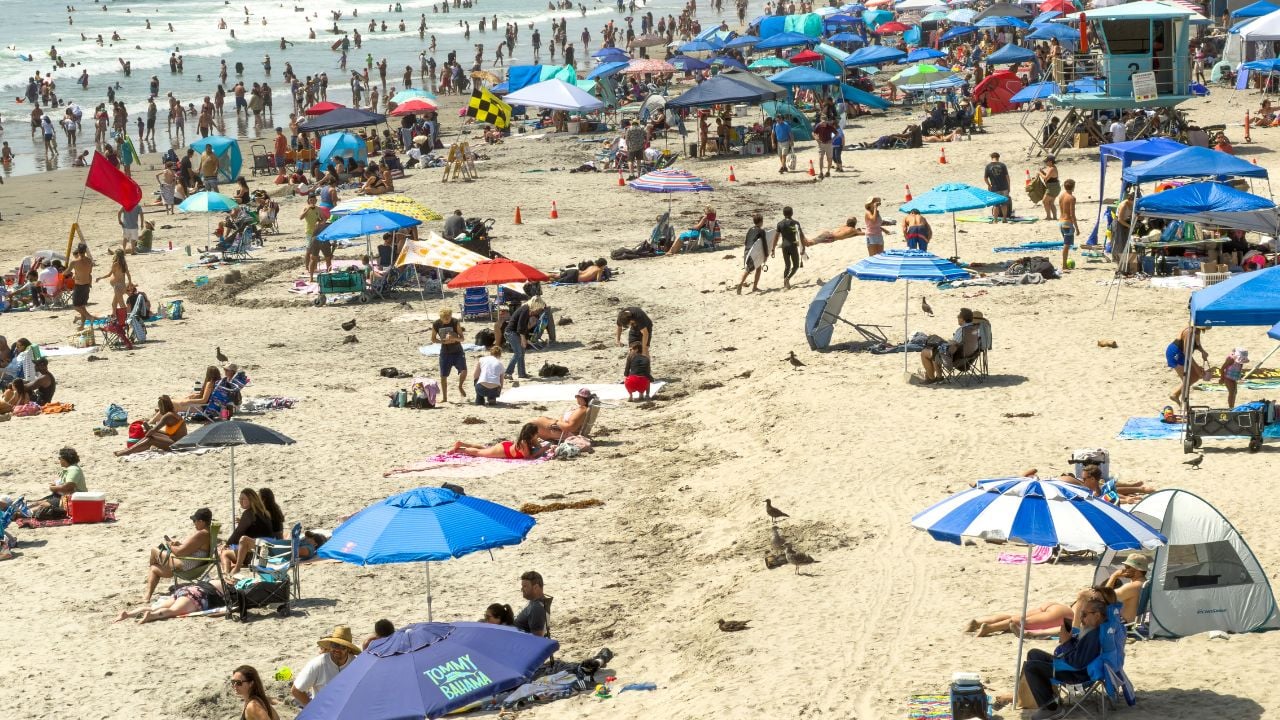
Tourists arriving at a packed California beach tend to misjudge how much sand counts as open.
A 2025 survey of more than 1,000 Americans found that 54% call sitting too close to another group one of the most annoying things a beachgoer can do.
No sign says so.
California’s wide-open beaches, places like Huntington and Zuma, make the mistake an easy one. A stretch of sand that looks empty from the parking lot rarely stays that way by noon.
Leave more room than feels necessary, and let the beach fill in around your group instead of the other way around.
2. Dropping in on Someone Else’s Wave
California’s surf lineups run on one rule above all: The surfer closest to the peak of a breaking wave gets it first.
Del Mar’s own city page spells out the unwritten rules of the lineup, right down to who paddled out first and who’s waited longest for a turn.
None of it is law.
Take a wave that belongs to someone deeper on it, a move surfers call dropping in, and no lifeguard writes you up for it.
The lineup remembers anyway.
Tourists paddling out for the first time at a California break routinely break this rule inside the first set, usually without realizing it happened.
The Loophole California Surfers Aren’t Allowed to Use
California’s wave-priority rule still has one loophole surfers aren’t allowed to use.
Del Mar’s same city page calls out the move by name: Repeatedly paddling around someone to grab the inside position is a habit surfers call snaking.
It doesn’t earn priority just because it lands a surfer closer to the peak at the last second.
Position only counts when a surfer got there by paddling straight out and waiting, not by circling into place once a wave is already building.
3. Ignoring the Local Hierarchy at a Longtime Break
Some California surf breaks answer to an unofficial hierarchy that has nothing to do with who’s closest to the peak.
Lunada Bay on the Palos Verdes Peninsula carries that reputation. National Public Radio reported on it in 2016, and locals there had already been enforcing it for decades before that story ran.
Being in the right position on a wave doesn’t matter if the crew that surfs a break every day decides a newcomer hasn’t earned a turn yet.
Deference is the whole test.
Tourists who show up at a break with that kind of reputation can feel the difference within their first few waves, long before they’ve broken any of the lineup’s ordinary priority rules.
4. Shaking Sand off a Towel the Moment You Sit Down
A rolled beach towel picks up loose sand before a tourist even reaches the water, usually from the walk across a hot parking lot or a boardwalk.
Snapping it open to lay it flat sends that sand straight into whoever is already sitting downwind.
The same 2025 survey behind the crowding numbers found that shaking sand off a towel near someone ranked as more annoying than sitting too close, in a head-to-head comparison between behaviors.
Wind carries that sand into a neighbor’s lunch, sunscreen, or eyes.
Ouch.
Unroll a new towel slowly instead of snapping it, or step past the last row of towels before shaking anything loose.
Tourists rarely check which way the wind is blowing before they do it.
On a beach like Coronado or Huntington Beach, where the afternoon onshore wind picks up fast, the group downwind notices every time.
Psst! How much do you know about California’s coast beyond its beach customs? Take our quiz and see how many you can get right.
Quiz
California Coast IQ
Answer these questions on California’s coastline, surf history, and marine life. We bet you can’t get them all right. Prove us wrong?
What accidentally created Newport Beach’s Wedge, a break known for waves that can top 30 feet?
5. Blasting Music Instead of Wearing Headphones
Tourists who forget headphones at a California beach are usually the first to draw complaints.
That same 2025 survey found loud music rated as more annoying than smoking or vaping, in a head-to-head comparison of beach behaviors.
Sound travels farther over open water than many people expect.
A speaker cranked up at one end of a crowded stretch reaches blankets fifty yards away.
One hotel along the Manhattan Beach Strand runs a ticketed silent disco series right on the sand as a workaround, headphones required.
Pack earbuds instead.
6. Setting up on Someone Else's Saved Spot
A packed California beach rarely looks reserved, even when it already is.
The same 2025 survey found that taking over someone's saved spot ranked as more irritating than saving one in the first place, according to the beachgoers it surveyed.
A folded chair and a towel weighted down with a cooler usually mean the space is spoken for, even with nobody standing there.
That space isn't empty.
Tourists arriving at a crowded stretch like Huntington Beach on a summer weekend often read that same setup as open sand and claim it within minutes of parking.
Check for a chair, a cooler, or a staked umbrella before spreading out a towel.
If gear is already there, someone is coming back for it.
Why No One Posts These Rules
California's beaches carry no single owner who could post a sign about any of this.
No landlord exists.
State law guarantees the public's right to reach the sand below the mean high-tide line, no matter who owns the property next to it.
A Malibu homeowner spent years trying to block a public accessway anyway.
In 2018, the U.S. Supreme Court declined to hear a similar fight over Martins Beach, leaving the public's access intact.
7 In-N-Out Mistakes That Instantly Mark You as a First-Timer in California
In-N-Out keeps six items completely off its order board, on what it calls a "not so secret" menu that only shows up on the chain's website.
A first-timer who never checked that menu in advance ends up ordering a plain burger and fries, then wondering what everyone else in line just got.
7 In-N-Out Mistakes That Instantly Mark You as a First-Timer in California
9 Things That Surprise People Who Move to California

California's electricity runs about 27 cents a kilowatt-hour, the second-priciest rate in the nation, and that's not the only number that catches a new resident off guard.
Some of the surprises run the other way, though, cutting a new resident's costs instead of raising them.
