
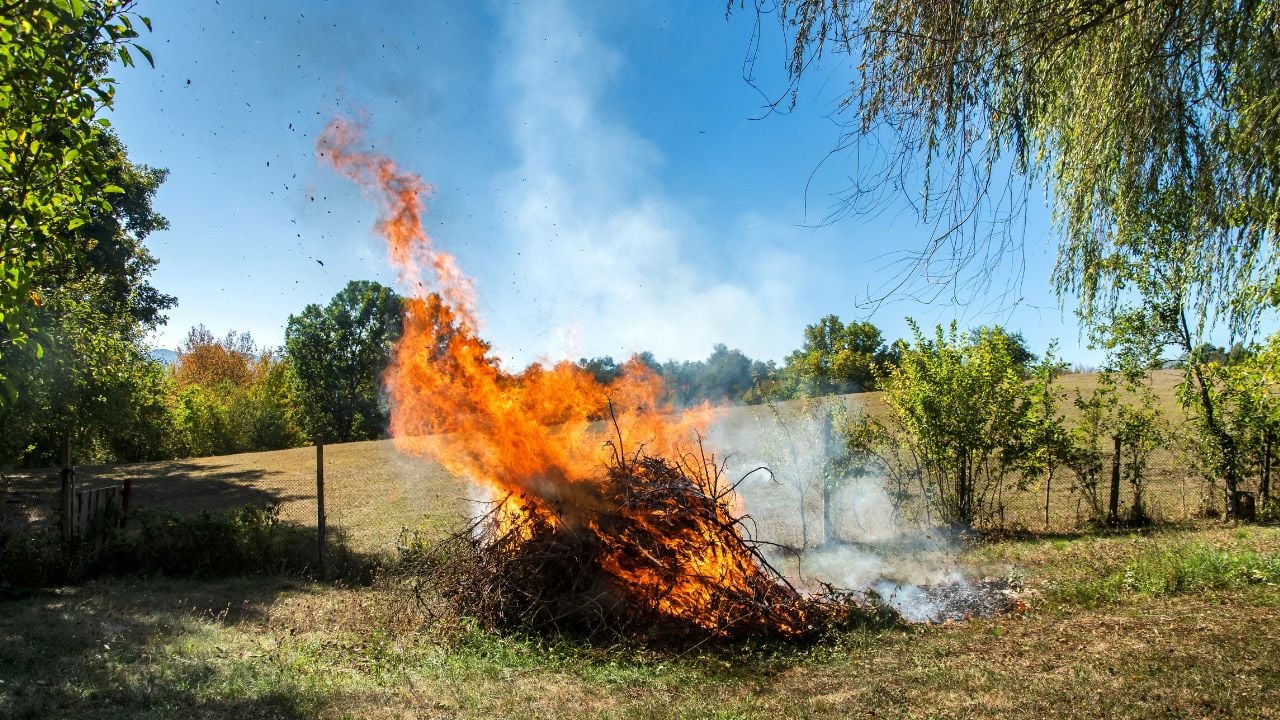
9 Pennsylvania Yard Burning Rules That Neighbors Call the Township About

A Pennsylvania township can fine a resident up to $2,500 for one illegal open burn, with as much as 90 days in jail attached to the same violation.
That’s the going rate for a single afternoon fire.
State rules set the baseline, and local ordinances are free to go further.
These are the Pennsylvania yard-burning rules that turn an ordinary afternoon into a visit from code enforcement.
Note: This is general information, not legal advice. Pennsylvania’s open burning rules combine state regulations with local township and borough ordinances that vary from place to place, so confirm the current requirements with your township or borough office.
1. Smoke Crossing the Fence
Pennsylvania bans open burning anywhere its smoke crosses onto a neighbor’s property, no matter what a local permit allows.
The state’s own air code spells out the rule, though it doesn’t apply the same way everywhere.
Counties inside Pennsylvania’s designated air basins, including the Pittsburgh and Philadelphia metro areas, face an even stricter, near-total ban on open burning.
A fire counts as illegal the moment its smoke is visible past the property line, a neighbor can smell it from their porch, or it stops them from using their own yard.
No permit overrides that.
A township can sign off on every other detail of a burn and still shut it down the moment a neighbor’s complaint proves the smoke crossed the line.
2. Burning the Household Trash
A homeowner can legally burn ordinary household trash in Pennsylvania only under narrow conditions, and the exemption covers far less than many residents assume.
State rules exempt what regulators call domestic refuse, burned on a single-family or two-family property, generated from everyday living.
The DEP points to an Environmental Protection Agency (EPA) study showing a single household burn barrel can release as much toxic pollution as a well-run municipal incinerator.
That’s from ordinary trash.
Burning anything beyond ordinary yard debris announces itself instantly: Plastics, foam, and treated wood send up a thick, chemical-smelling black smoke that carries much farther and much faster than a clean brush fire’s.
That’s the smell that turns a neighbor’s head.
It’s also why many townships go further than the state and ban household refuse burning outright, allowing only yard waste in a resident’s pile.
What Pennsylvania’s Trash Exemption Doesn’t Cover
Pennsylvania’s domestic refuse exemption covers only ordinary household waste from everyday living, not anything hazardous or bulky.
State rules separately ban burning demolition debris, treated or painted wood, tires, mattresses, polyvinyl chloride (PVC) pipe, waste oil, and old appliances or batteries, even on a single-family or two-family property.
A resident who tosses a broken television or a paint can into the burn pile has broken a state rule, not just a local one.
3. Using the Wrong Container
A burn barrel from the garage doesn’t automatically satisfy Pennsylvania’s container rules for a permitted burn.
Derry Township, for example, caps an approved container at 3 feet across and 5 feet tall, with a mesh-covered opening built to keep sparks from drifting.
That screen is what stops the sparks.
An oversized drum, an open pit, or a container with no mesh screen breaks more than a size rule.
It throws visible sparks and embers over the fence line, exactly the kind of hazard a neighbor sees and reports before any inspector does.
4. Too Close to a Structure
Townships across Pennsylvania set a minimum distance between an open fire and the nearest building or property line, and it’s rarely as close as a resident assumes.
Lower Providence Township requires 50 feet from any structure, street, or property line for an ordinary open burn.
Derry Township, for one, pushes an authorized open burn even further out, to 100 feet from a building and 150 feet from an occupied dwelling.
Fifty feet isn’t much.
A fire pit tucked against a shared fence line is exactly the kind of setback violation that draws a neighbor’s call before it draws a citation.
5. Skipping the Burn Permit
A yard fire in Pennsylvania doesn’t need one statewide permit, but many townships and boroughs require their own.
Schwenksville Borough makes residents apply at the borough office before burning yard waste, and the permit only lasts 30 days.
The borough also wants a call to the county fire board before the match gets struck, plus another call once the fire’s out.
Skip either one, and the burn was never authorized at all.
Pennsylvania’s own model open-burning ordinance is the template many townships and boroughs build their local rules from.
It treats an unauthorized burn as a summary offense, punishable by a fine up to $2,500 for a single violation, with as much as 90 days in jail if that fine goes unpaid.
A neighbor who spots smoke with no permit posted and no notice on file has an easy report to make.
6. Stacking the Pile Too High
Townships in Pennsylvania that allow yard-waste burning often cap how big the pile itself can get before it’s ever lit.
Schwenksville Borough’s limit is 5 feet in any direction, a size regulators consider small enough to stay controllable.
Bigger isn’t better.
A pile of branches and leaves stacked well past head height burns hotter and throws more sparks.
Its giveaway is visibility: Unlike smoke that has to drift or a permit that has to be checked, an oversized pile stands out over a fence line before anyone even strikes a match.
That makes it the easiest violation on this list for a neighbor to spot and report.
7. Fires Left Burning Past Dark
A clock runs on almost every open fire in Pennsylvania.
It usually stops at sunset.
Lower Providence Township requires every open fire extinguished no later than dusk on the day it’s lit.
Schwenksville Borough draws the same line, burning only between sunrise and sunset, fully out by the time the sun is.
A glowing pile at 10 p.m. is a violation, even if it started out legal at noon.
That’s also the hour a neighbor is most likely awake, outside, and annoyed enough to make the call.
8. Burning in High Wind
Wind changes the legal status of a Pennsylvania yard fire in real time.
Schwenksville Borough’s ordinance bars open burning outright during strong winds, drought conditions, or a declared spell of hazardous air quality.
Its rule for recreational fires spells out exactly why: They’re banned on windy days because the smoke can become a nuisance for nearby neighbors.
Wind does more than carry smoke somewhere it isn’t wanted.
It carries sparks and embers too.
A gust strong enough to push those across a property line can ignite dry grass, mulch, or a woodpile on land that was never part of the fire to begin with.
9. Burning Under a County Ban
Pennsylvania law lets an entire county suspend open burning at once, layered on top of whatever a single township already requires.
County commissioners can declare a temporary burn ban whenever at least 10 local fire chiefs, or half the county’s fire chiefs, request it.
That ban can run up to 30 days, with a possible 30-day extension.
No exceptions.
Every open fire in the county goes illegal at once, no permit, container, or distance able to exempt it.
A resident who missed the local news that week and lights a fire anyway is breaking a countywide rule, not just a local township’s.
That also makes it the clearest, most reportable violation on this whole list: A neighbor doesn’t need to measure a setback or check a permit board, just see smoke.
Psst! How much do you know about Pennsylvania’s air and fire rules? Take our quiz and see how many you can get right.
Quiz
Pennsylvania Burn Law IQ
Answer these questions on Pennsylvania’s air and fire rules and see how many you can get right.
What’s the maximum daily civil penalty Pennsylvania’s model open-burning ordinance allows for an ongoing violation?
Where the Rules Came From
One deadly week in a small Pennsylvania mill town set today's open-burning rules in motion.
On October 30 and 31, 1948, a thick smog settled over Donora, along the Monongahela River.
Nineteen people died within 24 hours, and roughly 500 more got sick enough to need help breathing.
The state took notice.
Pennsylvania created its first Division of Air Pollution Control in 1949, well before the federal government followed with the Clean Air Act and the Environmental Protection Agency in 1970.
Why Rules Change at the Township Line
Local governments across Pennsylvania write and enforce their own ordinances, and open burning is no exception.
More than 2,500 separate townships, boroughs, and cities across Pennsylvania each have the authority to write their own burning ordinance.
None can go softer.
State regulators are clear that a local ordinance can pile on stricter limits, but it can never loosen Pennsylvania's own rules.
That floor holds no matter which line on the map a resident lives inside.
Enforcement varies just as much as the rules do: Schwenksville Borough puts its own Fire Marshal and police department in charge of investigating complaints, not a separate state agency.
A summary conviction there carries a fine up to $1,000 plus court costs, with up to 30 days in jail if that fine goes unpaid, and each day a violation continues is its own separate offense.
9 Pennsylvania Rules About What You Can Build on Your Own Land

Owning a Pennsylvania yard doesn't mean total control over what goes up in it.
More than 2,500 townships, boroughs, and cities each write their own limits on sheds, fences, and additions, and many homeowners find out the hard way.
9 Pennsylvania Rules About What You Can Build on Your Own Land
9 Things Pennsylvania Utility Crews Can Legally Do in Your Yard Without Asking First
A fence around a Pennsylvania backyard doesn't decide who's allowed to walk in.
One gas corridor through an Allegheny County yard can run 60 feet wide, and the utility holding it doesn't have to ask first.
9 Things Pennsylvania Utility Crews Can Legally Do in Your Yard Without Asking First
