
7 Cottage Food Mistakes That Shut Down a Side Business in Alabama

One form stands between a legal Alabama cottage food business and one the county has never heard of.
Alabama’s Cottage Food Review Form goes to the county health department, not the state, and it’s supposed to land there before your first sale.
Many producers skip it.
These are the cottage food mistakes that can force an Alabama side business to shut down before it clears the county’s paperwork.
Note: This is general information, not legal advice. Alabama’s cottage food rules are subject to change, so confirm the current requirements with the Alabama Department of Public Health.
1. Skipping the Food Safety Course
Alabama’s cottage food law opens with one hard requirement before a home producer sells a single jar: An approved food safety course.
The course has to come from Alabama Extension or another accredited program, such as ServSafe.
Extension teaches it in county libraries, extension offices, and online sessions from Mobile to the Shoals, usually inside a single afternoon.
Not optional.
Without a current certificate, a producer isn’t legally operating a cottage food business, and every jar sold counts as an unlicensed food sale the county can step in and stop.
A certificate doesn’t renew on its own.
Letting it lapse creates the same problem as never taking the course in the first place.
2. Skipping the County’s Paperwork Check
Alabama also expects a cottage food producer to put their paperwork in front of somebody before the first sale, not just take a course and start selling.
The local county health department reviews the food safety certificate and the product labels through a Cottage Food Review Form, per the Alabama Department of Public Health.
That review isn’t a formal permit, but county officials still expect it filed before the first sale.
New producers sometimes finish the course, print their labels, and start selling at a Saturday market without ever mailing that form to their county health department.
There’s no paper trail.
If a market manager or a customer complaint raises a question, a producer with nothing on file can be told to pack up the table until the paperwork catches up.
3. Missing a Line on the Label
Alabama also spells out exactly what has to appear on a cottage food label, right down to the type size.
It needs the product’s name, the producer’s name and home or P.O. Box address, a full ingredient list in descending order by weight, an allergen disclaimer, and a statement that the food isn’t inspected by the health department.
All of it has to print in at least 10-point font.
Small print, big deal.
Leave off the allergen line, or shrink the ingredient list to save space on a jar lid, and the label no longer meets Alabama’s standard for a legal cottage food product.
That’s enough for the county to refuse its sign-off on the Cottage Food Review Form.
It’s also enough for a producer to be told to pull the product from the table until the label’s fixed.
4. Selling Something That Needs to Stay Cold
Alabama only extends cottage food status to food that’s shelf-stable at room temperature, no refrigeration required.
A custard pie, a cheesecake, or a cake topped with cream cheese frosting all fall outside that line.
Room temperature, always.
These are exactly the kind of items that can make somebody sick if they sit out too long.
Alabama’s health department can order a producer to stop selling while it investigates a complaint like that.
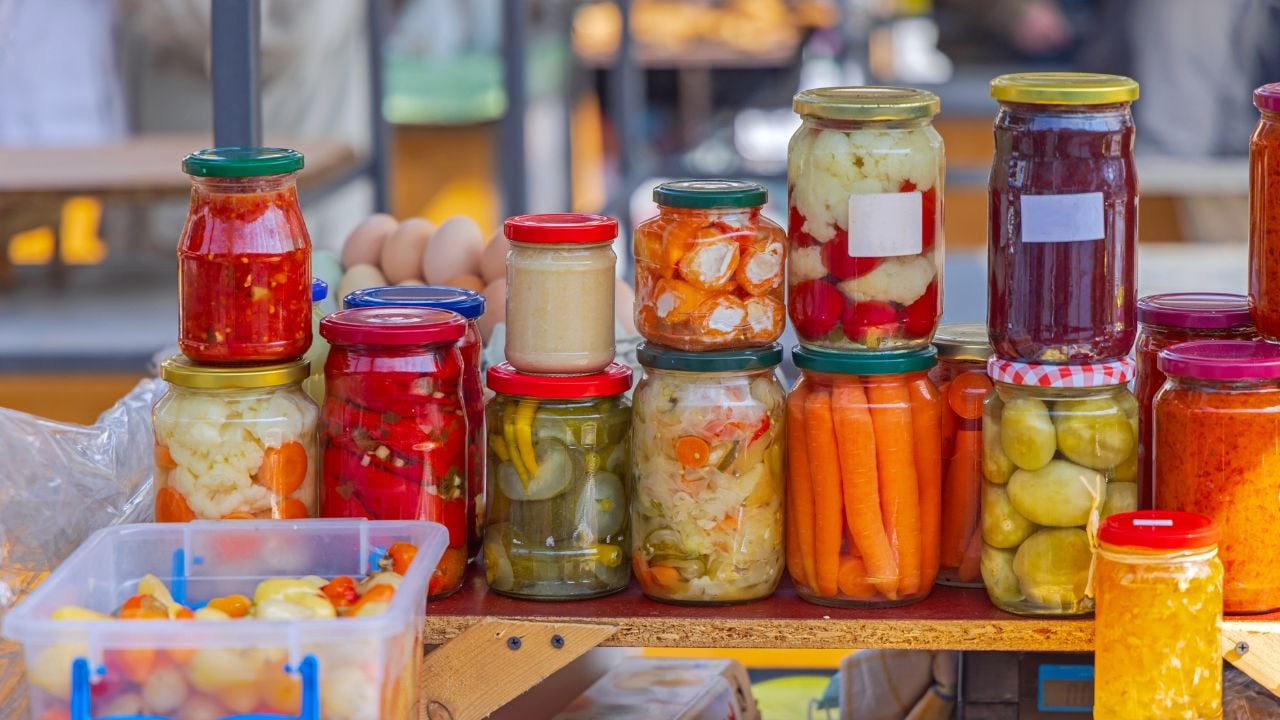
Some homemade items sit right on the edge, like a jar of salsa, hot sauce, or pickled okra.
Those can qualify as cottage food, but only after they clear a lab test for acidity many home cooks have never heard of.
The Pass-Fail Number Behind Alabama’s Pickles
Alabama’s cottage food law clears a fermented or pickled item, like salsa, sauerkraut, or hot sauce, only when it tests below a water activity of 0.88 or a pH of 4.2.
A processing authority, often Alabama Extension, runs that test for a fee.
Skip the test, and the jar isn’t legal to sell.
A great recipe doesn’t change that.
5. Selling a Food Alabama Won’t Allow
Alabama draws a hard line around a short list of foods that cottage food status never covers, refrigeration or not.
Meat, poultry, and fish are out, along with dairy products like soft cheese and homemade ice cream.
None of those fall under the cottage food exemption at all, so selling them counts as running an unlicensed food business, not just breaking a cottage food rule.
Garlic-in-oil mixtures are out too, since garlic stored in oil can grow botulism without any warning sign.
No exceptions.
That risk is exactly what can bring the health department in with a stop-sale order, since botulism gives no warning through smell or taste.
A producer who sells venison jerky at a tailgate, or a jar of pimento cheese at a church bake sale, finds that a spotless kitchen and a current course certificate cover none of it.
Psst! How much do you know about Alabama’s cottage food rules? Take our quiz and see how many you can get right.
Quiz
Alabama Cottage Food IQ
Answer these questions on Alabama’s home food rules. We bet you can’t get them all right. Prove us wrong?
Alabama’s cottage food law names one more food that’s always off-limits, no matter how it’s made. Which one?
6. Selling Where the Law Doesn't Reach
Alabama limits cottage food sales to direct transactions with the customer, whether in person, by phone, or online.
A producer can't place jars on a grocery store shelf on consignment or sell wholesale to a local restaurant.
Shipping a cake or a batch of cookies to a customer in Georgia or Tennessee breaks the same rule.
It's in-state sales only.
Cross either line, consignment or the state border, and cottage food status stops covering the sale entirely.
A home baker who mails pound cakes to relatives out of state, or lets a boutique stock her jam on a shelf, is running a food business with no exemption at all.
Alabama treats that the same as running any other unlicensed food business, course certificate or not.
7. Skipping the Farmers Market Permit
Alabama's cottage food registration doesn't automatically cover every farmers market table.
A state-certified farmers market falls under the Alabama Farmers Market Authority, a completely different agency from the health department that reviews cottage food labels.
A producer selling home-processed goods at one of those certified markets needs a separate permit on top of the cottage food paperwork.
Two agencies, two forms.
A market manager can turn a vendor away from the table on the spot for missing that permit.
Her cottage food paperwork doesn't matter there.
A baker who assumes her health department course covers every market table in Alabama finds out otherwise the first time a market manager asks for a permit she's never heard of.
The $20,000 Cap Alabama Removed
Alabama used to cap what a cottage food producer could earn in a year at $20,000.
That number held whether the business was booming or barely scraping by.
State lawmakers erased the ceiling through Senate Bill 160, effective Aug. 1, 2021.
No ceiling now.
Alabama Extension agents described the change at the time as room for home producers to grow past what the old ceiling ever allowed.
Many outdated blog posts and old printouts still repeat the $20,000 figure.
A producer who plans her business around a cap that no longer exists is only limiting herself, not following the law.
The Inspection That Never Happens
Alabama's cottage food process skips a step a lot of new producers brace for.
Nobody from the health department walks through a home kitchen before approving a producer to sell.
The county reviews the food safety certificate and the product labels, and that's the whole review.
That doesn't mean the state stays out of it forever, though.
Complaints change things.
If a product is suspected of making someone sick, Alabama Code §22-20-5.1(d) lets the health department issue a stop-sale, seizure, or hold order while it investigates.
That's what pulls Alabama back into a cottage food kitchen after the sale: Not a missing line on a label, but a customer who got sick.
