
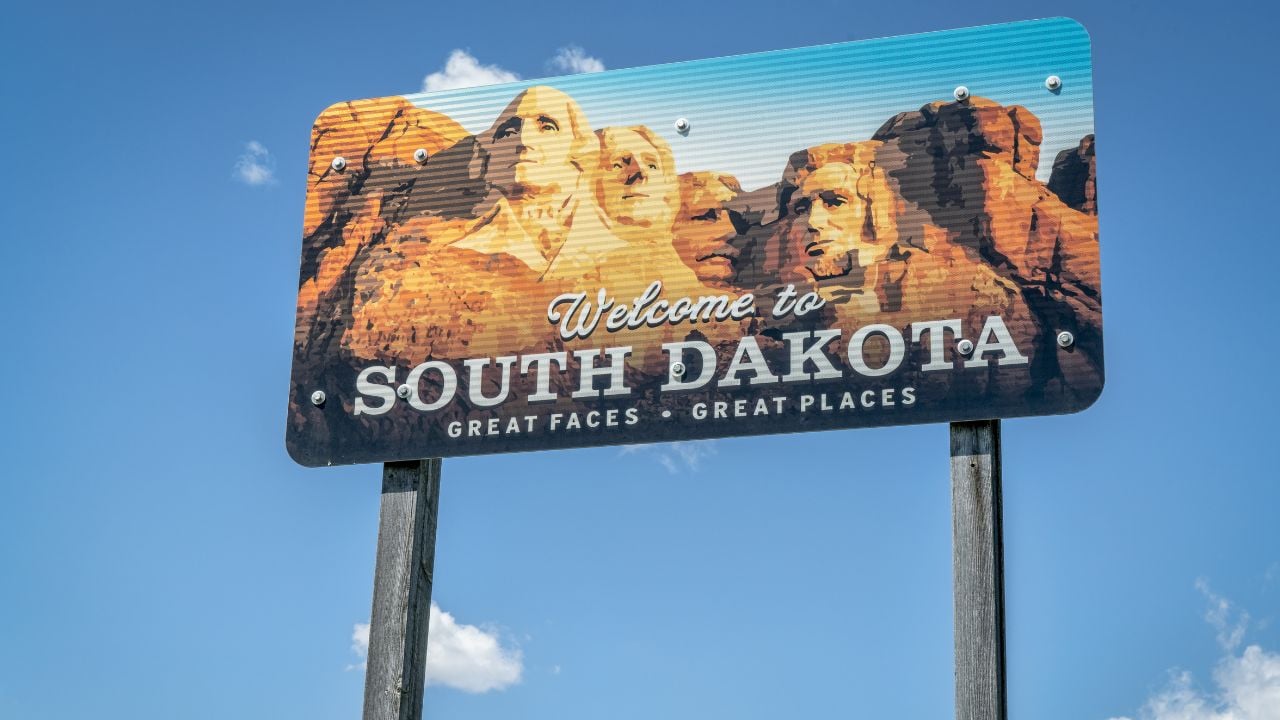
8 Things That Confuse Everyone Who Moves to South Dakota

South Dakota charges its full state sales tax on a routine grocery run. Idaho is the only other state that does the same thing.
Newcomers who budget the way they did back home find that out the moment they unload a full cart at the register.
These are the things that confuse out-of-staters who move to South Dakota.
Note: This is general information, not legal or tax advice. Tax rates, residency requirements, and vehicle registration rules are subject to change.
1. Roads Numbered Like a Grid
South Dakota’s rural roads skip names entirely and run on a numbered grid instead, streets running east-west and avenues running north-south, tied to the section lines surveyors laid out generations ago.
A mailing address can look like “40125 191st Street” instead of anything a newcomer would call a road name.
No sign says “Smith Road.”
The rural addressing grid exists so hunters, farmers, and 911 dispatchers can find any address by doing basic math off the county line.
Newcomers punching an address into a map app and getting back coordinates that read like a locker combination usually need someone local to translate before the directions make sense.
2. No State Income Tax
No state income tax touches a paycheck, a pension, or a Social Security check in South Dakota, no matter how much a household brings in.
Newcomers from income-tax states keep hunting for the withholding line on their first pay stub.
It’s not there.
South Dakota also skips a corporate income tax, an estate tax, and an inheritance tax, one of only nine states with no wage tax at all.
That combination pulls in retirees, remote workers, and business owners who move their legal address here even when they don’t move much else.
Sales tax and property tax pick up more of the load instead.
3. The Hidden Vehicle-Titling Fee
Titling a car in South Dakota looks like a formality until the county treasurer flags a missing document.
A newcomer who hasn’t yet swapped in a South Dakota driver’s license, or who’s still working off a temporary mailing address, gets hit with an extra $100 administrative fee on top of the standard title paperwork.
No exceptions.
P.O. boxes and mail-forwarding addresses don’t count as a physical address, and neither does an out-of-state license.
Getting a driver’s license first is the fix. That means an in-person stop at a licensing station with two separate, non-handwritten documents proving a physical address, a utility bill or lease works, before a car title ever gets touched.
Getting that sequence backward costs money, and the vehicle’s own tax bill adds another surprise on top.
The Math on South Dakota’s Vehicle Tax
South Dakota charges a one-time excise tax of 4% on a vehicle’s purchase price when it’s titled in the state, not an annual property tax.
A newcomer titling a $30,000 truck owes $1,200 once, at registration, and nothing more on that truck every year after.
That’s different from states that bill vehicle owners annually. South Dakota has no yearly personal property tax on cars at all.
4. Sturgis Rally Takeover
Every August, South Dakota turns one small town into the center of the motorcycle world, and newcomers who haven’t lived through it yet have no idea what’s coming.
Nearly 450,000 vehicles rolled into Sturgis over ten days last month, in a town with a population of roughly 7,000.
That’s not a typo.
The state drops interstate speed limits, installs temporary traffic signals, and watches hotel prices spike across the whole Black Hills region for the week.
The temporary signals and speed changes disappear again within days, and Sturgis goes back to being a town of 7,000 almost overnight.
5. Full Sales Tax on Groceries
Grocery runs in South Dakota carry the same 4.2% state sales tax as a television or a tank of gas.
No exemption, no reduced rate.
South Dakota and Idaho are the only two states that still charge their full sales tax rate on groceries at checkout, and South Dakota cities can add another 2% in local option tax on top.
South Dakota voters had a chance to end it in 2024 and turned the measure down at the ballot box.
Newcomers who moved from a state that exempts food learn the difference the first time they check a grocery receipt against the total on the shelf tag.
6. Two Time Zones, One State
Two time zones split South Dakota down the middle, with the Missouri River marking the line.
Two clocks, one state.
Forty-six counties run on Central time east of the river, and twenty counties run on Mountain time west of it.
A call from Sioux Falls to Rapid City crosses an hour gap without ever leaving the state.
The federal boundary even needed adjusting in 2003, when three counties asked to move into Central time because their business ties ran east, not west.
Meetings that span the state still need a time zone confirmed before anything else on the agenda.
7. Sioux Falls’ Credit Card Boom
Sioux Falls carries far more banking and credit-card jobs than other South Dakota cities its size, and newcomers job-hunting there in almost any field notice the concentration fast.
The reason traces back to 1980, when South Dakota lifted its interest-rate ceiling on consumer lending.
Citibank moved its credit card operation to Sioux Falls the following year, promising about 400 jobs.
That’s not a coincidence.
Citi alone still counted an estimated 1,000 to 1,500 Sioux Falls employees in the local development foundation’s 2025 employer tally.
Other major card and finance issuers followed the same math to South Dakota, and Citi, Wells Fargo, First PREMIER Bank, and Sammons Financial together account for well over 4,000 Sioux Falls jobs today.
A newcomer’s own credit card statement, wherever they used to live, may have been governed by South Dakota law the whole time without them ever knowing it.
Psst! How much do you know about South Dakota’s history and landmarks? Take our quiz and see how many you can get right.
Quiz
South Dakota IQ
Answer these questions on South Dakota history and landmarks. We bet you can’t get them all right. Prove us wrong?
South Dakota’s official state nickname wasn’t always “The Mount Rushmore State.” What was it before 1992?
8. Nine Nations, Nine Sets of Rules
Nine federally recognized tribal nations sit inside South Dakota's borders, and each one runs its own court system with its own jurisdiction.
That's nine legal systems.
State law simply doesn't reach inside those boundaries the way a newcomer might expect.
A speeding ticket, a liquor law, or a traffic stop can work differently the moment a driver crosses onto tribal land.
The nine tribal courts handle civil disputes, family law, and criminal cases involving tribal members under their own sovereign authority.
Road signs mark many reservation boundaries in South Dakota, but the change in speed limit or jurisdiction can still catch a driver off guard.
Each nation posts and enforces its own rules, and no single highway map covers all nine at once.
13 Things That Happen Inside Air Force One That No One Sees

Hollywood built a whole legend around Air Force One, escape pods included, and none of it holds up.
Air Force One runs on routines many Americans have never heard of, and a few of them would surprise even frequent flyers.
