
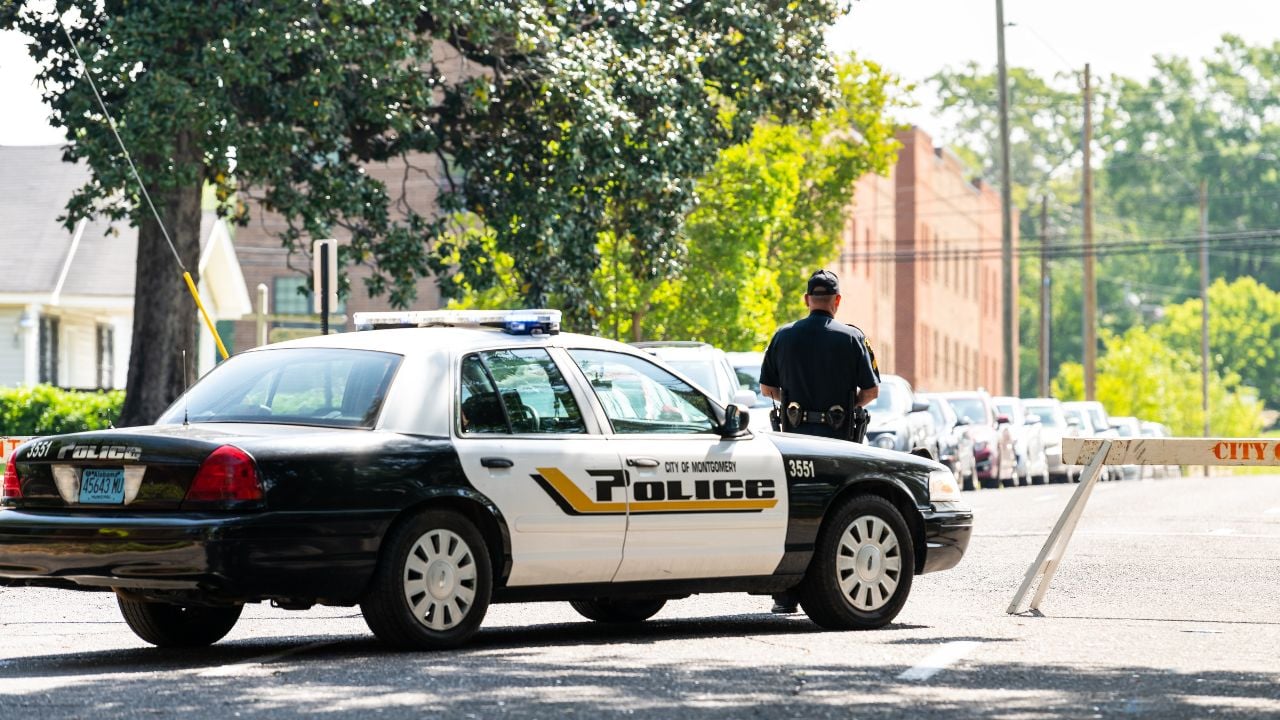
8 Alabama Speed Traps That Catch Out-of-State Drivers Off Guard

Institute for Justice senior attorney Samuel Gedge has a blunt theory about who small Alabama towns pull over.
Out-of-state plates rarely drive back to fight a ticket, so a traveler makes an easier target than a town’s own voters.
That’s the business model, allegedly.
These are the Alabama speed trap towns that catch out-of-state drivers off guard.
Note: This is general information, not legal advice. Traffic laws, fines, and how much a town can keep from them are subject to change.
1. Hillsboro
Hillsboro is a town of 407 people in Lawrence County, and its municipal court out-earns towns many times its size.
The court collected $253,183 in fines in 2020 alone, more than $600 for every resident in town.
Not a typo.
Hillsboro also sent more traffic-fine money to the state than nearby Muscle Shoals, a city roughly 40 times its population.
In 2021, its officers wrote more speeding tickets through federal overtime grants than the police departments in Mobile or Montgomery, two cities with far more people and far more traffic.
The news site AL.com’s 2022 investigation into Alabama’s ticketing named Hillsboro the anchor of a run of speed traps along the two-lane road connecting Huntsville to Muscle Shoals.
Locals learn the stretch.
Drivers who don’t know the road find out the hard way.
2. Town Creek
Fourteen miles west of Hillsboro on the same stretch of Alabama 20, Town Creek’s police department punches far above its weight.
Three full-time officers wrote nearly 1,600 tickets from grant-funded overtime alone in 2021, more than two tickets an hour.
That fast.
That’s the busiest rate of any Alabama department logging 200 or more overtime hours that year, according to AL.com’s 2022 records analysis.
Town Creek’s population runs just over 1,000.
Police Chief Jerry Garrett calls the tickets a safety measure rather than a revenue plan, and points to a lack of recent traffic deaths as evidence it’s working.
Drivers who don’t know this stretch of road rarely get the warning locals already carry in their heads.
3. North Courtland
Alabama 20 runs through North Courtland about halfway between Town Creek and Hillsboro, and the town’s ticket revenue took off fast.
The town, home to fewer than 500 people, sent more than $58,000 in court fines and fees to the state finance department in 2021.
That’s a 549% jump since 2017, the third-fastest increase of any town in Alabama over that stretch, according to AL.com’s 2022 analysis.
Fast money.
Only Hillsboro and Triana, a fast-growing town near Huntsville, grew faster.
North Courtland was also one of just six Alabama towns that sent the state more than $100 per resident that year, sitting on the same road that funnels travelers past Hillsboro and Town Creek in the first place.
The same drivers who miss the warning signs in Hillsboro and Town Creek run straight into North Courtland’s ticket writers next.
4. Rogersville
Rogersville sits on U.S. 72 in Lauderdale County, the highway that carries drivers between Tennessee, Mississippi, and the rest of north Alabama.
Rogersville’s municipal court filed more than 1.5 traffic cases per resident in 2020, and about nine of every ten cases it handled that year started with a traffic ticket.
Musicians noticed before regulators did.
Rogersville’s reputation predates the paperwork: The Drive-By Truckers put a Rogersville traffic stop into their 2001 album Southern Rock Opera.
The town earned that song the hard way, long before anyone ran the numbers.
5. Killen
U.S. 72 runs its cross-state traffic straight through Killen too, just south of the Tennessee line near Rogersville, and AL.com’s 2022 scoring put the town at No. 12 among Alabama’s worst speed traps.
Killen routes some of the drivers it stops into Lauderdale County’s driving school instead of a straight fine, and the town found its own way to squeeze more out of the arrangement.
The county charges $35 for the class, but Killen tacks on a separate $150 administrative fee before a driver ever sits down.
That’s $185 total.
Choosing the class dismisses the ticket, so the $185 replaces the original fine rather than stacking on top of it.
Killen also shames drivers who don’t pay: The town posted 500 names on Facebook in a single month for people who skipped court or left a fine unpaid.
Public and permanent.
Rogersville’s own municipal court shared that post.
6. Silverhill
Silverhill sits along Highway 59 in Baldwin County, the main road tourists drive to reach Gulf Shores and Orange Beach.
In 2019, its small police force wrote 2,229 traffic citations, a lot for a town that counted fewer than 800 year-round residents at the time.
About six tickets a day.
Silverhill’s population has since more than tripled, topping 2,500 by 2025 as Baldwin County’s growth pushes inland from the coast.
Police Chief Kenneth Hempfleng says his officers hand out more warnings than citations and defends the numbers as ordinary highway safety work.
Beach traffic doesn’t slow down for a town many drivers have never heard of until the lights come on behind them.
7. Summerdale
Highway 59 carries Baldwin County’s summer beach traffic straight through Summerdale, just up the road from Silverhill.
AL.com’s 2022 analysis, built from state finance records, federal grant data, and municipal court filings, ranked Summerdale the fourth-worst speed trap in Alabama.
That puts it just ahead of Brookside, the Birmingham-suburb town whose own ticketing scandal later forced the statewide law.
One spot ahead.
The town shares the corridor with Silverhill, Robertsdale, and Loxley, where the speed limit drops from 55 to 35 through each old downtown in a row.
Drivers headed to the coast from out of state learn the pattern one town at a time.
8. Georgiana
Interstate 65 carries Midwest traffic down to the Gulf Coast and the Florida Panhandle every summer, straight through Georgiana in Butler County, south of Montgomery.
AL.com’s 2022 investigation flagged the town among Alabama’s most aggressive ticket writers, ranking it eighth-worst on the same data-driven score that put Hillsboro at the top.
No back road here.
It’s an interstate, and drivers merging off I-65 for a bathroom break or a fill-up have no reason to expect small-town watching.
That’s exactly the surprise Georgiana built its reputation on.
The Law That Followed Brookside
Brookside, a small town on Interstate 22 just outside Birmingham, is the reason this cap exists: Its fines-and-fees revenue jumped from $82,467 in 2018 to $610,307 in 2020.
Nearly eightfold.
The Institute for Justice sued Brookside in 2022, and the case settled in 2026 for $1.5 million plus reforms to how the town tickets and tows.
Brookside ranked fifth-worst in AL.com’s own statewide analysis, behind four of the towns above, even with the new law already in place.
The same reform package requires municipal courts to track and publicly report their fines-and-fees data every year, the kind of disclosure Alabama’s small-town courts had never been required to make before.
What Alabama’s 10% Cap Limits
Alabama’s cap on ticket money, passed in 2022 as Act 2022-419, only covers fines and forfeitures, the actual penalty a court hands down for a violation.
The law caps that pot at 10% of a town’s general operating budget, sending anything above the line to the state’s Crime Victims’ Compensation Fund and Fair Trial Tax Fund.
Court costs and administrative fees, like Killen’s driving-school add-on, sit outside that math.
Psst! How much do you know about Alabama’s driving laws? Take our quiz and see how many you can get right.
Quiz
Alabama Rules of the Road
Answer these questions on Alabama’s driving laws. We bet you can’t get them all right. Prove us wrong?
Alabama’s move-over law is officially named after whom?
Why the Driving-School Loophole Exists
Several Alabama towns route ticketed drivers into a paid driving-school class instead of a guilty plea, and the reason comes down to who gets a cut.
When a driver pleads guilty to a ticket, state rules split the fine between the town, the county, and the state.
Driving school works differently.
When a town dismisses the ticket and charges a class fee instead, it doesn't have to share that fee the same way, so more of the money stays close to home.
Hillsboro charges $240 for its own class and keeps $195 of it, sending $35 to Lawrence County and $10 to the instructor.
Choose the online version instead, and the town skips the instructor fee while the driver pays $37 more to the outside class provider.
Hillsboro keeps $205 that way, $10 more than the in-person class, while that extra $37 goes straight to the outside provider instead.
7 States That Won't Touch a Penny of Your Retirement Income in 2026

Retire to Anchorage, and Alaska does something no other state bothers with. It pays you.
Every resident collects a yearly dividend from the state's oil savings, and not one dollar of a pension, a 401(k) withdrawal, or a Social Security check goes to the state either. These are the states that leave every dollar of your retirement income alone.
7 States That Won't Touch a Penny of Your Retirement Income in 2026
