
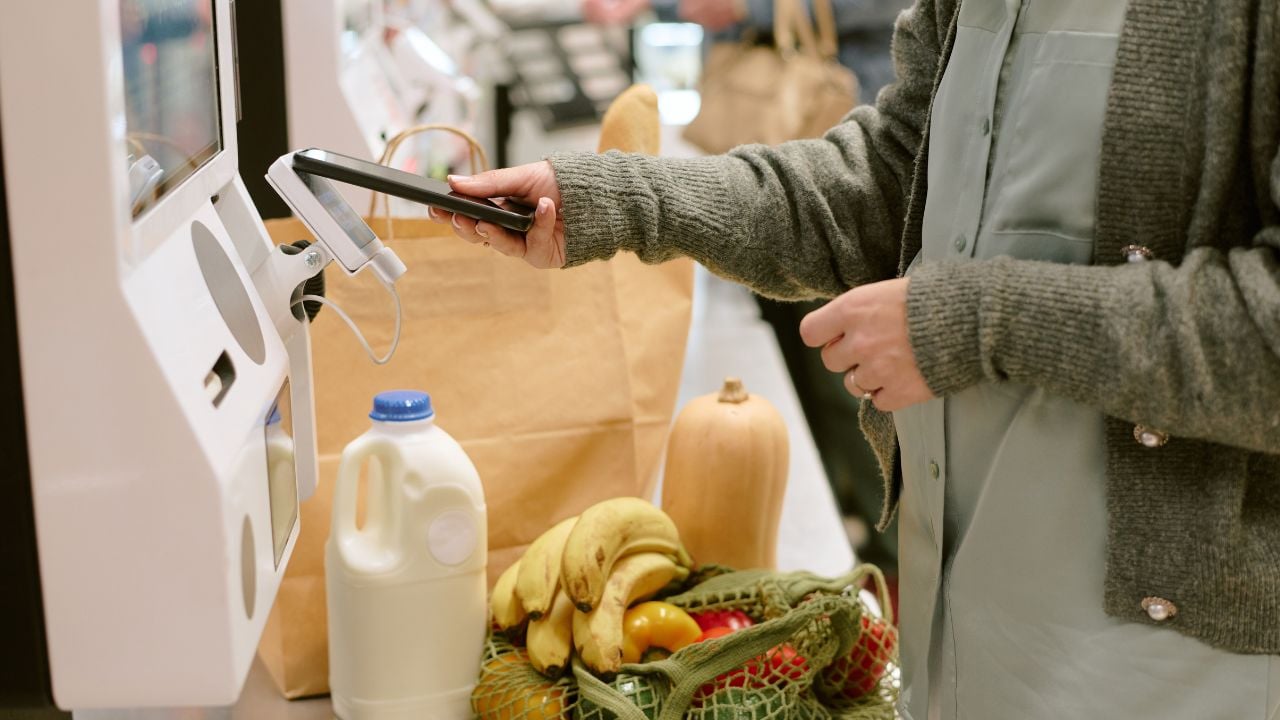
6 Joe V’s Smart Shop Payment Rules That Trip Up Texas Shoppers at Self-Checkout

Fourteen Joe V’s Smart Shop stores ring up groceries across Texas.
H-E-B built the discount banner on lower prices and a stripped-down staff, and that includes how you’re expected to pay.
These are the Joe V’s Smart Shop payment rules that trip up Texas shoppers at self-checkout.
Note: This is general information, not legal advice. Texas alcohol laws and individual store payment policies are subject to change, so confirm current details with the Texas Alcoholic Beverage Commission.
1. The Debit vs. Credit Choice
Joe V’s Smart Shop self-checkout terminals still ask a shopper’s debit card whether to run as debit or credit, even though it’s the exact same card either way.
That tap decides everything.
Pick credit, and the purchase routes through the card network’s signature rails with no personal identification number (PIN) required.
Debit is different: The screen stops for a four-digit PIN before it lets the sale go through.
A staffed cashier at Joe V’s Smart Shop usually runs the card through without asking, so shoppers who’ve never seen the prompt can stall at a self-checkout screen while a line forms behind them.
Both options draw from the same bank account, so nothing about the purchase changes, only which button a shopper taps first.
2. Cash That Never Touches a Cashier’s Hand
Joe V’s Smart Shop cashiers scan and bag every item, but they never handle a shopper’s money, even in a staffed lane.
That rule never bends.
Bills and coins go into a machine built into the payment terminal instead, the same kind of acceptor found on a self-checkout kiosk.
Retail analysts who visited a Houston-area Joe V’s for a pricing study described the whole checkout as a hybrid system: A person scans and bags, a machine takes the payment.
So even at a lane with a cashier, the payment step itself works like self-checkout.
Every self-checkout row carries that same bill and coin acceptor, so the habit holds no matter which line you pick.
Shoppers used to handing a $20 bill to a cashier sometimes stand there holding it out before they notice the slot.
3. No WIC Card-Split at the Keypad
Joe V’s Smart Shop shoppers report that self-checkout keypads run into trouble when a Special Supplemental Nutrition Program for Women, Infants, and Children (WIC) purchase needs to split with a second card.
Accounts posted to the consumer review site PissedConsumer describe exactly that happening.
One such account describes groceries already scanned and bagged, WIC covering part of the total, and the keypad unable to finish the rest of the sale on a debit card.
The shopper had to leave the row and start over at a staffed lane.
It was a rough reset.
Not every self-checkout keypad in Texas handles WIC the same way, but a shopper mixing WIC with another payment method at Joe V’s Smart Shop should plan for it.
The WIC Workaround at Joe V’s Self-Checkout
Joe V’s Smart Shop shoppers who want to pay with WIC and a second card can skip the keypad reset by keeping the two payments separate from the start.
Ring up the WIC-eligible items as their own order first, pay for those alone, then start a fresh transaction for everything else on a debit or credit card.
A staffed lane can also run both payment types together in one trip, since the keypad limit shows up at the self-checkout row and not at a staffed one.
4. Items the Lone Star Card Won’t Cover
Joe V’s Smart Shop takes Supplemental Nutrition Assistance Program (SNAP) benefits and the Lone Star Card at self-checkout, but the SNAP portion only pays for groceries the program covers.
Beer, wine, cigarettes, vitamins, supplements, and hot foods never ring up under SNAP, no matter which register scans them.
The self-checkout screen doesn’t sort that out for you.
Texas issues SNAP and Temporary Assistance for Needy Families (TANF) benefits on the Lone Star Card, a single card that moves roughly $6 billion in benefits statewide every year.
TANF cash rides on that same card and can cover the items SNAP won’t, but a shopper has to know to split the payment before the self-checkout screen flags the mismatch.
Drop a rotisserie chicken or a bottle of vitamins into a Joe V’s Smart Shop self-checkout order next to the groceries, and the SNAP balance alone won’t finish the sale.
The screen simply stops.
It asks for a second card before the sale can finish.
5. The Cash-Back Reward That Tapping Skips
Joe V’s Smart Shop self-checkout terminals read Apple Pay, Google Pay, and Samsung Pay with a simple tap.
Joe V’s Smart Shop picked up that feature months before October 2024, when H-E-B’s flagship stores finally added it.
That tap pays for the groceries, but it can skip a reward some shoppers are counting on.
The H-E-B Debit Card and the H-E-B Visa Signature Credit Card both pay 5% cash back on H-E-B family brand items, Joe V’s Smart Shop’s own store brands included.
That reward only applies when a shopper presents the physical card at the register.
A tap from a phone or a watch counts as a “digital wallet” transaction under the card’s own terms, and digital wallet purchases don’t earn that reward.
The payment still works.
What disappears is the cash back a shopper would have earned by swiping or inserting the same card instead of tapping it.
Psst! How much do you know about the history behind grocery checkout and payment in America? Take our quiz and see if you can ace it.
Quiz
Grocery Payment History IQ
Answer these questions on the history of grocery checkout and payment in America. We bet you can’t get them all right. Prove us wrong?
A pack of what gum became the first item ever scanned with a Universal Product Code (UPC) barcode, in 1974?
6. Less Cash Back on Name Brands
Joe V's Smart Shop shoppers who pay with the H-E-B Visa Signature or the H-E-B Debit Card earn 5% cash back on H-E-B family brand items at self-checkout.
That includes Joe V's Smart Shop's own store-brand groceries.
A name-brand box of cereal in the same cart earns the base rate instead.
Just 1.5% back, not 5%.
Pharmacy items, gift cards, restaurant purchases, and fuel don't earn the higher rate anywhere in the H-E-B family of stores, Joe V's Smart Shop included.
The self-checkout screen totals the whole order in one swipe, so a shopper watching for a flat reward across the cart won't see where the number landed until the statement posts later.
There's no cashier at the row to explain the math.
The ID-Scan Law at Self-Checkout
Texas grocery and convenience stores, Joe V's Smart Shop included, that sell beer and wine for takeout now have to run a customer's ID through an electronic scanner instead of just glancing at it.
That law took effect on September 1, 2025.
Clerks can't just eyeball it.
The law requires scanning the barcode on the back of a driver's license or ID card for any buyer who looks under 40.
That rule applies at self-checkout the same as it does at a staffed lane.
An employee who skips the scanner for a sale to someone who looks under 40 faces a Class A misdemeanor, with penalties up to a year in jail and a $4,000 fine.
That's true even when the buyer turns out to be 21 or older.
Starting September 1, 2027, the Texas Alcoholic Beverage Commission can also act against a retailer's permit for skipping the scanner, even if the buyer turns out to be 21 or older.
Any Texas grocery self-checkout row that sells beer or wine to go falls under this rule, so it's worth knowing before a six-pack lands in your cart at any store in the state.
A cashier still has some judgment built into the process, since the scanner requirement is tied to anyone who looks under 40, not automatically every buyer at the row.
The law draws that same age-40 line whether the sale happens at a staffed register or a self-checkout row, so Joe V's Smart Shop applies it exactly the same way at both.
7 Kroger Perks Texas Shoppers Over 60 Keep Missing
Kroger has sold groceries in Texas for more than 70 years, and its savings have moved almost entirely into the app.
These are the Kroger perks over-60 Texas shoppers keep walking right past every week.
7 Kroger Perks Texas Shoppers Over 60 Keep Missing
2 Places in Texas Where Groceries Cost More Than Houston

H-E-B, Kroger, and Walmart all fight hard for a cart in Houston, and that competition keeps prices down across the city.
Drive a little further across Texas, though, and that same grocery list starts costing more.
