
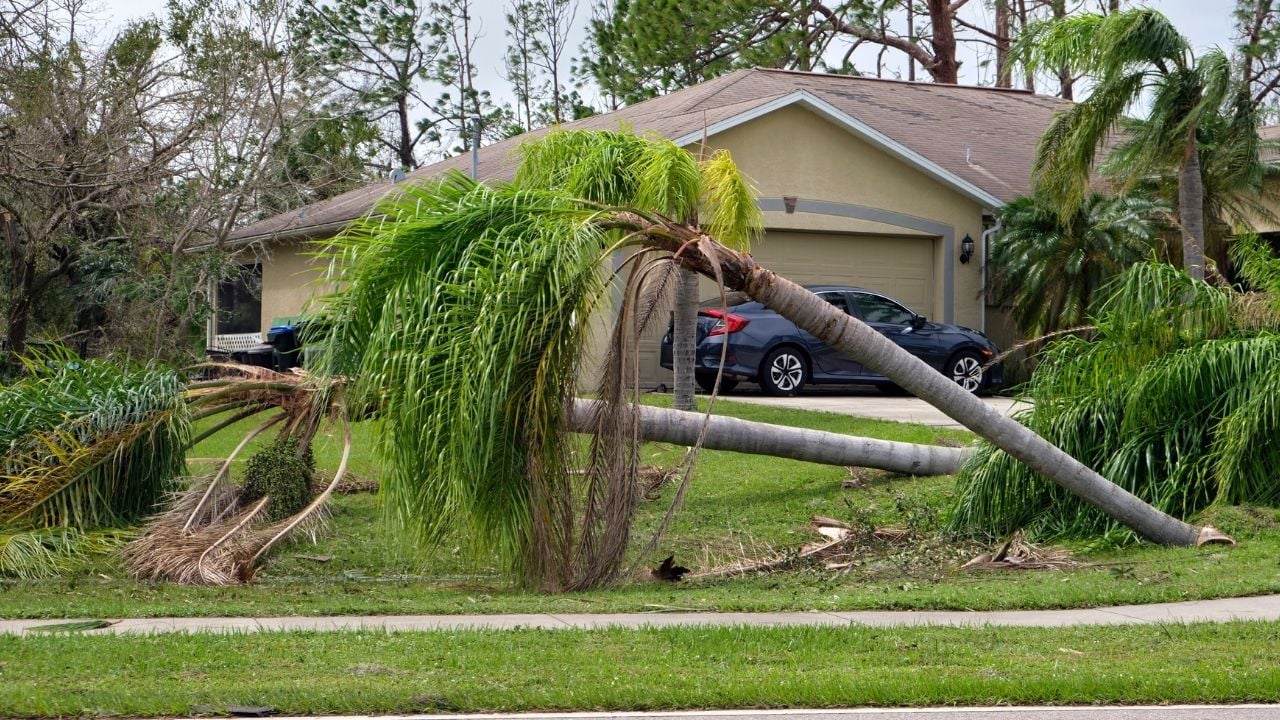
8 Situations When a Storm-Downed Tree in Florida Becomes Your Neighbor’s Problem, Not Yours

The Atlantic hurricane season hit its statistical peak a few days ago, according to the National Hurricane Center.
We don’t wish a downed tree on anyone.
But this is the time of year when it’s statistically more possible in Florida.
These are the situations when a storm-downed tree becomes your neighbor’s problem, not yours.
Note: This is general information, not legal or insurance advice. Property liability rules and insurance terms vary and are subject to change.
1. A Dead or Dying Tree
Florida draws a hard line here: Was the tree healthy, or was it already dead or dying?
A live tree that falls in a storm and lands on your side is, under Florida’s general rule, yours to handle.
That’s the same way a healthy oak’s shade is yours to enjoy without paying your neighbor for it.
A tree that was already dead or dying before the storm hit flips that rule, and Florida law generally shifts responsibility toward whoever owned the tree, not whoever’s yard it landed in.
That distinction decides everything below.
Proving a tree was already failing takes more than a hunch.
Homeowners increasingly point to a browning canopy, sloughing bark, or a full season with no new growth as evidence the tree was dying long before any wind arrived.
Healthy vs. Hazardous: The Line Florida Law Draws
Florida’s tree-liability rule sounds simple until you ask who decides whether a tree counted as healthy the morning before it fell.
A tree doesn’t have to be fully dead to count as hazardous under Florida’s arborist-certification process.
Signs like a documented lean, a fungal growth at the base, girdling roots, or one large dead limb can all be enough for a certified arborist to rate the whole tree an unacceptable risk.
It’s still a risk.
That holds even while most of the tree is still green and alive.
Looking fine to a passerby rarely holds up once a written risk assessment exists because the assessment measures structural risk, not how green the leaves were.
2. A Certified Arborist’s Flag
Florida law recognizes a tree hazard the moment it’s on paper, not only after a court says so.
State statute lets a homeowner hire an arborist certified by the International Society of Arboriculture, or a Florida-licensed landscape architect, to formally assess a tree.
That professional can document in writing that the tree “presents a danger” to people or property.
This exists for a reason.
It clears the way for a tree’s owner to remove it without waiting on a city or county permit.
Florida lawmakers built that path so a hazardous tree wouldn’t have to wait out a permitting process before it fell on someone.
If your neighbor already had that report in hand before the storm and never acted on it, the report becomes evidence they knew exactly what kind of tree was standing over your fence.
3. Already-Dropped Limbs on Your Side
A tree doesn’t need to fall completely before a court says its owner had notice.
Florida negligence law turns on whether a landowner knew, or reasonably should have known, about a hazard on their property capable of harming a neighbor.
Judges across the state have applied that standard to conditions on land for decades.
A pattern counts as knowledge.
If the same tree has already dropped large limbs onto your yard, your pool cage, or your car in past storms, and you can show it, that history builds a case. Your neighbor should have caught the danger before this storm did the rest of the work.
One dropped branch might be bad luck.
Three is a pattern a court can work with.
4. The Mid-Cut Landscaper
Wind isn’t the only way a tree comes down.
A landscaping crew can be actively pruning, topping, or removing a tree when it fails during that work, even as a storm’s outer bands roll through.
When that happens, the legal question shifts from the weather to the cut.
Arborists have long documented that improper pruning, especially “topping”, where a crew saws off a tree’s whole crown, forces weak, fast-growing regrowth.
That regrowth is more likely to snap in exactly the wind a storm brings.
It’s a landscaper’s mistake.
A tree owner who hired that crew doesn’t get to reach for the storm as an excuse when their own contractor’s cut made the failure more likely, not less.
Psst! How ready is your paperwork for a storm-downed tree? Run through this checklist and see where you stand.
5. Roots Undermined by Grading or Construction
A tree’s root system can fail for reasons that have nothing to do with wind.
New construction, a pool installation, a driveway repour, or heavy grading equipment can sever or compact roots on a neighboring lot months or even years before a storm arrives.
A tree with a damaged root system fails at wind speeds that wouldn’t touch a healthy tree.
Construction caused that, not wind.
When a property owner’s own work destabilized a tree before the wind ever picked up, Florida’s general negligence standard treats that instability as something the owner caused.
That keeps the responsibility on the property where the digging happened.
6. Code Enforcement’s Tree File
Florida cities and counties don’t wait for a storm to notice a dangerous tree.
Local code enforcement boards, created under state law to cite property maintenance violations, can and do open a file on a dead, decayed, or structurally failing tree well before hurricane season starts.
A citation is a timestamp.
If your neighbor’s tree already had an open code case, a notice of violation, or a compliance deadline attached to it before the storm, that record does the same job in court that an arborist’s report does.
It proves your neighbor already knew.
7. Your Unanswered Written Warning
Sometimes the only expert who flagged the tree was you.
Florida courts apply a foreseeable-risk standard to landowners: Once someone is on notice of a hazard on their property capable of hurting a neighbor, they owe a duty to do something about it.
A text, an email, or a certified letter counts as notice.
So does a conversation you can back up with a witness or a follow-up message.
Your neighbor did nothing.
If you warned your neighbor about a leaning trunk, a cracked limb, or roots heaving out of the ground, and the storm proved you right, that warning is the paper trail that turns the tree back into their problem.
8. Your Insurance Gap and Their Liability
The moment your own homeowners policy stops paying is exactly when your neighbor’s liability starts to matter most.
A fallen tree can land in your yard, across a fence, or on your car without ever touching your house, garage, or any other insured structure.
No structure, no payout.
Many standard Florida homeowners policies won’t pay a cent to remove a tree in that case. The Insurance Information Institute notes that debris removal is generally covered only when the tree damages a covered structure, with one narrow exception if it blocks a driveway or a wheelchair ramp.
That gap is exactly where the tree owner’s responsibility takes over.
If a hazardous tree next door caused the mess and your own carrier won’t touch it, going after the tree’s owner, or their liability coverage, becomes your best route to getting it hauled away for free.
What the Hurricane Deductible Changes
Even when a neighbor’s negligence caused the tree to fall, Florida’s hurricane deductible still decides what happens to your bill first.
The National Hurricane Center marks September 10 as the statistical peak of the Atlantic hurricane season, so a storm that forms in mid-September is arriving on the back half of the year’s worst stretch, not the front of it.
A Florida hurricane deductible isn’t a flat dollar figure like your regular deductible.
Insurers set it as a percentage of your dwelling coverage, usually 2%, 5%, or 10%.
A home insured for $300,000 can carry a hurricane deductible anywhere from $6,000 to $30,000, depending on which option the homeowner picked.
That number applies first.
The hurricane deductible only kicks in once the National Hurricane Center posts an actual hurricane warning for Florida, not just a tropical storm watch.
It runs until 72 hours after the last hurricane watch or warning for the state expires.
So if the storm that took down your neighbor’s tree never technically reached hurricane strength over Florida, the smaller all-other-perils deductible applies instead.
That swap can be worth thousands of dollars before anyone gets to the question of who was at fault.
9 Florida Building Code Rules That Surprise New Homeowners

Two of Florida’s 67 counties don’t build to the same code as the rest of the state.
Miami-Dade and Broward run a tougher hurricane rulebook that many new homeowners never hear about until a contractor mentions it.
9 Florida Building Code Rules That Surprise New Homeowners
9 Florida Home Insurance Discounts Homeowners Are Leaving on the Table

Florida will put up to $10,000 toward storm-proofing a home.
Asking for it is the part many homeowners skip, along with a stack of smaller credits already sitting on their policy.
9 Florida Home Insurance Discounts Homeowners Are Leaving on the Table
