
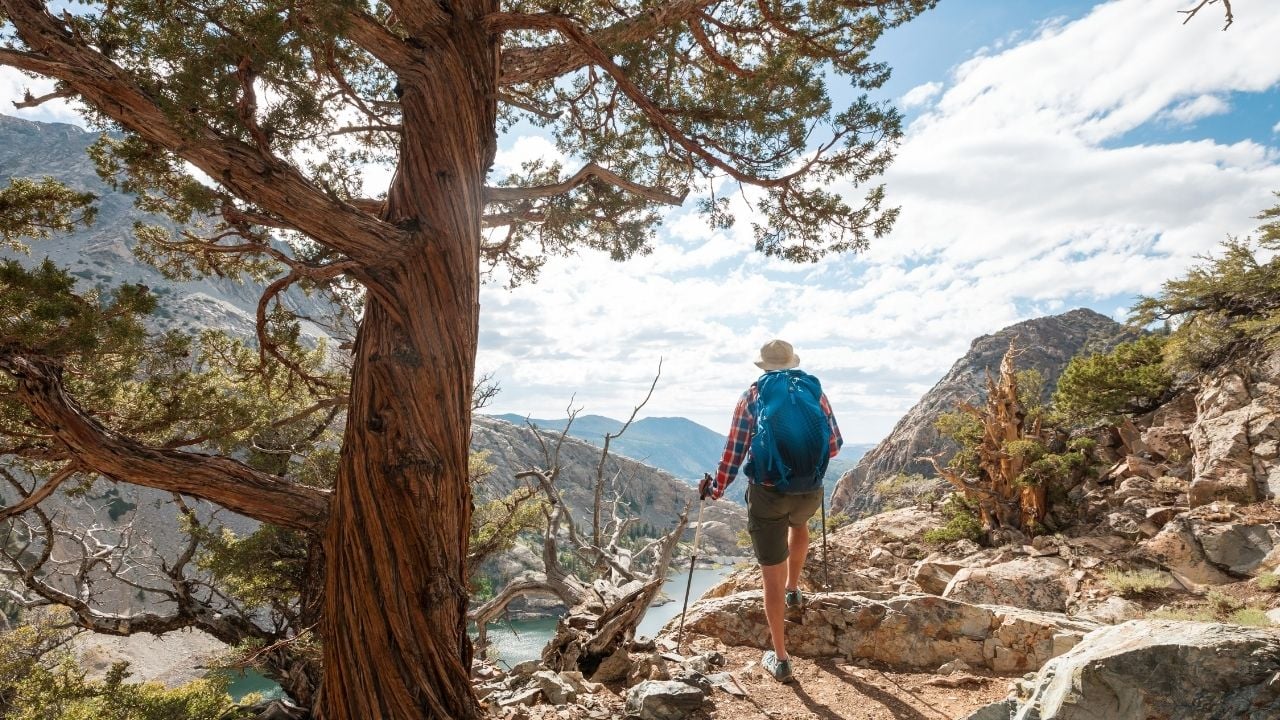
8 Things Californians Pack for the Sierra in September That First-Timers Leave Home

Sequoia and Kings Canyon stop requiring a reserved wilderness permit after Saturday, Sept. 26. A self-issue form at the trailhead takes over.
Getting in gets easier.
But staying comfortable up there gets harder, and anyone who’s hiked the Sierra in September packs for a mountain that stops behaving like summer.
These are the things Californians pack for the Sierra in September that first-timers leave home.
1. An Approved Bear Canister
Land managers across the Sierra require an approved, bear-resistant canister for overnight food storage in large stretches of its wilderness.
First-timers often show up with a stuff sack and a rope, planning to hang their food from a tree branch the old way.
Rangers turn them back.
A September hiker on Sequoia and Kings Canyon’s Rae Lakes Loop falls squarely inside the mandatory canister window, one that closes at the end of October.
The same route in November wouldn’t need one at all.
Kearsarge Lakes requires a canister every month of the year.
Yosemite Wilderness sets an even stricter rule, requiring an approved canister in every part of the park with no seasonal exception at all.
The Sierra’s Canister Rule Reaches East to Inyo National Forest Too
Inyo National Forest, on the Sierra’s eastern side, folds nine separate wilderness areas into one canister order, including the John Muir, Ansel Adams and Golden Trout Wilderness.
Each one requires food and refuse stored in a container built to keep bears out, or counter-balanced high in a tree instead.
The Interagency Grizzly Bear Committee (IGBC) tests each canister against its bear-strength standards before a park or forest approves the model.
Each park or forest then posts a list of which models qualify.
2. A Puffy Jacket and Warm Layers
The Sierra runs a wide temperature spread in September.
At 8,600 feet in Yosemite, the National Park Service puts a typical September day at a high near 65°F and a low near freezing.
Afternoon warmth gives way to a hard, fast freeze once the sun drops.
Camp gets cold fast.
A hiker who packed only a fleece for the trailhead parking lot spends the night shivering instead of sleeping.
Californians who’ve done a Sierra September trip before bring an insulated jacket, plus a warm hat and gloves for camp.
3. A Rain Shell
September in the Sierra still falls inside the summer monsoon pattern that keeps producing afternoon thunderstorms.
It isn’t rare.
The National Weather Service’s Hanford office confirmed a lightning-producing storm over Yosemite on September 21, 2023, when a strike injured two hikers sheltering in a cave near Half Dome.
That storm rolled through during a normal September trip window.
Californians who plan for that pack a lightweight rain shell, so a storm doesn’t turn into a long, shivering wait under a rock overhang.
First-timers usually bring a poncho at best.
4. A Headlamp With Spare Batteries
Days get shorter across the Sierra by mid-September, and afternoon storms can push a hike later than planned.
Darkness comes on fast.
A phone flashlight fading out half a mile from camp turns a routine return into a stumble over roots and rocks.
Californians who’ve hiked into a Sierra fall before carry a headlamp with spare batteries instead.
Cold weather drains a phone’s battery fast once the temperature drops.
Psst! How ready are you for a Sierra trip in September? Run through this checklist and see where you stand.
5. Traction Spikes
The Sierra can pick up its first snow of the season before September ends, especially above 9,000 feet.
It’s happened before.
That same NOAA database also logged 1 to 6 inches of snow above 8,000 feet in the Sierra on September 29 and 30, 2023.
The National Operational Hydrologic Remote Sensing Center credited that snowfall to the same storm system.
The lightning strike near Half Dome and that early snow both landed inside one ordinary Sierra September.
Californians who’ve been caught on an icy switchback pack traction spikes for exactly that stretch of trail.
First-timers usually leave them in the car.
6. A Wildfire Smoke Mask
Wildfire smoke reaches the Sierra in many Augusts and Septembers, and air quality can drop fast with a shift in the wind.
Some years it’s bad.
The National Park Service’s Yosemite page says one to three weeks of unhealthy air quality from regional fire smoke is common across August and September.
A dust mask from the garage doesn’t filter smoke particles.
Would a bandana tied over the mouth filter anything useful?
It wouldn’t.
Californians who’ve hiked through a smoky week before carry an N95 or KN95 mask instead, for camp and for the drive home.
7. A Below-Freezing Sleeping Bag
The Sierra’s overnight lows in September sit close to freezing at elevation, the same numbers the National Park Service posts for Yosemite’s high country.
That bag won’t cut it.
Many summer-weight bags are rated only a little below room temperature, nowhere near a Sierra camp sitting close to freezing.
A 40-degree bag on a 28-degree night means waking up every hour to reposition and never sleeping deeply.
Californians who plan around that bring a bag rated well under freezing instead of the one they used in July.
Psst! How much do you know about the Sierra Nevada beyond your packing list? Take our quiz and see how many you can get right.
Quiz
Sierra Nevada IQ
Answer these questions on Sierra Nevada geography, parks and records. We bet you can’t get them all right. Prove us wrong?
What is the highest point in the contiguous United States, rising from the Sierra Nevada?
8. A Printed Wilderness Permit
Sequoia and Kings Canyon's wilderness permit system runs on two different sets of rules within the same September.
Its quota season, with paid reservations and in-person pickup, runs from late May through Saturday, Sept. 26 this year.
After that, permits switch to free and self-issued, with no quota at all.
A trip that starts Sept. 25 needs a reservation, a fee and a ranger-issued permit.
A trip that starts Sept. 27 needs none of that, just a self-issue permit filled out at the trailhead kiosk.
Yosemite's wilderness office runs a stricter rule year-round: It doesn't treat a Recreation.gov confirmation email as a valid permit.
A trip leader has to pick up the actual permit in person at a wilderness center before setting out.
Pickup windows run one day ahead or the same morning, and missing that window over a paperwork mix-up turns a trailhead start into one more night in a motel.
Californians who've been turned away at a trailhead before now print everything and pick up the paper permit a day early whenever their schedule allows it.
A phone screenshot doesn't count at the permit station, no matter how strong the signal looks in the parking lot.
8 Things California's Fast-Food Restaurants Did Better in the '80s and '90s
A taco cost 59 cents at a California Taco Bell drive-thru at the end of 1990, and a couple of dollars covered lunch.
Taco Bell, Carl's Jr., Del Taco, In-N-Out and Wienerschnitzel all trace their first location back to California, long before any of them looked the way they do now.
8 Things California's Fast-Food Restaurants Did Better in the '80s and '90s
9 California Property Tax Loopholes Homeowners Don't Know They Qualify For

California hides a property tax break that can save a family's heirs a massive bill when a home passes down to them.
California protects only a set dollar amount of that home's value, under a limit few homeowners have ever heard of.
9 California Property Tax Loopholes Homeowners Don't Know They Qualify For
