

8 Montana Words and Phrases That Make No Sense to the Rest of the Country

A moving truck spins its tires axle-deep on a dirt road outside Choteau.
The rancher who stops to help takes one look and says it’s stuck in the gumbo.
The out-of-state driver has no idea what that means, and it won’t be the last time.
These are the Montana words and phrases that make no sense to the rest of the country.
1. Chinook
Chinook is the word Montana ranchers reach for when a warm, dry wind turns a snowed-in pasture bare within hours.
Locals call it the snow-eater.
The nickname isn’t an exaggeration.
A chinook pushed the temperature at Loma, Montana from 54 below to 49 above in 24 hours in January 1972, the biggest one-day swing ever recorded in the country.
Cattle that would otherwise go hungry under deep snow suddenly find bare grass again.
Outsiders hear “chinook” and think of a helicopter or a salmon, never a wind that can eat a foot of snow before lunch.
2. The Rims
Billings, Montana sits below a wall of sandstone cliffs that runs along the city’s north side, and locals just call them the Rims.
It’s the town’s compass.
The cliffs are Eagle Sandstone, cemented layers of sand and silty mud laid down 70 to 80 million years ago.
They mark the edge of an inland sea that once split the continent in half.
Longtime residents describe whole neighborhoods as above the Rims or below them.
That shorthand works like an actual address in a city where the cliffs show up in almost every view.
A visitor asking for directions by street name alone gets a blank look until somebody adds which side of the Rims they mean.
3. Coulee
Coulee is a landform much of the country has never had to name.
Montana has thousands of them.
A coulee is a dry ravine, carved by seasonal water, cutting steep-sided valleys into the open plains.
A National Public Radio survey of American regionalisms singled out coulee as Montana’s defining word, one term picked to represent each of the fifty states.
The word traveled down from French-Canadian fur traders, and in eastern Montana it still marks dry country too shallow to call a valley and too big to call a ditch.
Many eastern Montana place names carry the word right in them, a reminder of just how common the landform is out on the plains.
Coulee, Draw, or Gulch? Montana Sorts Them by Size
Montana’s dry-country vocabulary splits one idea into three different words, though usage varies and ranchers rarely mix them up.
A draw is usually the smallest, a shallow dip in the land that rises back up toward a ridge.
A coulee runs deeper and longer than a draw but stays narrower than a true valley.
A gulch is close to a draw in size, though the word points at a steeper, V-shaped cut instead of a gradual dip.
4. Barrow Pit
Montana road crews call the ditch running alongside a rural road a barrow pit, and it’s cut there for a practical reason.
Crews dig the ditch to drain water off the roadbed, using that same dirt to build the road up in the first place.
They borrow, not dump.
A regional dictionary traces the correct, original term to “borrow pit,” since the excavated dirt is borrowed for use elsewhere.
“Barrow pit” is the folk twist that caught on once people linked the word to a wheelbarrow.
A barrow pit fills fast during spring runoff, deep enough in places to swallow a mailbox post.
Psst! How much do you know about Montana’s other regional words? Take our quiz and see how many you can get right.
Quiz
Montana Slang IQ
Answer these on Montana’s other regional words, nicknames, and old ranch terms. We bet you can’t get them all right. Prove us wrong?
In Montana, “the Bob” is a nickname for which wild place?
5. The Crazies
A jagged little mountain range rises alone out of the plains between Big Timber and Livingston, and Montanans just call it the Crazies.
It's an island range, cut off from the main Rockies by the Yellowstone and Shields river valleys and only about 30 miles across.
Crazy Peak tops out at 11,214 feet, the third-highest summit in the state.
That's no small mountain.
Nobody agrees on exactly how the range got its name.
The most repeated story traces it to a settler woman who wandered into the peaks alone and was presumed to have lost her mind there.
Outfitters and hunters still use "the Crazies" as a plain answer to where they're headed, the way someone else might say downtown.
6. Shipping
Shipping, in Montana ranching, has nothing to do with the mail.
No stamps are involved.
Ranchers wean the calves from their mothers, load them onto trailers, and haul them to a sale barn where buyers bid on them by the pound.
Cattle auctions across Montana fill up fast every fall as ranch families bring in that year's calf crop.
Trucks and gooseneck trailers line up outside the sale barn before sunrise, and by afternoon that single day's price decides whether the ranch had a good year.
7. Hi-Line
Montana's Hi-Line is the string of prairie towns that runs six hundred fifty miles along U.S. Highway 2, all the way to the Canadian border.
James J. Hill's Great Northern Railway built a line through that stretch in the late 1880s.
The route became known as the Hi-Line because it was the northernmost transcontinental route in the country.
The highway came second.
Havre, Malta, and Wolf Point all trace back to that same rail line.
A Montanan drops the Hi-Line into conversation the way someone else leans on a hometown nickname, without a second thought.
8. Gumbo
Gumbo, in Montana, is mud, not a bowl of stew from Louisiana.
It turns slick as ice.
Gumbo is mostly bentonite clay, and that chemistry is exactly why it turns greasy the moment it rains and dries rock-hard once the sun's out again.
Eastern Montana ranchers check the sky before they drive a dirt road because gumbo can strand a truck up to its axles in minutes.
A school bus that makes its rounds without trouble on a dry Thursday can be rerouted by Friday afternoon if a fast rainstorm turns the gravel to gumbo overnight.
9 Cracker Barrel Traditions That Have Disappeared
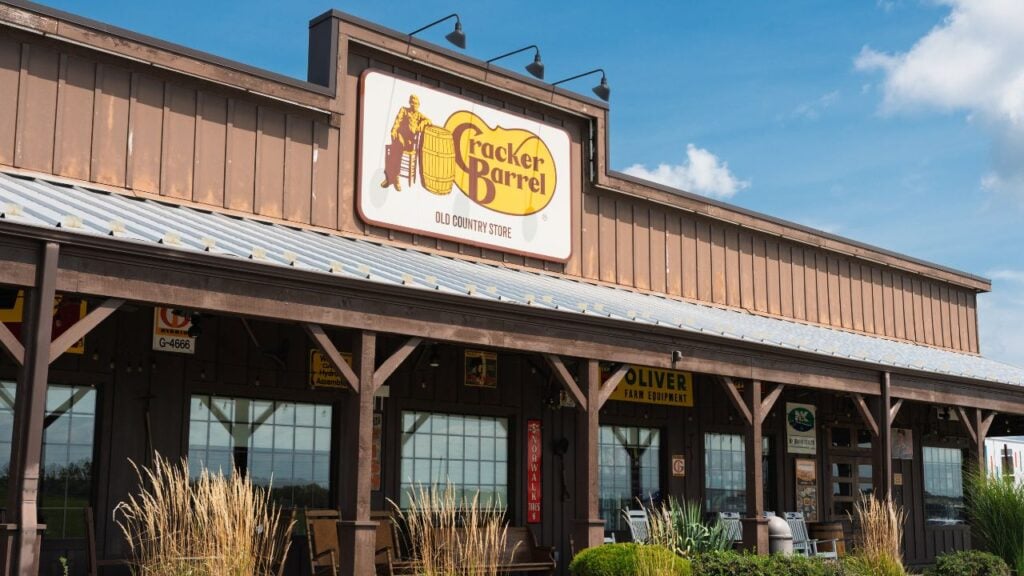
Cracker Barrel's stock dropped by $94 million in a single trading day in August 2025, right after the company swapped its old logo for a slimmer one.
The company put the old logo back within days, but that reversal wasn't the first change longtime regulars had noticed.
