
6 Rhode Island Foods and Drinks the Rest of the Country Has Never Heard Of

Rhode Island made coffee milk its official state drink in 1993. The syrup bottle still sits on grocery shelves the way ketchup does everywhere else.
Plenty of people outside New England have never poured a glass.
These are the Rhode Island foods and drinks the rest of the country has never heard of.
1. New York System Wieners
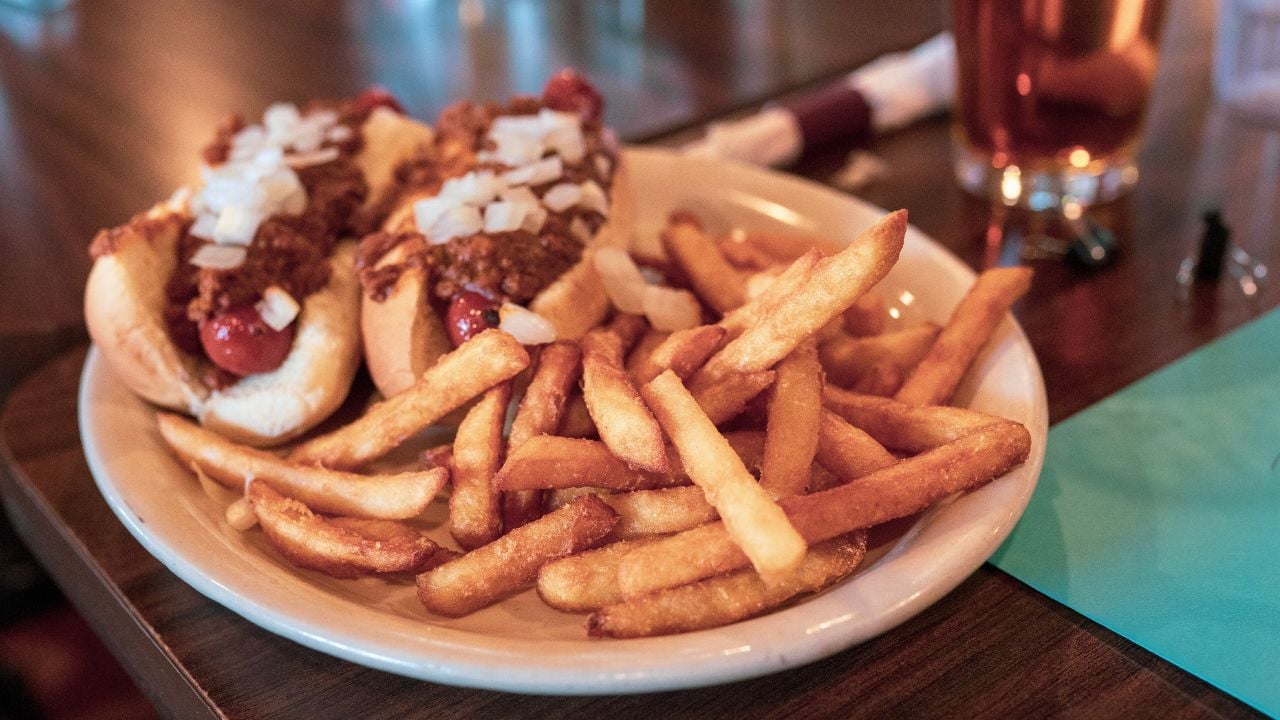
New York System wieners carry a name that points at the wrong city entirely, and diners across Rhode Island have served them this way for generations.
Short-order cooks in early-1900s Providence borrowed the “New York” label from Coney Island’s hot dog fame to sound big-city, then built a completely different sandwich around it.
A New York System wiener is thin, natural-casing, and steamed, topped with yellow mustard, chopped onion, celery salt, and a spiced meat sauce.
Ketchup never touches the wiener.
Cooks still build orders “on the arm,” lining four to six steamed buns down a forearm and dressing every bun before setting any of them down.
Rhode Islanders order them by the half-dozen.
In 2014, the James Beard Foundation gave Providence’s Olneyville outpost its America’s Classics award, a national honor for a sandwich many Americans have never seen on a menu.
2. Coffee Milk
Coffee milk is Rhode Island’s answer to chocolate milk, made by stirring sweet coffee syrup into plain milk instead of brewing anything hot.
No coffee is ever brewed.
A widely told account, reported by National Public Radio, traces coffee milk to Rhode Island’s Italian immigrant kitchens.
Grocery stores had syrup brands like Autocrat on the shelf next to the milk by the 1930s.
Nobody voted this into law by accident.
The General Assembly wrote coffee milk into the state’s statutes in 1993.
Ask for it at a diner in Ohio and a server will bring hot coffee with cream.
What Makes Coffee Milk Official
Coffee milk’s official status in Rhode Island comes from a statute, not a marketing slogan or a tourism campaign.
State law names coffee milk alone, so a bottle of hot brewed coffee or a plain cup of joe carries no legal claim to the title.
A company can call its product “iconic” any time it wants.
Only the Rhode Island General Assembly can put a drink’s name into the state code.
3. Stuffies
Stuffies show up on nearly every Rhode Island clam shack menu, and the name alone stumps many visitors.
A stuffie starts with a large hard-shell clam, chopped and mixed with seasoned breadcrumbs, onion, bell pepper, and a little butter, then packed straight back into its half-shell.
The shell goes back in the oven until the top browns.
Nobody eats the shell.
Clam shacks along Narragansett Bay sell them by the piece or the dozen, usually alongside clam cakes and a cup of chowder.
Order two stuffies at the counter, and nobody asks what that means.
4. Dynamites
Woonsocket, Rhode Island, lays claim to the dynamite, and the name has nothing to do with heat until the first bite proves otherwise.
The sandwich is loose ground beef simmered for hours in a tomato sauce loaded with onions and peppers, spooned onto a dedicated dynamite roll.
Some shops keep it mild.
Others load the sauce with crushed red pepper until it lives up to the name.
Woonsocket’s mill workers ate an early version of the sandwich for lunch in the 1920s, though the honor isn’t uncontested.
Madison, Maine, claims a version from the same decade, built with elongated meatballs instead of loose beef.
Outside this small stretch of New England, almost nobody recognizes either sandwich by name.
Rhode Islanders aren’t conceding the point.
Order a dynamite outside New England, and no kitchen has ever heard of the roll it’s supposed to sit on.
Psst! How much do you know about Rhode Island’s food quirks? Flip each card and see how many you get right.
5. Snail Salad
Snail salad turns up on Rhode Island Italian menus, seafood counters, and even white-tablecloth dining rooms, and the name alone stops many out-of-state visitors cold.
The dish is built from whelks, sea snails known as scungilli in Italian-American kitchens, boiled until tender, sliced thin, and tossed with olive oil, garlic, lemon, celery, and onion.
Nobody confuses it with escargot.
Italian immigrants in Rhode Island reportedly started eating whelks after finding them free along the shore in the late 1800s and early 1900s, according to Boston.com.
The snails cost nothing, and many immigrant families had little money for meat.
Restaurants across the state still serve it family-style as a shared appetizer, and Roadfood lists it on menus running from waterside clam shacks to fine-dining rooms.
Boston.com’s 2016 reporting found the whelk fishery that supplies it had grown into a Rhode Island industry worth more than $1 million a year at the docks.
Many Rhode Island Italian-American families still serve the dish as part of a Christmas Eve seafood spread.
Ask for snail salad outside the Northeast, and many kitchens have never made it.
6. Pizza Strips
A Rhode Island bakery box holds pizza strips, not slices, and the difference confuses just about everyone who didn’t grow up with it.
Italian bakeries stretch dough across a sheet pan, cover it in a thick tomato sauce, bake it, and let it cool completely before cutting it into rectangles.
There’s no cheese.
Many bakeries sell them cold or at room temperature, by the piece or the pound, in a flat white box.
That box is built for a birthday party or a Little League game, not a sit-down meal.
Cheese used to sit on top of some versions until a health department complaint years ago pushed at least one longtime bakery to drop it for good.
Saveur reports that one of its writers moved to Rhode Island and had never heard of pizza strips before arriving.
Many visitors still leave the bakery counter confused by the empty space where the cheese should be.
The cheese-free style stuck.
Why the Food Map Stays so Local
Rhode Island covers just 1,545 square miles, the smallest total of any state, and that size is part of why so many of its foods never spread far.
Nothing had far to travel.
Waves of immigrants settled into tightly packed mill villages rather than spreading across a wide state, and each group brought food habits that stuck close to home.
Woonsocket filled with French-Canadian workers recruited for its textile mills, a history the city’s history museum documents in detail.
Providence’s Federal Hill neighborhood became the city’s Little Italy at roughly the same time, according to Providence’s tourism office.
Italian groceries there still sell dried pasta and cured meats that many supermarkets outside the Northeast don’t carry.
None of that history required Rhode Island’s foods to travel beyond city or town lines, so many of them never did.
