
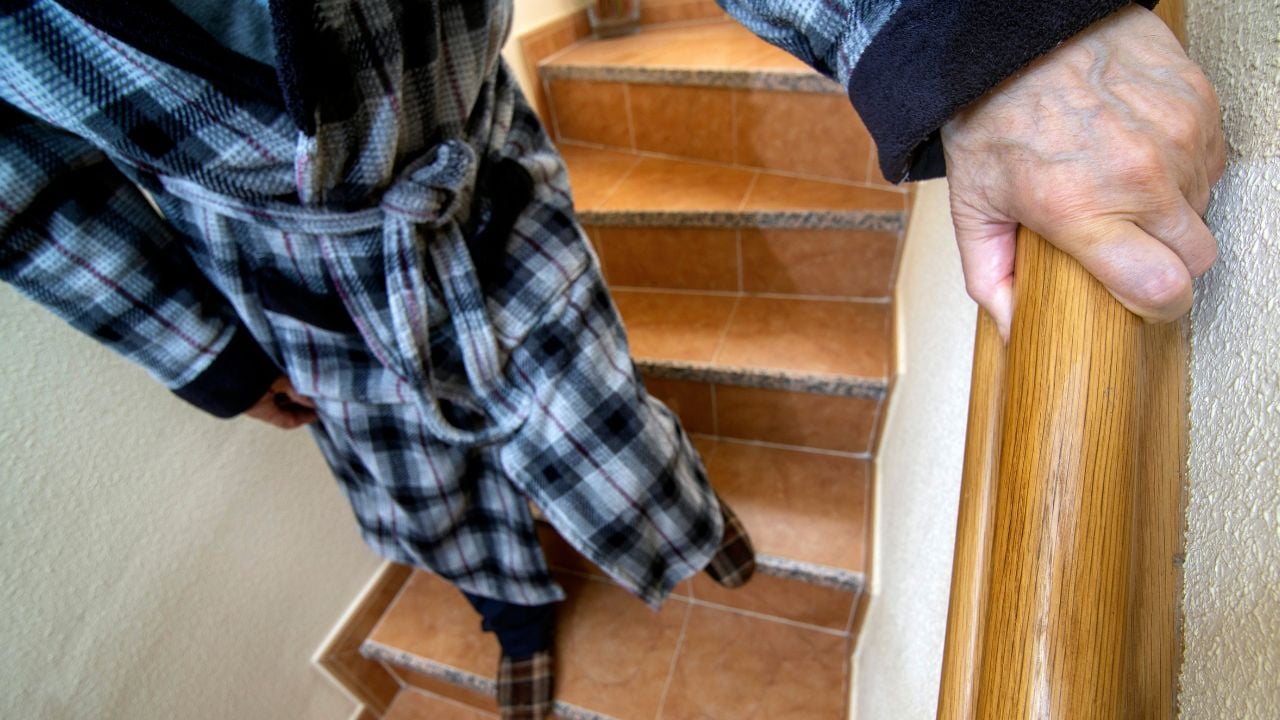
8 Signs the Stairs in a Michigan Home Are Becoming More Trouble Than They’re Worth

It’s rarely the roof or furnace that pushes a senior Michigan homeowner to finally call a real estate agent.
It’s the stairs.
These are the signs the stairs in a Michigan home are becoming more trouble than they’re worth for older residents.
Note: This is general information, not medical or financial advice. Costs, program eligibility and coverage details are subject to change. Talk to a doctor about your fall risk.
1. Aching Knees at the Top
Stairs become a problem the day your knees or hips start hurting on every step, up or down.
You might be able to get help.
Michigan runs a Medicaid waiver called MI Choice, the state’s program to help residents pay for home changes once a mobility decline like that makes a house unsafe.
That’s proof the state treats this exact symptom as more than a minor complaint.
The Centers for Disease Control and Prevention lists declining balance and strength among the most common reasons an older adult falls.
Joint pain on a staircase is often the mildest, earliest version of that same decline.
Ignore it long enough, and the stairs usually win.
A stair lift carries you up and down the stairs so your knees don’t have to.
Forbes Health lists Bruno’s installed price between about $3,800 to $11,000, with Stannah’s straight-stair models running $3,400 to $8,500.
Straight-stair models from other brands, including Acorn, often price lower, in the $3,000 to $5,000 range installed, though the final number depends on the stairway.
Why Medicare Won’t Pay for a Michigan Stair Lift
Medicare doesn’t cover a stair lift in a Michigan home because it isn’t classified as durable medical equipment the way a wheelchair or walker is.
Private insurance treats it the same way, as a home modification rather than a medical necessity.
MI Choice, the state’s Medicaid waiver mentioned above, sometimes pays for a stair lift instead, through a home modification benefit for residents who qualify by age, income and need.
Veterans have a separate path through a home modification grant from the U.S. Department of Veterans Affairs (VA).
2. Two Trips, Four, or None
The stairs in a Michigan home are hardest to handle mid-carry: A full laundry basket, a case of water, two grocery bags in one trip.
Roughly six in ten occupied Michigan homes were built in or before the 1970s, Bridge Michigan reported this year.
That’s long before the current building code set today’s minimum stairway widths.
A narrower, steeper stairwell built to that older standard leaves less room to carry a load with both hands than a stairway built today.
Some Michigan homeowners switch to smaller trips, then fewer of them, without ever deciding to.
That’s the giveaway.
It shows up as a laundry basket left at the bottom of the stairs for a few days, or one big grocery run split into two smaller ones.
Avoiding a full load on the stairs is your body flagging the risk, even if nobody says so out loud.
3. Ignoring a Stumble
A slip on the stairs, a grab for a railing that wasn’t there, or catching yourself halfway down already counts as a warning.
It’s not an accident to shrug off and forget.
Nobody reports a near miss.
The same aging housing stock that makes Michigan stairwells narrow also means many treads have been worn smooth by decades of use.
That’s exactly the kind of surface a foot catches on.
A national analysis of emergency room visits by adults 65 and older found stairs among the more common places a fall happens at home.
The bedroom and bathroom follow close behind.
A stumble is the same event as a fall that ended better.
Treat it that way.
4. One Bathroom, One Flight Away
The stairs turn dangerous once the only full bathroom sits on a different floor than the bedroom, especially on the walk at 2 a.m.
That’s when the avoidance starts: Skipping the trip and using a bedside container instead, or holding it until morning.
Once that becomes routine, the bathroom is no longer just inconvenient.
It’s already being avoided.
Michigan’s residential code requires a light switch at the top and bottom of any staircase with six or more steps under the state’s residential code.
That’s precisely because a dark flight at 2 a.m. is when a trip like that turns into a fall.
A single bulb at the bottom of the stairs doesn’t meet that bar, and neither does a hallway light that only reaches the first few steps.
Add a switch at both ends.
That’s one less reason for the avoidance to start.
5. When a Walker Doesn’t Fit
The stairs and the hallway leading to them were sized for the family who built the house, not necessarily the walker or wheelchair someone uses today.
Michigan’s housing stock skews old enough that this mismatch is common, not rare.
That same pre-1970s housing stock means many stairwells were framed years before today’s building code set its current minimum widths and clearances.
A walker that clips the wall on every step, or a wheelchair that can’t turn onto the landing, is telling you something plainly.
Widening a stairwell is invasive.
It’s expensive too.
Many Michigan families skip that project and lean on other fixes instead.
A first-floor bedroom, a stair lift positioned to leave enough tread space, or simply moving the household’s most-used rooms down to one level all work without touching the stairwell.
6. The Unused Upstairs
Use of the stairs in a Michigan home drops off every year once a household starts avoiding them, a room at a time.
Nobody sleeps there anymore.
A guest room, a home office, or a whole second floor that nobody dusts more than twice a year is the same signal, just spread out over time.
Michigan’s older housing plays a role here too.
Many of the homes built before 1970 went up as multi-story houses rather than the single-story ranches that became common later.
That means a first-floor bedroom option isn’t always already there.
At that point, the fix isn’t complicated: Move the bedroom to the first floor and stop treating the stairs as required daily travel.
A first-floor primary suite conversion isn’t cheap.
A bedroom remodel of that scope averages around $20,000 nationally, according to Angi’s home cost data.
Adding a full bathroom on top of it runs $10,000 to $50,000 more, though a simple room swap with no new plumbing can cost far less.
It still usually beats leaving the house behind.
7. The Wobbly Single Handrail
The stairs themselves start failing basic standards once a handrail wobbles, a tread wears smooth, or only one side of the staircase has a rail at all.
Michigan’s building code sets clear minimums for exactly this.
A step can’t rise more than 8¼ inches, and a tread has to give a foot at least 9 inches of depth to land on.
That’s the current rule from the state’s construction code commission.
A lot of stairs built decades ago never had to meet that bar.
The handrail matters just as much.
Code requires one continuous, graspable handrail between 34 and 38 inches high on any run of four steps or more.
AARP’s aging-in-place checklist, published by the nonprofit for older Americans, lists a sturdy railing among the basic upgrades any staircase needs.
A home isn’t ready for aging in place without one.
A handrail that wobbles doesn’t clear either bar.
That’s not repair anymore.
It’s a reason to stop trusting the stairs until someone fixes them.
Psst! How much trouble are your stairs causing? Run through this checklist and see where you stand.
8. Winter’s Added Hazard
The stairs in a Michigan home carry a different risk once ice and snow arrive, layered on top of whatever trouble was already there.
Michigan State University Extension flags icy front steps and slippery entry stairs as a defined winter fall risk for older adults.
Cold-stiffened joints and a hurried trip outside in the wrong footwear only add to it.
Small things stack up.
It recommends securing every railing, adding bright lighting over the stairs, and keeping ice cleats by the door.
Wet boots track melted snow onto interior stairs too, right at the entry a Michigander uses every day from November through March.
A tread that’s merely worn in July can turn slick in January.
A handrail that already wobbles or a joint that already aches has far less room for error once the entry ices over.
8 Home Warranty Claims Michigan Homeowners Get Denied For

A home warranty in Michigan promises coverage, not always a fix, and the fine print decides which claims survive.
A major home warranty provider recently paid $11.8 million after a Michigan investigation found it sold contracts it had little intention of honoring.
8 Home Warranty Claims Michigan Homeowners Get Denied For
9 Michigan Lake Access Rules Property Owners Get Wrong

Michigan’s Great Lakes shoreline runs about 3,288 miles, among the longest freshwater coastlines in the country.
Owning a piece of it comes with far more fine print than many buyers expect, and these are the lake access rules that catch Michigan property owners off guard.
