
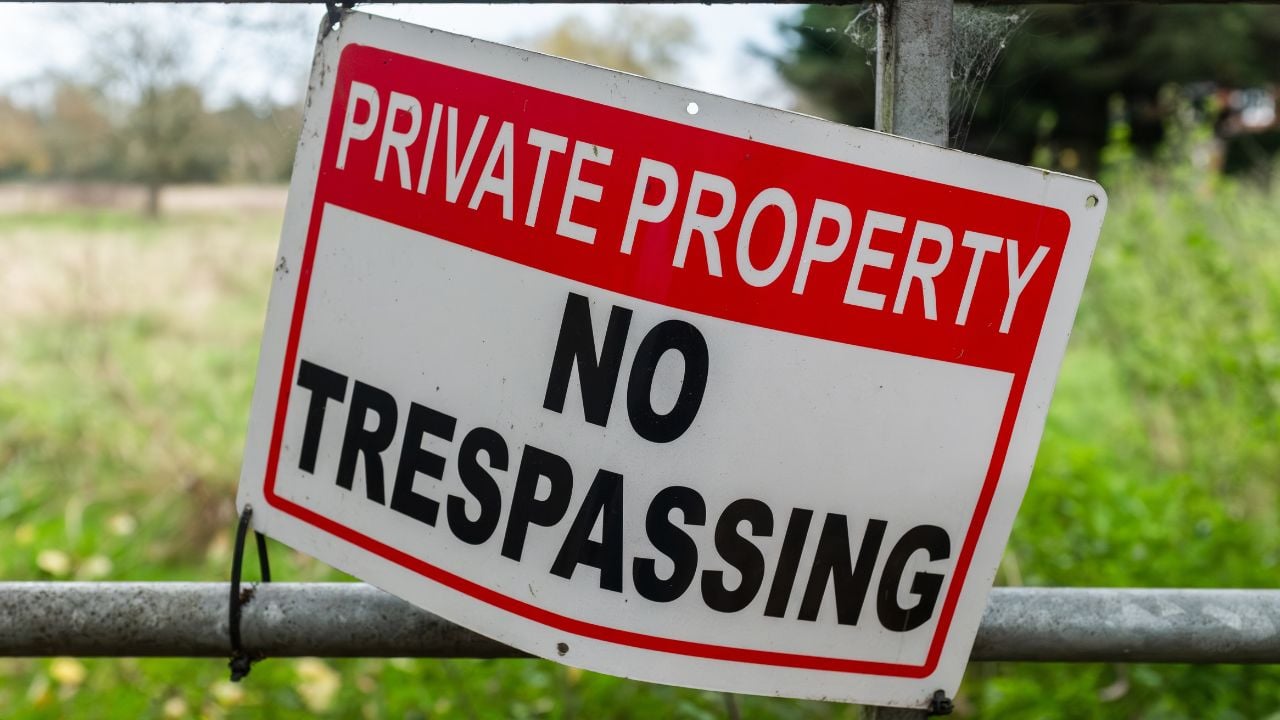
8 Easement Surprises That Cost Georgia Landowners Their Privacy

A property line tells you where your land ends. It doesn’t always tell you who else has a right to use it.
That distinction can come as a surprise when you’re counting on peace and privacy.
These are the easement surprises that cost Georgia landowners their privacy.
Note: This is general information, not legal advice. Easement and recording rules vary by county and can change over time. Confirm your easement’s exact terms with your county’s Clerk of Superior Court deed records or a licensed Georgia real estate attorney.
1. A Verbal Yes That Doesn’t Expire
State law lets a neighbor’s request to cross your land begin as a favor you can revoke anytime, right up until that neighbor spends money acting on your word.
Under Georgia’s parol-license rule, permission like that stays revocable only until the other person relies on it financially.
Lay gravel, run a pipe, or build a driveway on the strength of that word, and the permission becomes an irrevocable easement that runs with the land.
No deed shows it.
It never touches a signature or a recording at the courthouse either.
At that point, taking the favor back is no longer an option.
2. The Seven-Year Clock
Georgia’s prescriptive-easement rule can turn a neighbor’s daily walk across your yard into a legal right after just seven years on land that’s already developed.
Wild land gets twenty.
The use has to run openly, continuously, and without your permission the entire stretch, since a single objection or a single yes resets the clock.
Many Georgians who let something slide out of politeness are the people this rule catches.
3. A Right You Never Signed
State law recognizes an easement that forms automatically the moment an owner divides a single tract and sells it off in pieces, with no deed language granting it at all.
The same private-way statute creates this right “by implication of law” whenever a landowner sells part of a tract and the buyer needs that old path to reach the road.
No signature makes it real.
Nobody draws up a new deed for it, and the strip stays bound whether the current owner ever heard of it or not.
A back lot cut from a larger farm decades ago can still be reached by the same dirt road the original owner drove.
That right survives without anyone ever filing paperwork on it.
4. A Path That Won’t Die
Georgia law doesn’t allow an easement to disappear just because nobody has used a right-of-way in years, or even decades.
State courts have ruled for close to a century that a right acquired by grant survives nonuse unless there’s clear evidence the holder meant to give it up.
Silence isn’t surrender.
Even a locked gate you put up years back proves nothing on its own.
5. A Neighbor’s Landlocked Court Order
A landowner who can’t reach their property except by crossing yours can ask a superior court to carve a permanent road across your land.
No consent required.
Georgia’s private-way law treats the mere act of filing the case as a declaration of necessity.
The burden then shifts to you to show a reasonable alternate route already exists.
Courts have granted it even to a landlocked lot’s owner, but only when no other reasonable way in or out exists.
6. What the Power Company Can Remove
A right-of-way granted to a utility carries more control over your land than many property owners expect, stretching well past the poles and wires themselves.
You still hold the title.
Georgia Power’s easement rules bar a landowner from building anything permanent on the strip, including a shed, a pool, a septic tank, or a well.
The company can also order the removal of plantings it once approved, at its discretion.
That discretion covers trees and shrubs too, not just new construction.
Even a fence or a driveway crossing the strip needs a signed agreement with the company first, not just the landowner’s say-so.
The Notice You’re Not Guaranteed
Georgia Power says its crews try to notify a landowner in person before trimming or maintenance work, and leave a door hanger with a contact number when nobody answers.
That practice isn’t a legal requirement.
Once an easement exists, the company already holds the right to enter and leave the property to maintain its lines.
A missed knock on the door doesn’t undo that access.
7. A Servitude for Stormwater
Georgia law puts a servitude, a kind of easement, on the lower of two adjoining lots, forcing it to accept whatever stormwater drains down from the higher one.
That servitude works like one more easement on the property, even though it carries a different legal name.
Georgia’s appellate courts have upheld that rule for decades, ruling a lower lot “owes a servitude to the higher.”
Damming it isn’t allowed.
That holds as long as the upper owner hasn’t artificially increased the flow.
An upstream owner can still be sued for concentrating runoff into a single pipe and dumping it below.
The downhill owner just can’t fence the water out.
Psst! How many of these Georgia easement claims would you get right? Tap each one to see if it holds up.
8. A Conservation Deal You Never Made
A conservation easement can bind a piece of land forever, long after the person who signed it is gone.
The restriction has no expiration.
Under Georgia’s conservation-easement law, the limits last for an unlimited stretch unless the original agreement says otherwise, and every later owner is bound by them.
Buy a Georgia farm or a wooded tract already carrying one of these agreements, and the limits on building, subdividing, or clearing timber transfer to you the day you close.
Nobody asks whether the new owner ever wanted those restrictions in the first place.
7 Things Georgia Sells at State Surplus Auctions That Bargain Hunters Never Check

Georgia’s surplus auctions move through everything the state decided it no longer needs, from office furniture to heavy equipment.
Many bargain hunters chase the obvious stuff and skip past the categories that carry the biggest savings.
7 Things Georgia Sells at State Surplus Auctions That Bargain Hunters Never Check
9 Georgia Home Projects That Turn Into a Code Violation Without a Permit

Every Georgia county and city writes different permit rules for size, height, and depth, so a project that’s fine in one town can be a violation in the next.
A routine weekend build can cross one of those lines before a homeowner even realizes a permit was required.
9 Georgia Home Projects That Turn Into a Code Violation Without a Permit
