
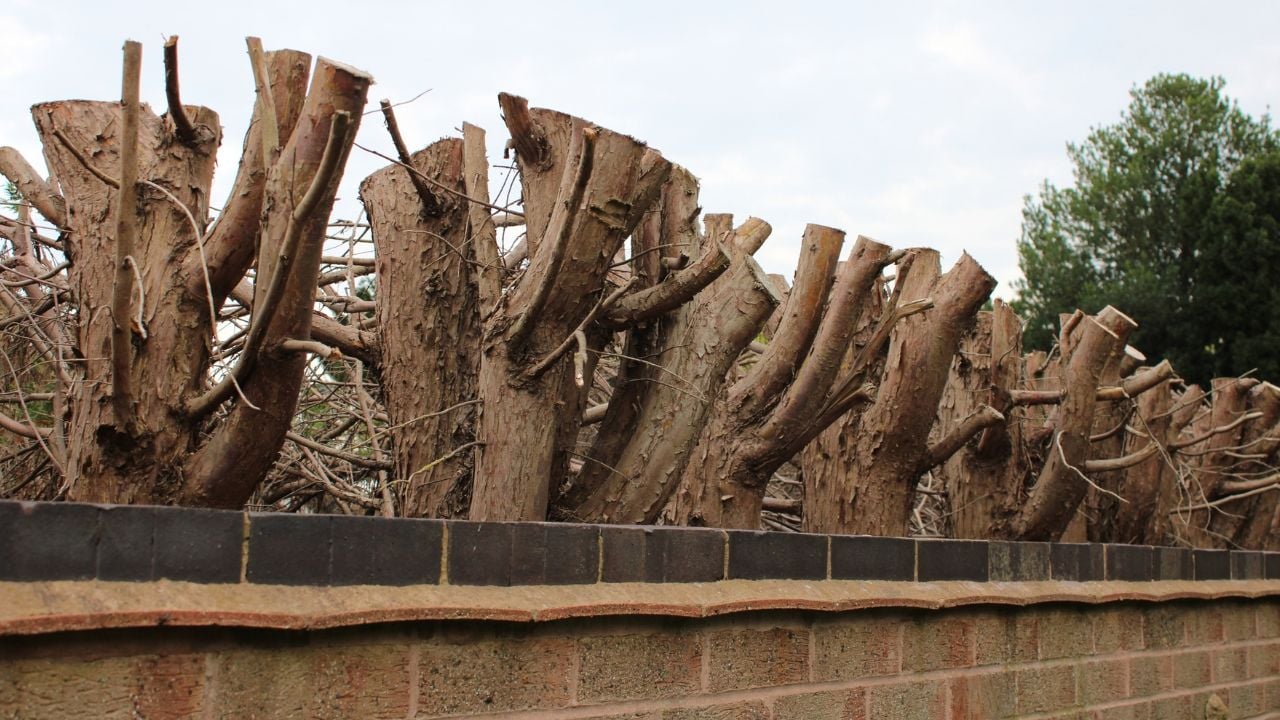
9 Things Virginians Can’t Legally Do to a Neighbor’s Tree

Removing a neighbor’s trees in Virginia without asking first can cost three times what that timber was worth.
That’s an expensive mistake.
Tree trouble in Virginia usually starts a lot smaller than that.
These are the things Virginians can’t legally do to a neighbor’s tree.
Note: This is general information, not legal advice. Tree and property laws vary by Virginia locality and are subject to change.
1. Trimming Across the Line
State law lets a homeowner trim a neighbor’s overhanging branches and invading roots, but only from their side of the property line.
Reach across that line for one more cut, and the job turns into trespassing.
Every inch counts.
A ladder against the neighbor’s fence counts as crossing it.
So does one foot planted in a neighbor’s flower bed.
The safer move is asking first, then trimming from a ladder or pole saw planted on your grass.
2. Cutting Down a Shared Tree
A tree trunk growing squarely on the boundary line between two properties belongs to both owners, not just the one it leans toward.
Long-standing property law treats a line tree the same as a shared fence, and nobody gets to change it alone.
One neighbor can’t cut it down, poison its roots, or hack it back to a stump without the other’s okay.
Ask first.
A landowner who removes a shared tree without agreement can end up covering what it was worth to the other side.
A court can tack on more, for good measure.
3. Cutting It Down for Sunlight
Property owners can’t legally cut down a neighbor’s healthy tree, or force a neighbor to do it, just because it blocks the sun or ruins a view.
The Virginia Supreme Court drew that line in a 2007 case, Fancher v. Fagella, after a sweet gum tree’s root system cracked a homeowner’s retaining wall and foundation.
Physical damage, not blocked light or a lost view, is what it takes to win an order forcing removal or covering repairs.
Root damage counts.
A retaining wall crumbling under invasive roots, a foundation cracking from below, a sidewalk buckling year after year, those are the kinds of harm courts recognize.
Losing your afternoon sun to a tall oak doesn’t, no matter how many years you enjoyed that yard without it.
4. Trimming It to Death
A property owner who trims a neighbor’s tree so hard it dies doesn’t walk away clean just because the cutting happened on their side of the line.
Self-help trimming is legal.
Killing the tree in the process isn’t.
Courts can make the trimmer pay for the tree’s value once it’s dead, the same as if they’d cut it down outright.
Root work is where this trips people up most.
Severing too many roots to fix a driveway crack can topple a tree that looked perfectly healthy from the trunk up.
A certified arborist’s opinion before any major root cut is cheaper than a judgment after one.
Psst! How much do you know about Virginia’s tree laws? Flip each card and see how many you get right.
5. Skipping the Timber Math
Cutting down a tree that stands on a neighbor’s side of the line, not a shared trunk on the boundary, is a different kind of mistake.
Virginia’s timber trespass law treats it as one of the toughest civil penalties on the books.
Under Virginia Code Section 55.1-2836, a tree’s owner can collect triple its stump value, plus up to $450 an acre to replant it.
That adds up fast, even on just a handful of mature oaks that never crossed onto your property at all.
The only way around it is proving you acted prudently and believed, in good faith, that you had a right to cut.
Section 55.1-2835 puts that burden on the person who did the cutting, not on the tree’s owner to disprove it.
Guessing doesn’t count.
The Timber Math on One Oak
Virginia’s timber trespass law turns one bad decision into a big bill fast.
Cut a stand of oak worth $2,000 on the stump without permission, and the owner can collect $6,000 in triple damages alone.
Add up to $450 an acre for replanting, the appraisal bill, and the neighbor’s attorney’s fees, and one afternoon with a chainsaw can run into five figures.
6. Poisoning or Girdling It
Homeowners can’t legally kill a neighbor’s tree slowly.
Herbicide poured at the roots, a ring of bark stripped around the trunk, or salt worked into the soil all count the same as a chainsaw.
Virginia Code Section 18.2-140 makes it a Class 3 misdemeanor to injure, burn, or destroy a tree growing on someone else’s land without written permission from the owner.
No chainsaw required.
Girdling and poisoning injure a tree just as surely as cutting it, they just take longer to show.
A tree that “just died” the same summer a fence dispute started invites exactly the kind of arborist inspection that turns a dead tree into a criminal complaint.
7. Taking Its Fallen Wood
You can’t legally haul off the wood from a neighbor’s tree once a storm brings it down, not without asking first.
Virginia Code Section 55.1-2838 defines larceny of timber to reach wood whether it’s still standing or already lying on the ground.
Free wood isn’t a thing.
A downed oak still belongs to whoever’s yard it grew in, even after the storm does the cutting for free.
Cutting it into firewood-length rounds and carting it home counts as taking it.
A text message asking first turns a theft charge into a free load of firewood.
8. Nailing Something Into It
Nobody can legally drive anything into a neighbor’s tree without asking.
A “No Trespassing” sign, a set of screw-in deer stand steps, or a zip-line anchor for the kids all count the same.
The same Virginia Code Section 18.2-140 that bans poisoning a tree also bans injuring one.
Every screw or nail leaves a wound the tree has to grow around for the rest of its life.
It doesn’t matter.
The tree still takes the injury either way.
A hammock strap cinched too tight, a string of patio lights stapled around the trunk, a fence line nailed straight into the bark.
Each one injures a tree that isn’t yours, without the written permission the law requires.
9. Destroying a Survey-Marker Tree
Virginia singles out one kind of tree for extra protection, the one a surveyor marked years ago to show where a property line runs.
Virginia Code Section 18.2-137 makes it a Class 3 misdemeanor to destroy “any tree marked” to designate the boundary of a tract of land.
That’s a separate charge from the general property-damage law that covers everything else in a yard.
This tree gets special treatment.
The law does give a way out.
If the tree’s owner is paid in full for the damage, a court can dismiss the charge.
That’s the owner’s call to make, not the person who cut the tree down.
A blazed corner tree only has to matter to one neighbor with an old survey and a grudge.
Cutting it down over a fence-line argument can turn a shouting match into a criminal complaint.
That’s on top of whatever the civil case over the fence itself was already going to cost.
8 Virginia Roadside Markers Hiding a Story Nobody Stops to Learn

More than 2,600 official historical markers line Virginia’s roads, part of the oldest state marker program in the country.
Drivers typically get about a stoplight’s worth of time to read one before traffic moves them along, missing everything the sign never had room to say.
8 Virginia Roadside Markers Hiding a Story Nobody Stops to Learn
8 Virginia Antique Shop Tricks That Turn a Bargain Into a Bad Deal

A mahogany secretary desk sold for $71,000 at a Virginia estate sale in 2004, then fetched only about $14,400 by 2018.
Nothing about that swing broke a single law, and a Virginia antique shop can follow every rule on the books while still handing a shopper a bad deal.
8 Virginia Antique Shop Tricks That Turn a Bargain Into a Bad Deal
