
7 North Dakota Foods Locals Love That Confuse Everyone Else

A University of Wisconsin field study on North Dakota’s settlement history found German-Russian families made up more than 40% of Stark County’s population by 1910.
Families like those left North Dakota’s kitchens with dish names that still trip up anyone who didn’t grow up saying them.
These are the North Dakota foods locals love that confuse everyone else.
1. Hotdish
Hotdish is North Dakota’s word for the dish.
Locals correct anyone who calls it a casserole.
Fargo’s tourism office puts it plainly: Hotdish is one word, and the other word doesn’t apply here.
Not a casserole.
Fargo’s Drekker Brewing hosts an annual Hotdish Festival every winter, now in its eighth year, where local restaurants compete for a People’s Choice award decided by the crowd.
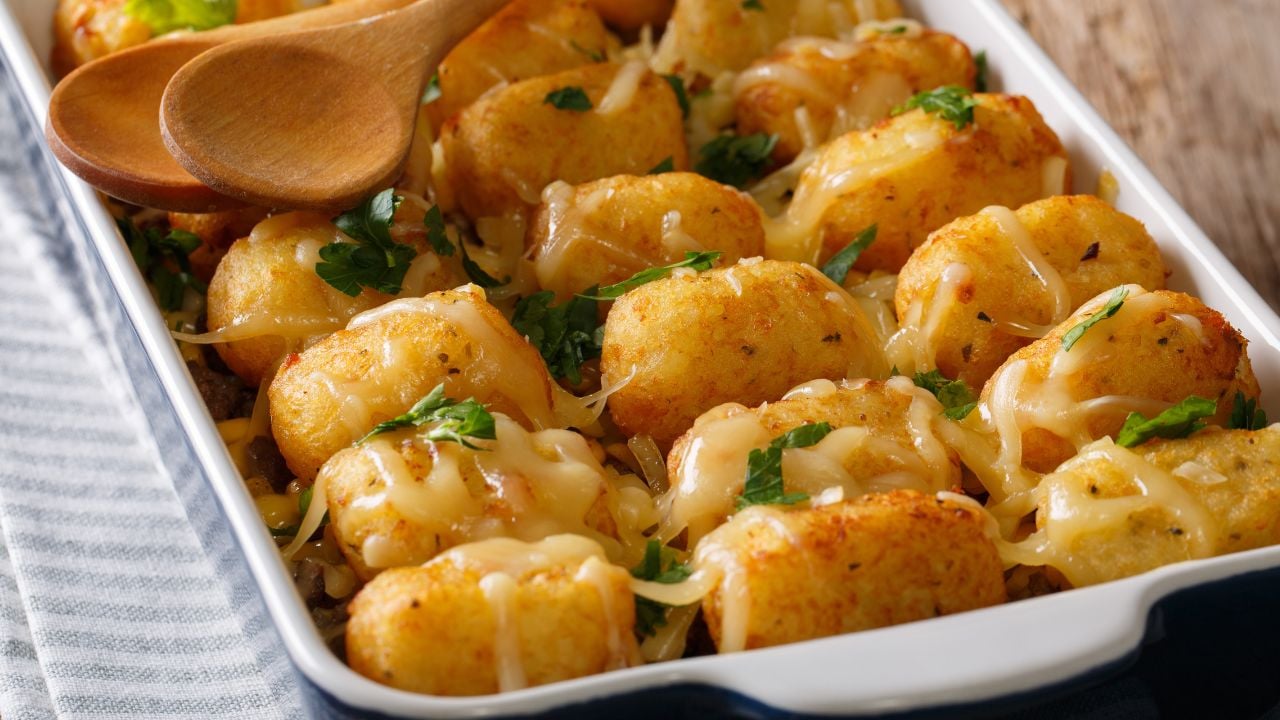
Many home cooks build it as Tater Tot Hotdish: Ground beef, a can of cream soup, and a layer of tots baked golden on top.
Someone who didn’t grow up on it usually asks the same question first.
Why does a five-ingredient dinner get a name at all?
Nobody budges on the point.
What Makes a Hotdish a Hotdish
Hotdish isn’t simply North Dakota’s word for casserole. It follows a set formula.
The formula runs on four parts: A starch on the bottom, a cooked protein, and a canned or cream-based binder holding it together.
A crunchy topping goes on top, baked until it browns.
A hotdish never needs tots to earn the name, only the formula.
2. Kuchen
Kuchen is North Dakota’s German-Russian answer to dessert.
It refuses to be just a cake, a pie, or a custard.
A cookie-like crust holds a sweetened custard filling, and fruit, often apple, sits baked into the top of it.
Ask three locals what it is.
Expect three different answers.
Someone expecting a plain fruit pie gets custard instead.
Someone expecting custard gets a crust sturdy enough to hold up a slice of cake.
USA Today ran a 2018 Readers’ Choice Best Kuchen award for North Dakota, with ten bakeries and cafes competing statewide, and gave the win to Karen’s Kuchens in Larimore.
A whole category, just for kuchen.
North Dakota State University’s extension guide calls it a popular dessert among the state’s German-Russian families.
It still shows up at potlucks, with the fruit on top changing by household and by season.
3. Knoephla Soup
Knoephla soup is a dumpling soup, and the name alone confuses many people who didn’t grow up eating it.
Potato, onion, celery, and carrot simmer together in chicken broth and whole milk.
Small hand-rolled dumplings made from flour, dill, parsley, and egg go in near the end.
The word comes from the German for little button, a nod to the shape those dumplings take once they hit the pot.
Kroll’s Diner in Fargo calls its version the hands-down favorite on the menu, moving roughly 245 gallons of it a month once winter sets in.
Not pretty.
Regulars call it the lumpy yellow soup.
Locals order it without a second thought.
4. Cheese Buttons
Cheese buttons are dumplings with a confusing name that promises nothing about what’s inside.
A simple dough of flour, eggs, and water wraps around a filling of dry cottage cheese.
Cooks boil the dumplings until they float, then top them with melted butter, onions, or sour cream.
No buttons involved.
The state’s tourism guide lists cheese buttons on the menu at the White Maid Restaurant in Napoleon.
Bismarck’s LaVonne’s Cheese Button Factory Plus has sold cheese buttons wholesale to stores across the Bismarck-Mandan area since opening in 2015.
The business is registered with the state’s Pride of Dakota program for North Dakota-made food.
A factory built on nothing but cheese buttons.
The German name is kase knoephla, close enough to knoephla soup’s name that even some locals mix the two dishes up at first mention.
One is a soup.
The other is a side dish that has never once contained a button.
Psst! How much do you know about North Dakota’s food festivals and history? Take our quiz and see how many you can get right.
Quiz
North Dakota Food Trivia
Answer these questions on North Dakota’s food festivals and history. We bet you can’t get them all right. Prove us wrong?
Cream of Wheat, the hot breakfast cereal, was first made in 1893 at a mill in which North Dakota city?
5. Fleischkuechle
Fleischkuechle is a fried, meat-stuffed pastry North Dakota's German-Russian settlers brought by way of Ukraine, and even locals warn newcomers about the name before the food.
Cooks mix ground beef or pork with onion, garlic, and spices, wrap it in a thin dough, then deep-fry it until the outside turns golden and crisp.
Nobody spells it right the first time.
Cloverdale Foods sold around 150,000 Golden Fleischkuechle a year for nearly two decades at a small plant in Stanton, North Dakota, before that plant closed.
Golden Plains Frozen Foods in Leeds took over production and now ships fresh batches from the new facility.
Demand at events like the North Dakota State Fair regularly clears the shelves by the caseload.
Gone fast.
Small-town diners still list fleischkuechle on the menu without translating it for anyone.
6. Sauerkraut
Sauerkraut in North Dakota isn't a hot dog topping.
The town of Wishek builds an entire day around proving it.
German-Russian immigrants started Sauerkraut Day in 1925 to honor where they came from.
Wishek's Association of Commerce still schedules it on the second weekend of every October.
The 100th celebration in 2025 went through 260 gallons of sauerkraut, 1,100 pounds of hot dogs, and 500 pounds of bacon in a single free meal.
Not a garnish.
Someone new to town expects a spoonful on the side.
Wishek hands them a plate where the sauerkraut outweighs the hot dogs and bacon combined.
7. Lefse
Lefse shows up on nearly every fall table.
Newcomers take one look at its round shape and expect a savory food instead of dessert.
Cooks mix riced potatoes into a soft dough, roll it paper-thin, and cook it on a dry griddle.
The finished round looks close enough to a flour tortilla to fool a first-timer.
That resemblance is exactly what trips people up.
Sweet, not savory.
Many families roll it with butter, sugar, and cinnamon and eat it as a treat, not a wrap for anything savory.
Prairie Kitchen in Fargo still serves it that way, with smoked butter, cheese, and jam on the side.
Some cooks still turn it on a grooved lefse stick that belonged to their grandmother, the same tool and the same recipe passed down without measurements written anywhere.
A stack of it disappears at a fall supper long before anyone gets around to cutting the pie.
Where the Recipes Came From
North Dakota's German-Russian families behind these foods didn't arrive directly from Germany.
Their ancestors had farmed in Russia and Ukraine for generations under a promise of land and freedom from military service, a promise Czar Alexander II revoked in the 1870s.
Forced conscription pushed many of those families toward the Dakota Territory instead, chasing homestead land along the new Northern Pacific Railway.
That wave of settlement wasn't spread evenly across the state.
A University of Wisconsin field study on the migration tracked that share as it grew, from 40.6% of Stark County's population in 1910 to 46.6% by 1920.
German-Hungarian families were the county's next-largest group at the same time, making up more than a quarter of the population.
That concentration kept their kitchens intact for generations.
Norwegian homesteaders were filling in the northern counties around the same years, on the same railway land rush.
Neither group left much of a written recipe behind.
No cookbooks.
Karen's Kuchens in Larimore still bakes kuchen from a recipe carried over from the Black Sea area of Russia in the early 1900s.
Nothing about it was ever written down.
