
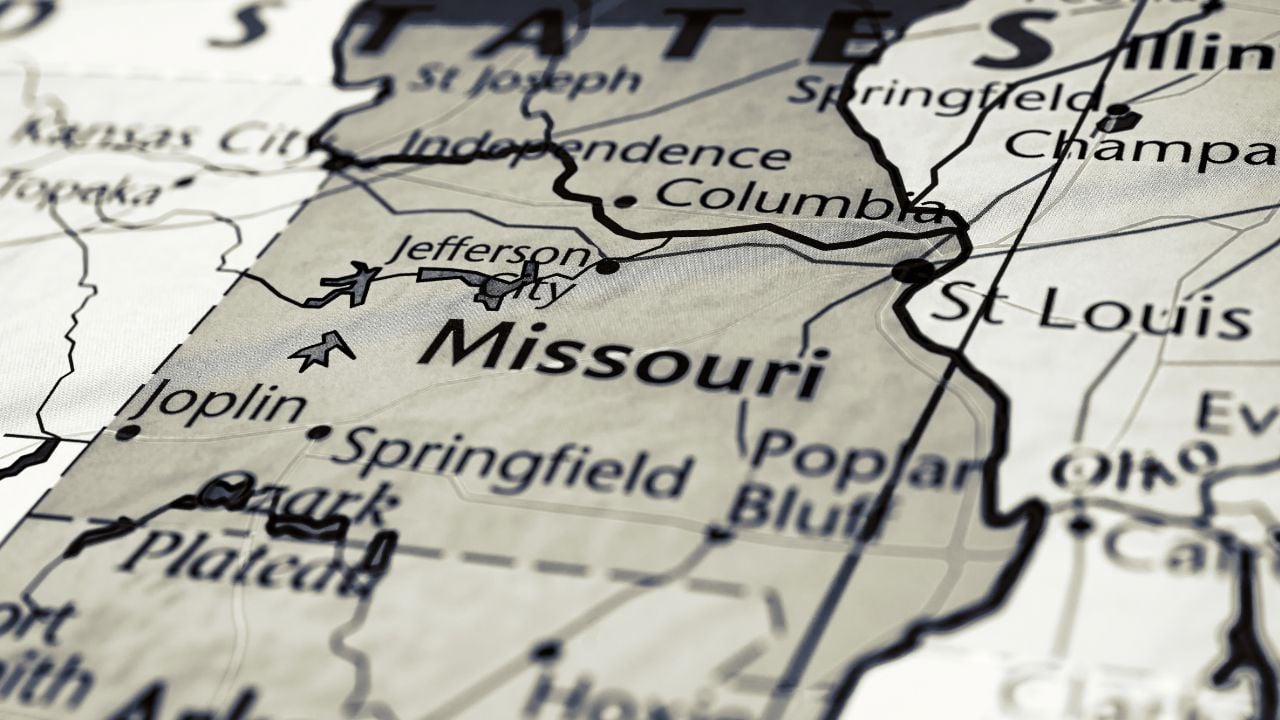
9 Things Out-of-Staters Get Totally Wrong About Missouri

A trivia app flashes “Name Missouri’s capital,” and the easy guess for out-of-staters is St. Louis.
That guess is wrong.
These are the things out-of-staters get wrong about Missouri.
1. Kansas City’s Missouri Address
Kansas City carries the name of a different state, and that alone convinces many out-of-staters it must sit inside Kansas.
It doesn’t.
Kansas City, Missouri had about 521,000 residents in 2025, next to roughly 158,000 people across the state line in Kansas City, Kansas.
State Line Road splits the metro down the middle.
Much of the skyline, the stadiums, and the barbecue joints out-of-staters picture sit on the Missouri side of it.
A visitor can fly into Kansas City International Airport, rent a car, and never once cross into the state the city’s name points to.
2. America’s First Wine Country
Ask an out-of-stater what the state grows, and corn, soybeans, and cattle come up long before wine does.
Missouri ranked as the country’s second-largest wine-producing state before Prohibition, trailing only California.
The federal government named Augusta, Missouri the nation’s first American Viticultural Area (AVA) on June 20, 1980.
Napa Valley’s AVA followed about seven months later, on January 28, 1981.
German immigrant families planted the hillsides around Augusta in the 1840s, decades before that federal designation made it official.
More than 120 wineries operate across the state today, many of them within a short drive of those original hillsides.
Missouri’s Role in Saving French Wine
Missouri wine did more than predate Napa’s paperwork.
A root louse called phylloxera wiped out vineyards across France during the 1870s.
Missouri’s state entomologist discovered that native Missouri grapevines carried natural resistance to it.
Growers shipped millions of the resistant rootstocks across the Atlantic, and grafting French vines onto them helped save the French wine industry from collapse.
3. State Capital
The state’s capital isn’t St. Louis or Kansas City, even though out-of-staters usually guess one of the two.
Both guesses are wrong.
The state legislature settled on Jefferson City in 1821, a river town built to hold the government rather than a business district or a port.
The city still runs small, with about 42,000 residents as of 2025.
Every state budget and every governor’s signature still moves through a capitol smaller than either of the state’s big two.
4. Biggest City
The state’s biggest city isn’t the one with the fame: Out-of-staters see the Gateway Arch, the Cardinals, and Anheuser-Busch’s brewery downtown in St. Louis and assume it has to be the largest city in the state.
Kansas City carries more people.
Kansas City’s population sat at about 521,000 in 2025, next to about 278,000 in St. Louis, according to the Census Bureau.
The gap runs the other way in visibility.
St. Louis draws the tourists, the postcards, and the Arch selfies, while Kansas City holds the state’s largest population.
St. Louis wins the argument tourists care about, and Kansas City wins the argument the Census Bureau keeps score on.
5. Ozark Highlands
Many people wrongly file Missouri under flat Midwest farmland, the same mental shelf as Kansas and Nebraska.
That assumption doesn’t hold here.
The Ozark Plateau rises to 1,772 feet at Taum Sauk Mountain, Missouri’s highest point, with ridgelines, spring-fed rivers, and waterfalls tucked into the hollows.
The ground underneath holds more surprises.
Missouri has documented more than 7,500 caves, second only to Tennessee, enough that conservation officials call Missouri the Cave State right alongside the Show-Me State.
Psst! How Missouri are you? Run through this checklist and see where you land.
6. Earthquake Country
Tornado sirens are the sound out-of-staters expect from the weather, not the ground itself moving.
The state’s southeast corner sits on the New Madrid Seismic Zone.
Three magnitude 7-plus earthquakes shook the region in the winter of 1811 and 1812.
The U.S. Geological Survey (USGS) documents only five earthquakes that size east of the Rocky Mountains in the historical record.
Nothing since has matched them.
USGS research shows the same fault zone has produced repeated sequences of magnitude 7 to 8 earthquakes over the past 4,500 years.
The ground under southeast Missouri isn’t finished.
7. A Union State Fought Over
Many out-of-staters mistake the state for a Confederate one, between the Jesse James lore, the Southern-sounding name, and years of fighting inside its borders.
It didn’t secede.
Missouri’s elected convention rejected secession by a 98-1 vote in early 1861 and stayed inside the Union for the rest of the Civil War.
A rival, self-declared Confederate government still claimed the state from exile, which is why a Missouri star ended up on the Confederate flag anyway.
Both sides fought for control of the state’s towns and rivers for four more years.
8. Two Ways to Say It
Out-of-staters who assume there’s one correct way to say Missouri’s name are wrong before they finish the sentence.
“Missour-ee” and “Missour-uh” have both been in common use for more than a century.
A 2023 Saint Louis University/YouGov poll found just 15% of northwest Missouri residents use the “Missour-uh” pronunciation, compared with 6% in St. Louis, a modest regional lean.
“Missour-ee” still wins in both regions, and everywhere else in the state.
Politicians choose their pronunciation carefully.
Former Missouri Governor Jay Nixon used both pronunciations in his inaugural speech, National Public Radio reported, seemingly to avoid taking sides.
9. Nation’s Lead Source
Out-of-staters picture the state’s economy as farmland and factories, with mining rarely entering the frame.
That’s a blind spot.
Missouri mined about 117,000 metric tons of lead in 2019 alone, and the U.S. Geological Survey still lists Missouri as the country’s top producer of the metal.
No postcard mentions it.
The mining happens away from the interstate corridors tourists usually drive, in the same Ozark hill country that out-of-staters already picture as nothing but empty woods.
9 Habits That Give Away Someone Who Grew Up in Missouri

A new hire mentions she grew up outside St. Louis, and before anyone learns her last name, someone asks where she went to high school.
She’s answered that one a hundred times before.
