
9 Things That Change When Nebraskans Cross Into Iowa

A Nebraska driver cruising Interstate 80 at 75 mph loses five of those miles per hour the instant the highway crosses into Iowa.
That’s just the start of it.
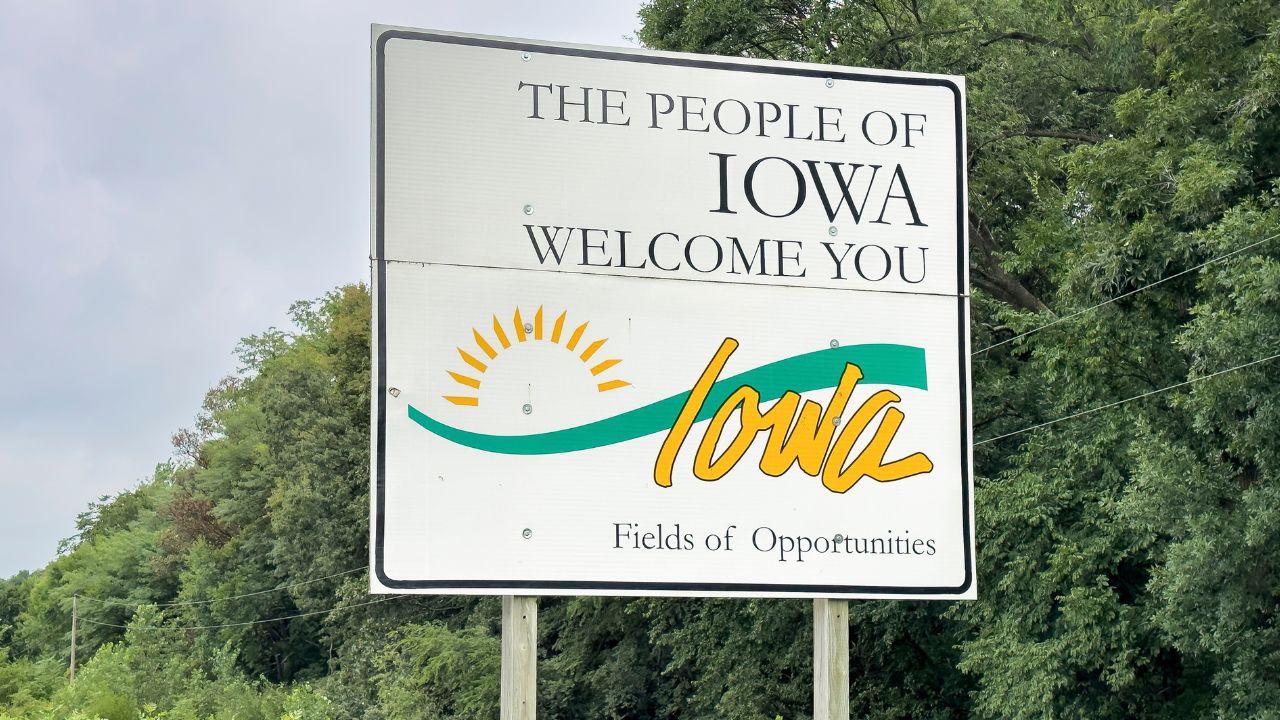
These are the things that change when Nebraskans cross into Iowa.
Note: This is general information, not legal or tax advice. Nebraska and Iowa’s laws, tax rates, and rules are subject to change.
1. Slower Speed Limit
Nebraska lets drivers run 75 mph on its rural interstates until they cross the state line.
That number drops the moment Interstate 80 or Interstate 29 crosses into Iowa.
Five mph.
Iowa’s rural interstate limit tops out at 70 mph, a cap Iowa’s transportation department has held since 2005.
A cruise-control habit set for miles behind the wheel can turn into a ticket within minutes of crossing, for anyone who misses the new speed limit signs.
2. Cheaper Gas Tax
At 31.8 cents a gallon, Nebraska’s state motor fuel tax runs through the end of 2026.
Iowa’s rate sits at a flat 30 cents a gallon for regular gasoline.
Under two cents.
That gap turns into a cheaper fill-up the moment a driver’s tank runs dry on Iowa asphalt.
3. Stricter Seat Belt Rules
A missing seat belt in Nebraska counts only as a secondary offense.
An officer there can only write the ticket if the driver already faces some other charge.
Iowa doesn’t work that way.
Front-seat riders there fall under a primary enforcement law, so an Iowa officer can stop and cite a driver for an unbuckled belt alone.
No other violation needed.
4. Vanishing Helmet Law
A helmet is still required in Nebraska for any motorcyclist under 21.
Older riders need one too, unless they’ve completed an approved safety course and wear eye protection, a rule that took hold in 2024.
Cross into Iowa, and the requirement disappears completely.
Iowa is one of only three states with no helmet law at all, for any rider, at any age.
5. Steep Pay Cut
Nebraska’s minimum wage rose to $15 an hour on January 1, 2026, with small annual bumps built in after that.
Iowa skipped that raise.
Its wage floor still sits at the federal minimum of $7.25 an hour, and state law won’t let an Iowa city or county set a higher wage.
A job posting that reads like a raise on the Nebraska side of a help-wanted board can read like a pay cut a few miles into Iowa.
6. License Plate County Codes
Ninety of Nebraska’s 93 counties stamp a county number before the letters on every plate they issue.
Douglas County’s number is 1, Lancaster’s is 2, and so on down the list, a system the state has run since the 1920s.
Only the three biggest counties, Douglas, Lancaster and Sarpy, dropped the number for letters-only plates back in 2002.
Everywhere else, the number stays.
Iowa skips the numbers, no matter the county.
Iowa state law requires every plate to spell the county’s name out in full instead.
A dashboard full of Nebraska’s coded plates gives way to Iowa’s plain-spoken ones within the length of a bridge.
Psst! How much do you know about Nebraska and Iowa beyond the interstate signs? Take our quiz and see how many you can get right.
Quiz
Nebraska vs. Iowa Trivia
Answer these questions on Nebraska and Iowa history and geography. We bet you can’t get them all right. Prove us wrong?
An Iowa city named Carter Lake sits on which side of the Missouri River, thanks to a flood that shifted the channel in the 1800s?
7. Mobile Sports Betting
In Nebraska, sports betting only happens in person, at a handful of licensed racetrack casinos, with no mobile app option this year.
Iowa settled that already.
Iowa has allowed mobile sports wagering statewide since 2019, so a phone that's useless for a bet in Omaha suddenly works the moment its owner parks in Council Bluffs.
Nebraska voters may close that gap with a ballot measure this November, but for now the app stays dark until the state line.
8. Flatter Income Tax
Nebraska taxes income on a graduated scale that runs from 2.46% up to 4.55%.
Iowa scrapped that structure.
Every taxpayer there now pays a single flat 3.8% rate, whether the paycheck is modest or enormous.
Two very different tax forms wait on opposite sides of the same river.
The Bracket Math Behind Nebraska's "Graduated"
Nebraska's income tax uses a graduated bracket system, and that trips up many people who assume the top rate applies to their whole paycheck.
It doesn't work that way.
Nebraska taxes a worker's first slice of income at 2.46%, and only the amount above the top bracket's threshold faces the 4.55% rate.
Iowa skips that math, since every taxable dollar there gets the same flat 3.8% no matter how large the paycheck grows.
9. Football Allegiance Flip
Cornhusker country stretches from one end of Nebraska to the other, red gear and Husker flags included.
Iowa splits its loyalty between the Hawkeyes and the Cyclones, and neither team wears Husker red.
The two programs used to meet only when the schedule lined up.
Not anymore.
The border rivals have played every Black Friday since Nebraska joined the Big Ten in 2011, with the winner taking home the Heroes Trophy.
Nebraska still leads the all-time series 30-22-3.
Iowa has won the Big Ten-era matchups 10-4, taking the more recent bragging rights.
Nearly Identical Sales Tax
Nebraska charges a 5.5% state sales tax, while Iowa charges a 6% state sales tax.
Half a point.
Add in local option taxes, and the average gap nearly closes: Nebraska's combined state-and-local rate averages 6.98%, and Iowa's averages 6.94%.
Nebraska exempts groceries bought for home cooking from sales tax, and Iowa does the same.
A cart in Omaha and a cart in Council Bluffs starts out taxed identically.
Where the two states split is how far individual cities can push it.
Nebraska cities and counties have pushed local option rates as high as 2% on top of the state rate, reaching a combined 7.5% in some places.
Iowa's local option holds to a flat 1% almost everywhere, so combined rates there typically land around 7%.
