
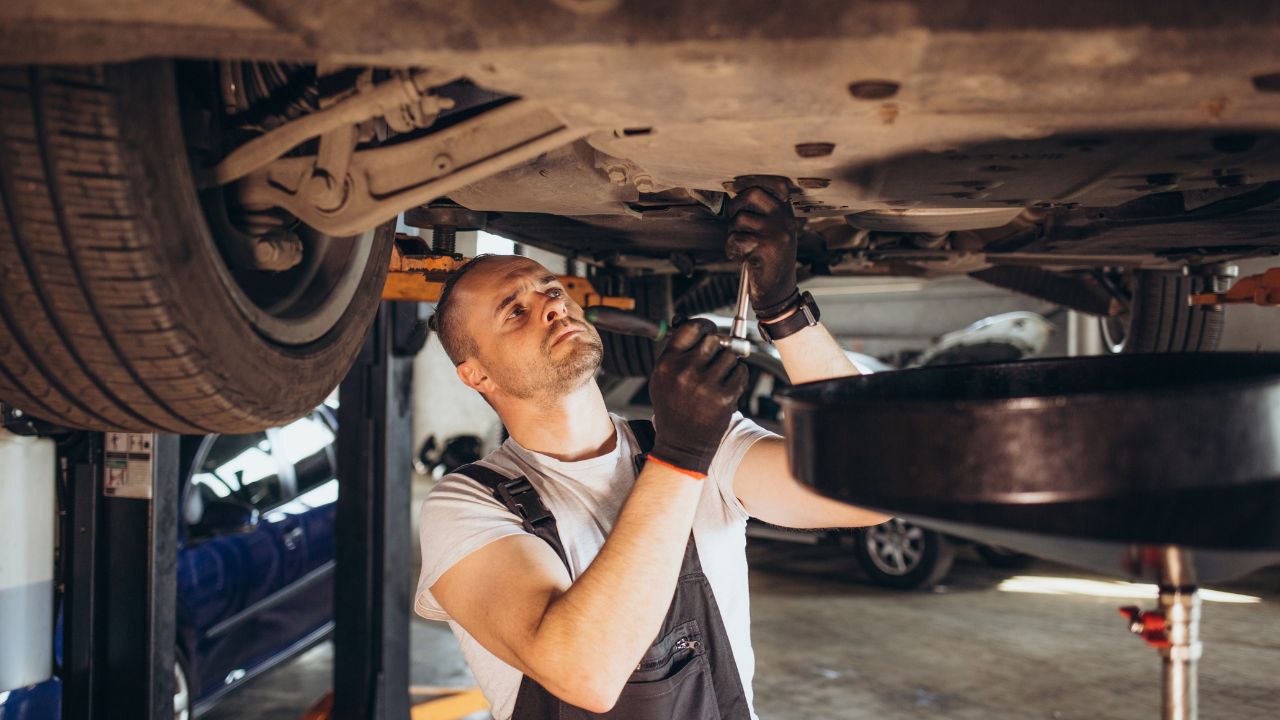
15 Things a Virginia Safety Inspection Checks Before Your Car Passes

Your inspection sticker can sit expired for months before a Virginia officer is allowed to pull you over for it.
Grace period or not, your car still has to pass once it’s sitting in the inspection bay.
These are the things a Virginia safety inspection checks before your car passes.
Note: This is general information, not legal advice. Inspection standards and requirements are subject to change, so confirm the current requirements with the Virginia State Police Safety Division.
1. Brakes
An inspector drives the car before touching a single bolt, feeling how the pedal responds and watching exactly how the car stops.
The pedal proves itself first.
Inspectors check the lines too, since a leak or a weak line can undo brakes that otherwise feel fine.
A State Police count of Virginia’s roughly 8.2 million inspected vehicles in 2018 turned up brake problems in almost 725,000 of them.
2. Parking Brake
The parking brake gets graded on its own during an inspection, separate from the pedal.
An inspector sets it and confirms it holds the car without slipping.
No slipping allowed.
A parking brake that needs three clicks to catch, or doesn’t catch at all, fails on its own even when the regular brakes are fine.
3. Steering and Suspension
Loose steering or a bouncy ride draws scrutiny in an inspection, apart from the brake check.
The wheel shouldn’t wander.
Inspectors look for play in the steering wheel, worn ball joints, sagging springs, and shocks that no longer control the car’s bounce.
State Police’s count of Virginia’s 2018 inspections found steering and suspension problems were the most common defect type that year, with emissions and exhaust systems close behind.
4. Tires and Lug Nuts
A tread gauge settles the question on the tire check, not a guess.
Tread worn down past 2/32 inch fails, and so does a tire with a bulge, a cut deep enough to show cord, or a sidewall that’s separating.
Inspectors check the wheels too.
A rim that’s bent or cracked fails, and so do lug nuts that are loose, stripped, or missing.
5. Headlights
Both headlight settings, low beam and high, get tested in an inspection.
A dead bulb fails.
So does a light aimed too far off.
A badly aimed headlight either blinds oncoming drivers or leaves the road ahead dark, and the inspection treats proper aim as part of the same check.
6. Turn Signals and Brake Lights
Turn signals, brake lights, hazards, and the license plate light all answer to the same line on a Virginia inspection.
One burned-out bulb is enough.
The inspection treats that whole set as one category, separate from the headlight check.
7. Windshield
Glass counts as a safety part on the inspection, not just something to see through.
Sight lines matter.
A pit, chip, or star crack bigger than 1.5 inches across fails if it sits above the bottom three inches of the glass, the stretch directly in the driver’s line of sight.
A sticker or tint strip placed wrong on the glass fails the same way.
8. Wipers and the Defroster
The wipers and the defroster ride along with the windshield check on the inspection.
A torn or split wiper blade that smears instead of clears fails.
Fogged glass fails too.
A defroster that doesn’t clear the glass fails right along with it, and neither one gets a pass just because the rest of the car looks fine.
9. Mirrors
Every mirror the car came with has to give a clear view to pass inspection.
Cracked doesn’t make the cut.
Neither does one that’s missing, loose in its mount, or clouded enough that it no longer shows the lane beside the car.
10. Horn
How far the horn carries matters more than whether it makes noise on the inspection.
Loud isn’t always far.
It has to be audible from at least 200 feet and firmly mounted to the car, not dangling on its wiring.
A weak honk that only carries a few car lengths fails the same as no horn at all.
11. Seat Belts
Inspectors check every seat belt the car was built with, seat by seat.
Every seat counts.
A belt that’s cut or frayed fails, and so does a buckle that won’t latch or an anchor that’s loose or missing.
A seat with no belt at all where one is required fails outright.
12. Airbag System
The same regulation that governs seat belts also covers airbags on a Virginia inspection.
The light isn’t the test.
Under that rule, the dashboard’s airbag readiness light is advisory only, not a reason to fail the car even if it stays lit.
What fails the car is different: A visibly defective air bag system, a deployed air bag that’s never been replaced, or any air bag part that’s been removed or disabled.
13. Exhaust System
The inspection traces the exhaust system from the engine all the way to the tailpipe.
Leaks don’t get a pass.
A leak that lets fumes into the cabin fails.
A muffler hanging loose, held up by wire instead of its mounts, fails the same way.
14. Doors
Even the doors get a line on the inspection.
One bump tells the truth.
Every door next to the front seats has to open from both inside and outside and latch properly once it’s shut.
A door that pops open over a bump, or one that needs a slam and a prayer to stay closed, fails.
15. Hood Latch and Battery
The inspection ends under the hood, checking two things many drivers never think about.
Nothing gets to rattle loose.
The hood latch has to hold the hood fully shut, since a broken or missing latch release fails on its own.
The battery has to be securely mounted too, with its bracket and hardware in place instead of sliding loose against the fender.
Psst! How much do you know about Virginia car inspections? Flip through these and see how many you get right.
What Won’t Fail Your Car
The state’s inspection manual leaves a lot off the list, and that surprises many drivers.
A glowing check engine light doesn’t touch the safety inspection at all, since the manual never opens the car’s onboard computer.
It’s advisory, nothing more.
A dented bumper, a faded paint job, or a patch of surface rust don’t touch it either, since every item on the checklist is mechanical, never cosmetic.
Rejection Sticker’s 15 Days
An inspection that goes badly still ends with paperwork, not a tow.
A car that fails gets a rejection sticker good for 15 days, plus the day of the inspection itself, to get the problem fixed and come back.
Fifteen days, no more.
Anyone who misses that window ends up with a fully expired sticker on the windshield.
Even then, Virginia law blocks an officer from stopping a car over an expired sticker alone until the fourth month after it expired.
What Virginia’s Grace Window Doesn’t Cover
Virginia’s four-month window only protects a driver from being pulled over for the sticker.
It doesn’t make a genuine defect legal.
A car stopped for a broken taillight or bad brakes is still breaking the law over the equipment itself, sticker grace period or not.
Which Vehicles Skip Inspection
Not every vehicle goes through this checklist every year.
A car 25 years old or older can register on antique plates and skip the annual inspection.
Exceptions stay narrow.
Virginia only allows an antique-plated car out for club events, exhibitions, parades, and occasional pleasure drives that don’t run past 250 miles.
Mopeds and low-speed vehicles skip the checklist too, since Virginia doesn’t require either one to carry an inspection sticker at all.
New Cars in Transit
State law even lets a new car skip inspection while it’s fresh off a dealer’s truck.
First owner, first sticker.
State law waives the inspection for a new car traveling from the manufacturer straight to a dealer’s lot, and for one moving between two lots the same dealer runs.
Virginia also exempts a new car a dealer’s technician already inspected the way the manufacturer requires, using an employee who normally handles that work for the dealership.
A manufacturer can also put a brand-new car on Virginia’s roads under manufacturer test plates before that car ever reaches a dealer, a separate exemption from the delivery route.
The same law clears a new vehicle to drive straight to a shop that installs its permanent body, a step some trucks and specialty vehicles still need before they’re finished.
8 Virginia Traffic Laws That Are Harsher Than Out-of-State Drivers Expect

A busted taillight and a rolling stop sound like nothing until the word “misdemeanor” shows up on the paperwork.
Several of Virginia’s traffic rules carry heavier penalties than many out-of-state drivers expect, and one wrong move at a routine stop can turn into exactly that.
8 Virginia Traffic Laws That Are Harsher Than Out-of-State Drivers Expect
8 Fence and Property Line Rules Virginia Neighbors Commonly Misunderstand

Many Virginia homeowners never open the state’s property code until a new fence sparks an argument with the neighbors.
By the time it reaches that point, the deadline that would have settled things peacefully has usually already passed.
8 Fence and Property Line Rules Virginia Neighbors Commonly Misunderstand
