
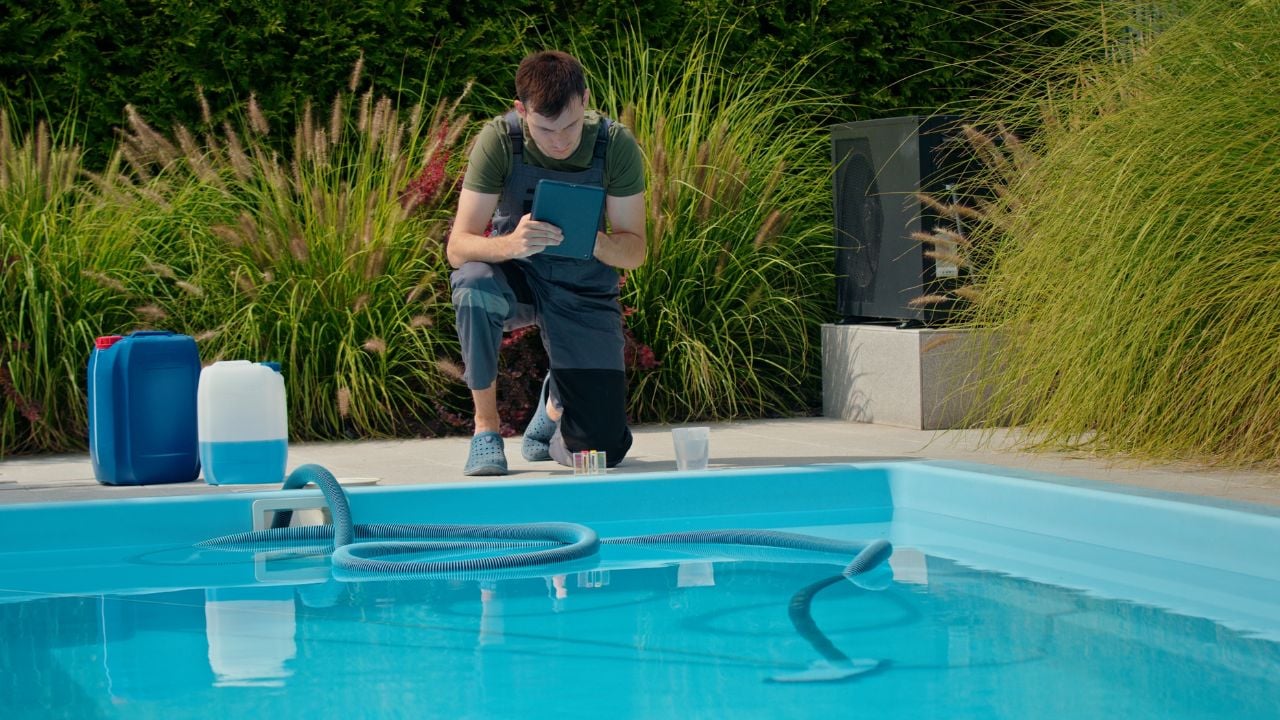
9 Things Arizona Pool Techs Know About a Homeowner in Five Minutes

Pool techs don’t need long to size up a yard.
A quick look at your tile line and gate can say a lot about how you care for your place.
These are the things Arizona pool techs know about a homeowner in five minutes.
1. Scale on the Tile Line
A pool tech’s eyes go to the tile line before anything else.
Phoenix’s Water Services Department has measured tap water hardness as high as 17.6 grains per gallon in its water quality reports, hard enough to leave calcium behind on nearly everything the water touches.
A faint gray haze on the tile says somebody brushes the waterline every week or two.
A thick, crusted ring that’s crept an inch up the grout means years without an acid wash, no matter how recently the current owner signed the deed.
That ring took years.
2. Self-Latching Gate
A pool tech checks the gate next, and that’s not just manners.
Arizona law requires a pool to be enclosed by at least a five-foot barrier with a self-closing, self-latching gate.
The latch has to sit at least 54 inches up.
A gate propped open with a pool noodle is one tell.
A latch worn loose enough to swing free on its own is a second, and both point to the barrier having become a formality nobody enforces anymore.
Not a great sign.
A gate that snaps shut and clicks on the first try tells a different story.
That kind of gate usually belongs to a house with young kids in it, or one that just passed a home inspection.
3. Skimmer Basket
The skimmer basket is where a pool tech reads how long it’s been since anyone paid attention.
Arizona’s monsoon season, officially June 15 through September 30 each year, can dump mesquite pods, dust, and storm debris into an open pool in a single afternoon.
A basket packed solid after one storm says nobody’s run the pump or skimmed since it blew through.
That adds up fast.
Someone who runs the pump daily keeps that basket mostly clear, even the week after a storm, without waiting for a tech to remind them.
4. Scale Inside the Salt Cell
Popping open the salt cell takes about five minutes for a pool tech, and it tells them plenty.
Hard water cakes calcium onto a salt cell’s plates the same way it cakes the tile line.
Hayward’s maintenance guide warns that a caked cell can stop chlorinating well before it looks obviously dirty.
A cell scraped clean on a regular basis means somebody’s paying for a service plan, or doing the acid dip themselves.
A cell buried in white crust tells you neither one happened.
That crust doesn’t happen overnight.
5. Topping off the Water
A pool loses water fast once evaporation sets in, and that’s the bill homeowners underestimate.
Phoenix’s high reaches 100 degrees or hotter on 111 days a year.
An uncovered pool can lose a noticeable amount of water on any one of them, and the loss only speeds up on a dry, windy afternoon.
A pool tech looks for how that water gets replaced.
An autofill valve wired into the plumbing means someone paid extra upfront to never think about it again.
A garden hose coiled by the equipment pad, with a worn track through the gravel to the water’s edge, shows somebody’s out there dragging it themselves.
That’s a very different owner.
Psst! How much do you know about Arizona’s relationship with water? Take our quiz and see how many you can get right.
Quiz
Arizona Water IQ
Answer these questions on Arizona’s desert water history. We bet you can’t get them all right. Prove us wrong?
Which Arizona city is home to the original London Bridge, moved there from England?
6. Solar Panels on the Roof
Solar heating panels on the roof above an Arizona pool are common enough that state law has an answer for who's allowed to touch them.
The Arizona Registrar of Contractors requires anyone installing or repairing solar pool heating to hold a license classification built for it, not just an ordinary pool license.
That's B-6 for a residential contractor and A-19 for a commercial one.
Panels gone brittle and cracked, with the hose disconnected and coiled off to the side, are easy to spot.
They point to an owner who gave up on stretching the swim season into the cooler months.
Panels still plumbed in and clamped down tight usually belong to a pool people still use well past the Fourth of July.
Not every pool gets that.
7. Cracks in the Deck
Deck cracks tell a pool tech something different from what many homeowners assume.
Arizona's clay-heavy soil expands and contracts hard enough to crack concrete pool decks and driveways alike, according to the home-improvement authority Rosie on the House.
That cracking typically shows up as a horizontal fracture with little vertical displacement.
That kind of crack can show up under a deck of any age.
Not proof of anything.
What tells a pool tech about the current owner is what happened after the crack showed up.
A crack that's been caulked, epoxied, or at least swept clean points to somebody who noticed and dealt with it.
A crack packed with dirt and sprouting a weed says nobody's looked twice in years.
8. Stabilizer Reading
A pool tech can take a stabilizer reading with a five-minute test kit, and it points to something many owners never stop to think about.
Cyanuric acid keeps the desert sun from burning off chlorine within hours.
But cyanuric acid doesn't leave pool water through evaporation the way calcium and salt do, according to water treatment specialists at Orenda Technologies.
Draining part of the water and refilling is the standard way to bring a high reading back down.
A pool topped off with a hose for years, with no water ever drained out on purpose, can carry a sky-high reading nobody meant to create.
That's the accidental kind.
A reading that stays in range usually belongs to an owner who dilutes on a schedule.
A partial drain every spring, or a service company doing it during a routine visit, is what keeps the number down.
Why an Untouched Pool Still Needs Draining
An Arizona pool's cyanuric acid and calcium levels tend to rise together for the same reason.
Evaporation removes only water, and everything dissolved in that water stays behind and gets more concentrated every time someone tops the pool back off.
Draining part of the water and refilling with fresh water is the standard, practical way to bring either reading back down.
That's why a pool tech who finds both readings high usually asks how long it's been since the last drain, not what the owner did wrong.
9. Pump on the Pad
A pool tech treats the pump on the equipment pad as the last stop, and it can date the whole system in about ten seconds.
A 2023 Department of Energy rule set efficiency standards for dedicated-purpose pool pump motors that basic single-speed models can't meet, laid out in the Federal Register.
Many motor sizes had to comply by September 29, 2025, and the remaining mid-size class has until September 28, 2027.
Those deadlines still matter.
A single-speed pump still humming away on the pad is the tell for equipment nobody's touched since before those standards took hold, whether that's five years back or fifteen.
A newer, quieter variable-speed model bolted down next to it tells a different story just as often.
The old one finally gave out in the heat, not that anybody went looking to upgrade early.
9 Texting Habits Arizonans Judge Each Other for in Private

Texting swapped one kind of awkward for another, and Arizonans have picked their least favorite habits.
Nobody says any of it out loud, but almost everyone keeps a running list in their head.
9 Texting Habits Arizonans Judge Each Other for in Private
10 Popular Devices That Lock Arizona Buyers Into Monthly Fees
A gadget's price tag on the shelf is rarely the whole story once a monthly fee kicks in.
These are the popular devices that keep charging Arizona buyers long after the checkout screen.
10 Popular Devices That Lock Arizona Buyers Into Monthly Fees
