
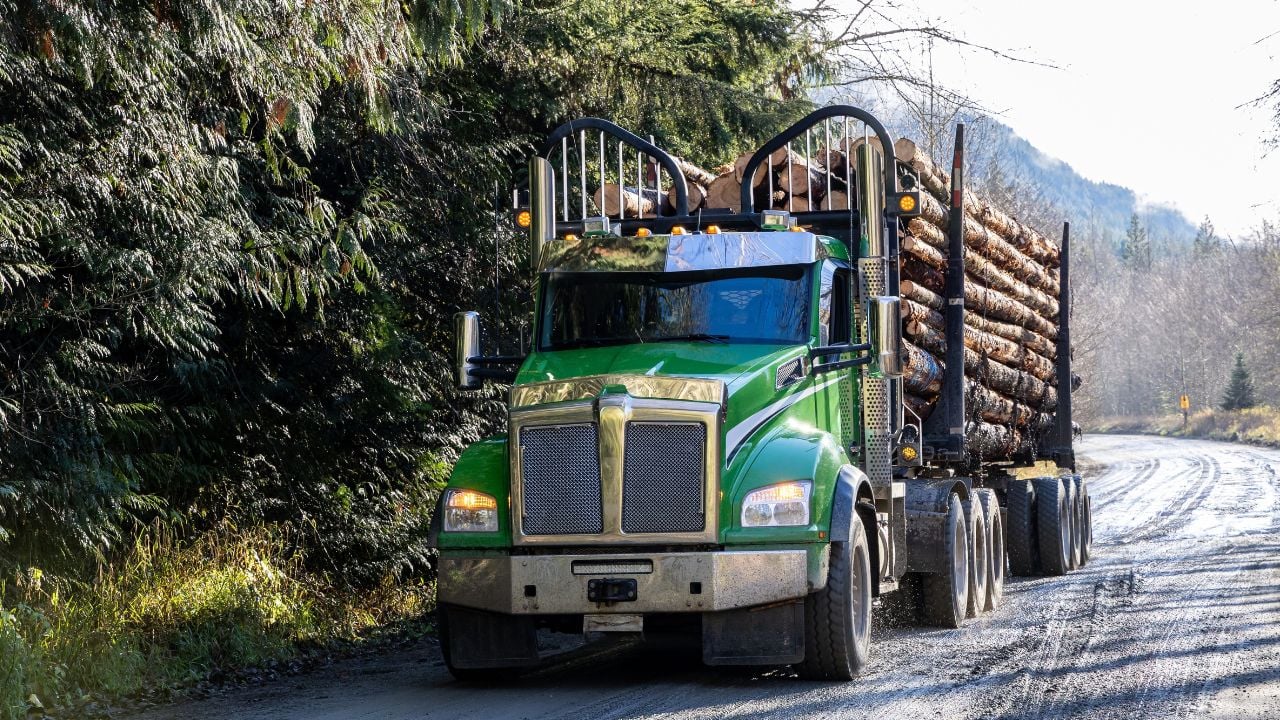
6 Things Montana Loggers Do Before the First Big Snow

The leaves are still turning in Montana, but logging crews are already looking ahead to snow.
Here’s how crews get a head start.
1. Chains Go on the Trucks
Logging crews spend part of every fall making sure the trucks are legal before a single flake falls.
Montana’s chain rule applies to any towing unit rated at 26,001 pounds or more, and it runs from October 1 through April 30 in areas the state marks as chain-required.
A loaded log truck clears that weight easily.
Drivers check the chains, the mounts, and the spare set weeks before a storm because getting caught without them on a mountain grade is a fine crews would rather skip.
That fine adds up fast.
2. Diesel Gets a Winter Blend
Loggers treat cold-weather fuel as a fall job, not a winter scramble.
Diesel can gel into a waxy sludge once the temperature drops, and the Montana Logging Association says the cold is hard on engines, fluids, and electronics alike.
Crews switch to a winter-blend fuel or add an anti-gel treatment before the cold sets in.
Fuel lines freeze fast.
Crews mount block heaters on skidders and loaders too, so a machine left out overnight still turns over the next cold morning.
3. Steep Ground Gets Finished First
Loggers work their way off the hardest terrain before the ground has a chance to freeze solid.
Crews log the steep slopes and soft, wet units first, while the dirt still holds a machine’s weight, and save the flatter ground for later.
That saved ground becomes the winter job site.
Frozen dirt.
Once the ground locks up hard, heavy equipment can cross terrain that would turn to soup back in October.
That’s exactly why loggers plan their fall around finishing the risky units first.
How Much of Montana Is Forest
Montana carries more than 26 million acres of forest land, according to the U.S. Forest Service.
That’s more than a quarter of the entire state.
A lot of it sits on steep, mountainous ground that a wheeled or tracked machine can only reach part of the year.
That’s the math behind why loggers time so much of the work around the ground rather than the calendar.
4. Logging Roads Get Crowned and Drained
A logging crew doesn’t just walk away from a road when the season winds down.
Montana’s forestry practices guidelines call for every seasonal logging road to be crowned or water-barred once work on it wraps up.
Crews check culverts too, to make sure water has somewhere to go.
Skip that step, and spring runoff turns the road into a ditch.
Bad road.
A washed-out road costs far more to fix than an afternoon with a grader in October.
5. Slash Bond Gets Settled
Loggers close the paperwork on a finished unit the same way they close out the ground.
Montana law requires a bonded Fire Hazard Reduction Agreement on private land.
The state holds part of the sawmill’s payment as that bond until crews reduce the leftover branches and debris to an acceptable standard.
Delay costs money.
Crews push to finish the hazard reduction work and get the state to sign off before the unit disappears under snow for months.
Psst! How much do you know about Montana? Take our quiz and see how many you can get right.
Quiz
Montana IQ Check
Answer these questions about Montana. We bet you can’t get them all right. Prove us wrong?
Montana’s official state nickname was adopted in 1961. What is it?
6. Slash Piles Wait on a December Permit
Loggers stack their burn piles long before they're allowed to light them.
Permits take time.
Montana's winter open-burning season doesn't start until December 1.
In the state's western counties, crews still have to file a same-day or weekend burn request and win approval against the forecast before striking a match.
Wait too long, and the piles just sit there.
The Trees Behind the Trucks
Loggers fill most of those trucks with just three species.
Douglas-fir covers roughly 7 million acres of Montana, more than any other commercial tree in the state, with lodgepole pine close behind at about 4.9 million acres and ponderosa pine at around 3 million, according to the Montana Climate Assessment.
Different trees, different jobs.
Douglas-fir tends to dominate the northwest corner of the state, lodgepole pine shows up on both sides of the Continental Divide, and ponderosa pine claims the drier country.
That split is part of why a logging operation outside Kalispell looks nothing like one running east of the divide.
8 Montana Words and Phrases That Make No Sense to the Rest of the Country

A moving truck spins its tires axle-deep on a dirt road outside Choteau, and the rancher who stops to help says it's stuck in the gumbo.
The out-of-state driver has no idea what that means, and it won't be the last time.
8 Montana Words and Phrases That Make No Sense to the Rest of the Country
7 Things Montana Neighbors Do That Newcomers Mistake for Being Nosy

A mail carrier out of Sidney drives the longest rural delivery route in the country, 195 miles a day.
Garfield County averages just 0.3 people per square mile, and when the nearest neighbor lives that far away, keeping an eye out for strangers turns into a habit.
7 Things Montana Neighbors Do That Newcomers Mistake for Being Nosy
