
7 Things Maine Homeowners Need to Finish Before Winter Sets In

Winter in Maine doesn’t wait for your to-do list.
A few jobs done now can help you avoid a cold house, a burst pipe, or a bigger heating bill later.
These are the things Maine homeowners need to finish before winter sets in.
Note: This is general information, not legal, insurance, or repair advice. Costs, codes, and coverage details are subject to change, so confirm the specifics with your insurer.
1. Draining the Outdoor Spigots
The outdoor spigot is easy to overlook once winter sets in and the garden hose goes into storage.
The water inside it freezes and expands.
Frozen pipes generally start below 20°F, especially in an uninsulated space like a garage or a crawl space, according to Consumer Reports.
Bad news for anyone who forgot the hose.
A burst pipe repair runs about $500 on average and can rise past $3,000, based on HomeAdvisor’s pricing data.
Ouch.
You disconnect the hose, drain the spigot, and shut off the interior valve behind it if your house has one.
It takes five minutes and costs nothing at all.
What an Unwinterized Pipe Costs You
A pipe rarely bursts at the exact spot where the ice forms.
The ice blocks the flow, and pressure builds between that blockage and a closed faucet until the pipe gives out at its weakest point, sometimes feet from the freeze itself, according to Live Science.
Homeowners insurance usually covers the water damage that follows, not the cost of the pipe itself.
Insurers can deny even that much if you left the heat off or otherwise skipped reasonable precautions, according to that same CNBC analysis.
2. Booking the Heating Tune-Up
Nothing in a Maine home works harder each winter than the furnace or boiler, yet it’s often the last thing anyone thinks to check.
Just over half of Maine’s homes still heat primarily with oil, the highest share of any state, according to the governor’s energy office.
That dependence makes a working system less of a comfort and more of a necessity.
A basic furnace inspection runs about $80 to $100, and an inspection that adds a full tune-up costs closer to $125–$200, according to Angi’s cost data.
Worth it.
You’d rather pay that now than find out what a mid-winter breakdown costs once the furnace quits for good.
Call before you need one, not after.
3. Sealing Drafty Doors and Windows
A door or window that leaks air undoes everything the furnace just did to warm your home for winter.
That price gap between this year and last is 81%, according to Maine’s energy office.
Every draft around a door or window widens it further for your particular house.
That adds up fast.
Weatherstripping around a door frame and caulk around a window sash close the gaps that let warm air leak out and cold air work its way in.
You can feel many of them with the back of your hand on a windy day, right where the frame meets the wall.
A tube of caulk costs a few dollars, and sealing every door and window in an average house is a weekend afternoon’s work, not a contractor’s job.
4. Clearing the Gutters
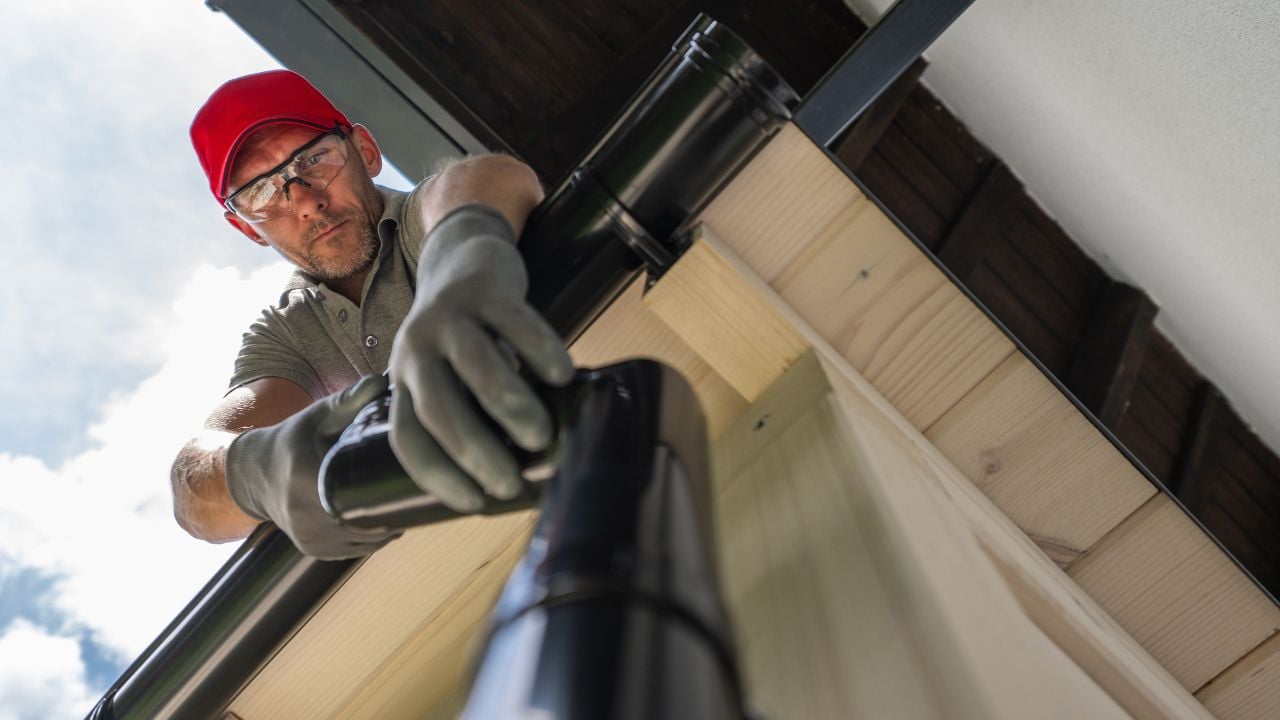
Gutters clogged with fall leaves can’t do their one winter job, which is draining meltwater off your roof before it refreezes.
Warm air leaking from your living space can push the attic above freezing, and that’s when snow on the roof starts to melt.
That meltwater refreezes the moment it reaches the colder roof overhang, according to State Farm.
That’s the problem.
Clean gutters can’t stop an ice dam from forming on their own.
But they help the meltwater drain away instead of pooling under the shingles, the same State Farm guidance notes.
Angi’s gutter-cleaning guidance calls for cleaning them at least once or twice a year, done after the leaves are down, and more often than that if oak or pine trees hang over your roof.
A pair of work gloves and an hour on a ladder beats a soggy ceiling in February.
5. Sweeping the Chimney
Creosote collects inside a chimney all winter long, and much of it stays out of sight until a sweep gets a light up the flue.
Nobody wants that.
Creosote doesn’t build up on hot flue walls when there’s enough draft moving through the chimney.
And it’s the buildup that turns an ordinary fire into a chimney fire, according to the Maine Forest Service’s wood-heat guidance.
The agency’s advice is simple: Sweep according to how much creosote has built up, not by the calendar.
A chimney that’s burned mostly green wood needs a look sooner than a chimney that’s burned dry, seasoned logs all year.
You want that checked before you light the first fire of the season, not after you catch a whiff of smoke where there shouldn’t be any.
6. Checking the Attic Insulation
An attic without enough insulation heats the outdoors all winter long.
Most of Maine sits in climate zone 6 for building-code purposes, with Aroostook County alone falling into the colder zone 7.
ENERGY STAR recommends R-60 of insulation for an attic starting from scratch in either zone, or R-49 if you already have 3 to 4 inches down there.
That’s not a weekend guess.
A local insulation contractor can measure what’s up there and tell you exactly how far off your attic is.
That beats finding out the hard way from a high heating bill.
Psst! How winter-ready is your Maine home? Run through this checklist and see where you stand.
7. Testing the Sump Pump
Basements flood in winter for a different reason than they do in spring.
It’s not the storm outside, it’s a sump pump nobody checked before the ground froze.
Easy to forget.
A frozen discharge line is usually why a sump pump fails in winter: Ice inside the line stops the water from draining, according to American Family Insurance.
The test itself takes five minutes.
Pour a few gallons of water into your sump pit and watch it work.
A working pump kicks on within a second or two, drains the pit, and shuts off on its own once the water’s gone.
A battery backup is worth checking too, since a pump that only runs on house current does nothing during a power outage.
A battery-backed pump keeps running when the electricity goes out, according to that same American Family Insurance guidance.
Test it before the ground freezes, not after a storm’s already taken your power down.
6 Things That Shut Down in a Maine Town the Week the Season Ends
Bar Harbor still feels like the middle of summer the week after Columbus Day.
The schedule behind it doesn’t, and Acadia’s free Island Explorer shuttles are only the first thing to shut down for the season.
6 Things That Shut Down in a Maine Town the Week the Season Ends
10 Maine Words and Phrases That Make No Sense to the Rest of the Country

A driver who’s never set foot in Maine pulls off Route 1 in Wiscasset and asks for directions to the nearest seafood shack.
The man behind the counter says “Ayuh” and keeps pouring coffee, and that’s the whole answer, the first of many Maine words that leave visitors puzzled.
10 Maine Words and Phrases That Make No Sense to the Rest of the Country
