
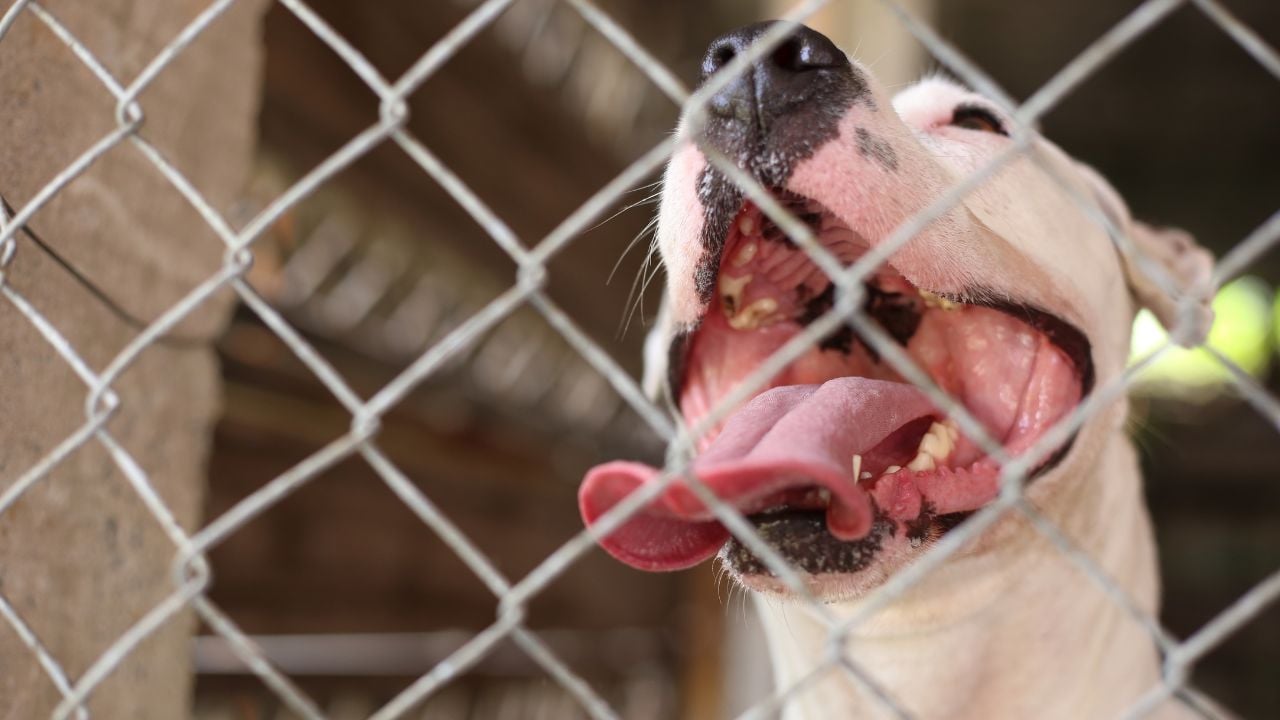
7 Dog Rules That Can Get a Texan Cited in Their Backyard

Your backyard probably feels like the one place where you shouldn’t get in trouble over your dog.
Texans may find that state law and some city ordinances see it differently, and Fort Worth’s rules are a good example.
Check these in your own yard before an officer does.
Note: This is general information, not legal advice. Dog rules and penalties vary by city and are subject to change.
1. Chain Tethers
Chain tethers are banned for an unattended dog under the Safe Outdoor Dogs Act.
Section 821.102 bars you from leaving a dog outside and unattended on a chain or on a restraint with weights attached.
The law defines a restraint as a chain, rope, tether, leash, cable or other device that attaches a dog to a stationary object or trolley system.
A leash tied to a porch post fits that description.
Your dog’s restraint also has to run at least 10 feet, or five times your dog’s length from nose to tail base, whichever is greater.
The collar or harness has to be sized for your dog’s measurements and body weight, and it can’t choke your dog or cause pain.
A knowing violation is a Class C misdemeanor.
The House Research Organization’s analysis of Senate Bill 5 in 2021 puts that fine at up to $500.
A repeat conviction is a Class B misdemeanor, with up to 180 days in jail, a $2,000 fine, or both.
2. Shelter, Shade and Water
Your dog needs shelter, shade and water whenever you leave it outside on a restraint.
Section 821.102 also requires a spot where your dog can avoid standing water and excessive animal waste.
You can’t leave a restrained dog outside and unattended without all four.
A knowing violation of that rule carries the same Class C penalty, a fine of up to $500.
Houston’s Chapter 6, as amended by Ordinance 2022-44, requires you to give each animal clean water in sufficient quantities at all times.
It also requires adequate shelter for a tethered dog left outside and unattended.
What Counts as Adequate Shelter
Texas’ Safe Outdoor Dogs Act defines adequate shelter as a sturdy structure that protects your dog from inclement weather.
Your dog must be able to stand erect, sit, turn around and lie down in a normal position inside it.
Inclement weather covers rain, hail, sleet, snow, high winds, and extreme low or high temperatures.
The definition gives no number for extreme.
Senate Bill 5 of 2021 eliminated the fixed temperature requirements in the earlier law, according to the House Research Organization.
3. City Tether Bans
Fort Worth bans using a chain, rope, cable or similar device to attach an unattended dog to a stationary object.
Breaking that ban falls under the city’s penalty section, which sets a fine of up to $2,000 for each violation.
Each day the violation continues counts as a separate offense.
Section 821.104 lets cities go further than the state, and your address decides which ban you face.
Dallas lets you tether a dog only when you’re with it.
You must also attach the tether to your dog’s harness or collar, not directly to its neck.
4. Fort Worth Fence Height
Fort Worth sets a 48-inch minimum for the fence around a dog’s enclosure.
The city code measures that height from the ground and sets 72 inches for aggressive dogs.
The city’s animal control page recommends 60 inches for large breeds and dogs that scale fences, so your fence may need more than the minimum.
Chain link, welded wire, wrought iron, brick, mortared stone, concrete block and wood stockade all qualify, along with similar material the Code Compliance director approves.
Failing to keep your dog under restraint is unlawful in Fort Worth, and the same penalty section applies.
Dallas takes a different approach for dogs kept outdoors and requires at least 150 square feet for each dog six months of age or older.
Psst! Here’s a quick checklist for your yard setup. Tick what’s true for you.
5. Dangerous-Dog Enclosures
If your dog is designated dangerous, Texas law puts extra demands on your yard.
Section 822.042 requires you to keep the dog on a leash in the immediate control of a person or in a secure enclosure at all times.
A secure enclosure is a locked fenced area or structure that keeps out the general public, including children, and prevents the dog’s escape.
It also has to be clearly marked as holding a dangerous dog and meet your local animal control authority’s requirements.
Within 30 days of learning the dog is dangerous, you must register it with animal control and carry liability insurance or show financial responsibility of at least $100,000.
Dallas adds a sign warning of a dangerous or aggressive dog at each enclosure entrance and a muzzle whenever the dog leaves the enclosure.
Section 822.045 makes failing to follow those state rules, or a city or county dangerous-dog regulation, a Class C misdemeanor.
6. Piled-Up Dog Waste
Dog waste piling up in your yard can cost you in Fort Worth.
The city’s animal control page says no one may discharge, deposit or allow any animal waste to accumulate on private or public property.
Its sanitary standards also tell you to remove manure and droppings from your yard.
The penalty section covers both, so each day the waste sits can count as a separate offense.
Dallas’s pet waste page says a dog owner commits an offense by knowingly permitting a dog to defecate on private property.
7. Barking and Noise
How long can your dog bark before Fort Worth counts it as a violation?
The city’s noise ordinance makes it unlawful to keep a dog that barks on a frequent, repetitive or continuous basis for ten minutes or longer.
An offense is punishable by a fine of up to $500, and each day it continues counts separately.
Dallas sets its threshold at 15 consecutive minutes of recorded barking.
Your neighbors can report it by calling 311 or filing with the city prosecutor’s office.
In Houston, a neighbor can ask the city to declare your dog a public nuisance under Section 151 of its Chapter 6.
The neighbor starts the case with a signed, notarized affidavit listing dates and times, and emailed statements don’t count.
One Offense per Dog
Texas’ dog tether law counts each dog as a separate offense.
The restraint of each dog in violation is a separate offense, so if you keep three dogs on bad restraints, you can face three charges.
The offense also requires a knowing violation.
If the same conduct breaks another law, Section 821.102 lets prosecutors charge you under that section, the other law, or both.
State Tether Exceptions
The state’s dog tether rule carves out several exceptions in Section 821.103.
They cover a dog left in an open truck bed only as long as a quick task takes.
They also cover a dog taken from home and restrained only as long as an activity needs.
Hunting and field trial training are exempt too.
For a trolley system, the length rule counts the distance your dog can travel along the running line.
The law also doesn’t stop you from walking your dog on a handheld leash.
Rabies and Registration Paperwork
Missing paperwork for your dog can draw a ticket even when your yard is fine.
Texas law requires you to vaccinate your dog against rabies by the time it’s four months old and at regular intervals after that.
Your veterinarian issues the vaccination certificate.
Skipping your dog’s rabies shot is a Class C misdemeanor under Section 826.022.
Section 826.031 lets cities and counties require you to register your dog.
Ignoring a required registration is a Class C misdemeanor under Section 826.032.
Houston requires you to register a dog four months or older every year, with a rabies certificate and proof of a registered microchip.
In Dallas, the city’s Pet Laws page says courts accept compliance dismissal requests, online or in person, for violations like a missing rabies vaccination, microchip or spay-or-neuter.
9 Everyday Outdoor Hazards Texas Dog Owners Need to Watch For
A Texas backyard can look the same in the afternoon as it does in the evening.
What lies beyond the fence is another matter.
9 Everyday Outdoor Hazards Texas Dog Owners Need to Watch For
6 Things a Texas City Can Fine You for That an HOA Can’t Touch
A Texas city and a homeowners association each enforce a different rulebook.
Homeowners tend to blame the wrong rulebook.
6 Things a Texas City Can Fine You for That an HOA Can’t Touch
