
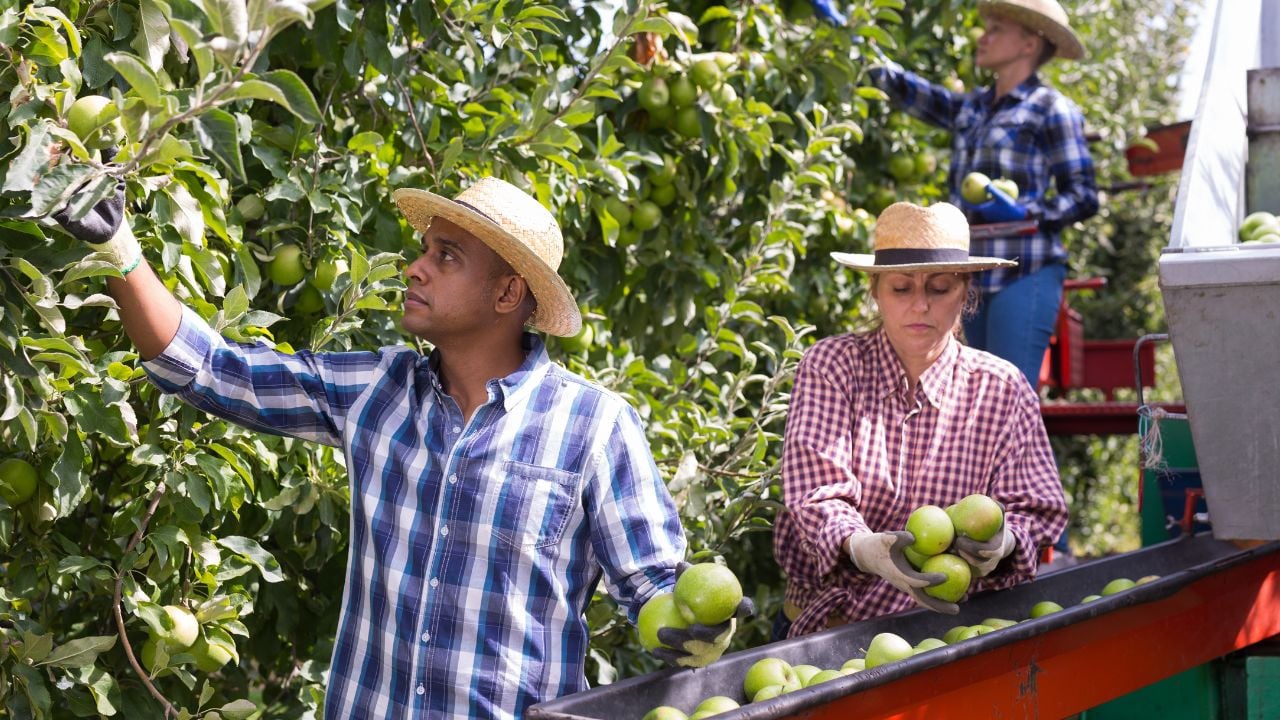
7 Things Washington Apple Orchards Do in October That Shoppers Never See

The crisp apple you buy next spring may have been picked this month.
A lot happens to it between the tree and your kitchen.
Here’s what Washington orchards get up to in October before that fruit reaches the store.
1. Starch-Iodine Tests
Washington State University (WSU) harvest guidance points orchards to a simple starch-iodine test for judging how mature an apple is.
Harvest runs through the end of November, RFD-TV reported in September, so orchards are still testing fruit in October.
WSU’s chart rates an apple on a scale of 1 to 6, and an apple with full starch stains solid blue-black.
A 6 on that chart means an apple free of starch.
When orchards pick for storage, look for 25 to 35 percent starch conversion and firmness above 15 pounds.
For the fresh market, orchards aim for 4.5 to 6.0 on that scale.
That’s the range behind the fresh-market apples in your cart.
Orchards have a window of 7 to 11 days, give or take a few, to harvest fruit at its best quality.
The window is short.
2. Counting Days From Bloom
Washington orchards typically pick Cosmic Crisp from late September through early October, according to the variety’s brand site.
WSU and the Washington Tree Fruit Research Commission give orchards growing Cosmic Crisp for storage a target of 165 to 175 days after full bloom.
The sugar reading should be at least 11 degrees Brix.
Firmness should come in at 23 pounds or below.
The starch index needs to hit at least 2.0 on that 1-to-6 scale.
Those are four of the numbers orchards watch before the first bin comes off the tree.
Then comes the wait.
The first shipping date for this year’s Cosmic Crisp crop is Nov. 9, 2026.
If you’re waiting on this year’s Cosmic Crisp, that puts the first shipments weeks after the first picking.
3. Late Pink Lady Picks
Washington orchards harvest Pink Lady, also called Cripps Pink, as a late-season apple, according to WSU.
Chelan Fresh says its Pink Lady apples are harvested starting at the end of October.
If you drive through apple country in late October, Pink Lady may be among the last apples still on the trees.
Superfresh Growers told FreshPlaza in September that Pink Lady will round out this season’s harvest later this fall.
In 2019, FreshFruitPortal reported that Washington growers were rushing to pick the last of the crop.
Many growers had turned to an early-maturing Cripps Pink strain to spread their risk.
That strain harvests up to three or four weeks earlier than the other Cripps Pink strains.
4. Sorting by Color, Shape and Size
Washington apples picked in October leave the orchard in large bins that head promptly to a nearby packing house, according to the Washington Apple Commission (WAC).
There, the apples are thoroughly washed.
Computer-controlled cameras and scales then sort them by color, shape and size.
Another system can determine an apple’s internal condition and cull apples that don’t meet the state’s standards.
You wouldn’t see any of it from the produce aisle.
Heat is a separate reason some fruit skips the fresh market, the Yakima Herald-Republic reported in September.
Some of the earliest apples picked this year may have problems from the summer heat.
Those are likely bound for processing instead of the fresh fruit market.
Psst! How much do you know about Washington apples? Take our quiz and see how many you can get right.
Quiz
Washington Apple IQ
Answer these questions on Washington apple history and growing. We bet you can’t get them all right. Prove us wrong?
By the 1920s, Washington had passed which state as the country’s top apple producer?
5. Fungicide at Harvest
Washington apples picked in October should get postharvest fungicide soon afterward, according to WSU.
Waiting raises the risk of decay in storage.
The treatment can be a drench at harvest or a spray on the packing line.
In the Pacific Northwest's apple and pear industry, a fog treatment called thermonebulization has become common.
Fog reduces the spread of spores between bins compared with drenching non-sanitized bins.
The treatments target blue mold, which WSU calls the top postharvest disease of apples and pears, worldwide and in the Pacific Northwest.
It starts in wounds such as punctures, splits and bruises.
Picking wet or cold fruit raises the chance of bruising.
Bruises let mold in.
6. Sealed Storage Rooms
Packing houses test the apples picked in October for starch and sugar content to determine when they'll be at peak flavor, WAC says.
The apples highest in sugar go into refrigerated storage rooms, and the packing house packs and sells them soonest.
Apples with higher starch content go into sealed, controlled atmosphere storage rooms instead.
Inside, nitrogen replaces oxygen, and the temperature stays near freezing.
That slows the apples' respiration rate, so they mature more slowly.
The slowdown is deliberate, and over that time starch slowly changes to sugar.
An apple that comes out of storage tastes freshly picked.
The Northwest Horticultural Council says many varieties can store for 12 months or longer in controlled atmosphere, when growers use proper growing and harvesting techniques.
Many of those apples ship between January and September.
So if you buy an apple next spring, it may have spent months in a room like that.
The Oxygen Math Behind Cosmic Crisp Storage
WSU and the Washington Tree Fruit Research Commission recommend 33°F, 2% oxygen and 1% carbon dioxide for Cosmic Crisp in controlled atmosphere storage.
Ordinary air is about 21% oxygen, so storage rooms cut it by 19 percentage points to reach 2%.
That leaves roughly one-tenth of the oxygen you breathe outdoors.
7. Fall Nitrogen Sprays
Washington apple orchards get a fall window for nitrogen sprays, according to WSU.
That window runs between October and November, once harvest ends and before the leaves start to turn yellow.
When orchards need them, the sprays can help build reserves for next season's crop.
Orchards spraying for reserves have to finish before natural leaf fall.
Urea at 5% has also been used to reduce the fungus that causes apple scab.
Some growers have used urea paired with zinc sulfate at 2% to bring on early leaf drop after harvest.
Fall sprays benefit trees only when they're deficient in that particular nutrient.
Reports That Ended This Year
The Washington State Tree Fruit Association's board discontinued apple reports this year, including its Aug. 1 forecast, its five-year forecast and its October and November storage reports.
The Yakima Herald-Republic reported the decision on Sept. 20.
The association's first crop report will come Dec. 1, after harvesting has ended.
If you follow the crop numbers, that means no storage updates from the association in October or November.
The association also said early estimates can give the market a false sense of certainty.
9 Reasons Washingtonians Keep Driving Into Oregon and Never Go Back

A drive across the Columbia River can change what you pay at the register.
The reasons start at the gas pump and go from there.
9 Reasons Washingtonians Keep Driving Into Oregon and Never Go Back
8 Washington Trips That Get Better the Week the Crowds Leave

Some of Washington's busiest spots look different once summer ends.
These are the trips that get better the week the crowds leave.
8 Washington Trips That Get Better the Week the Crowds Leave
