
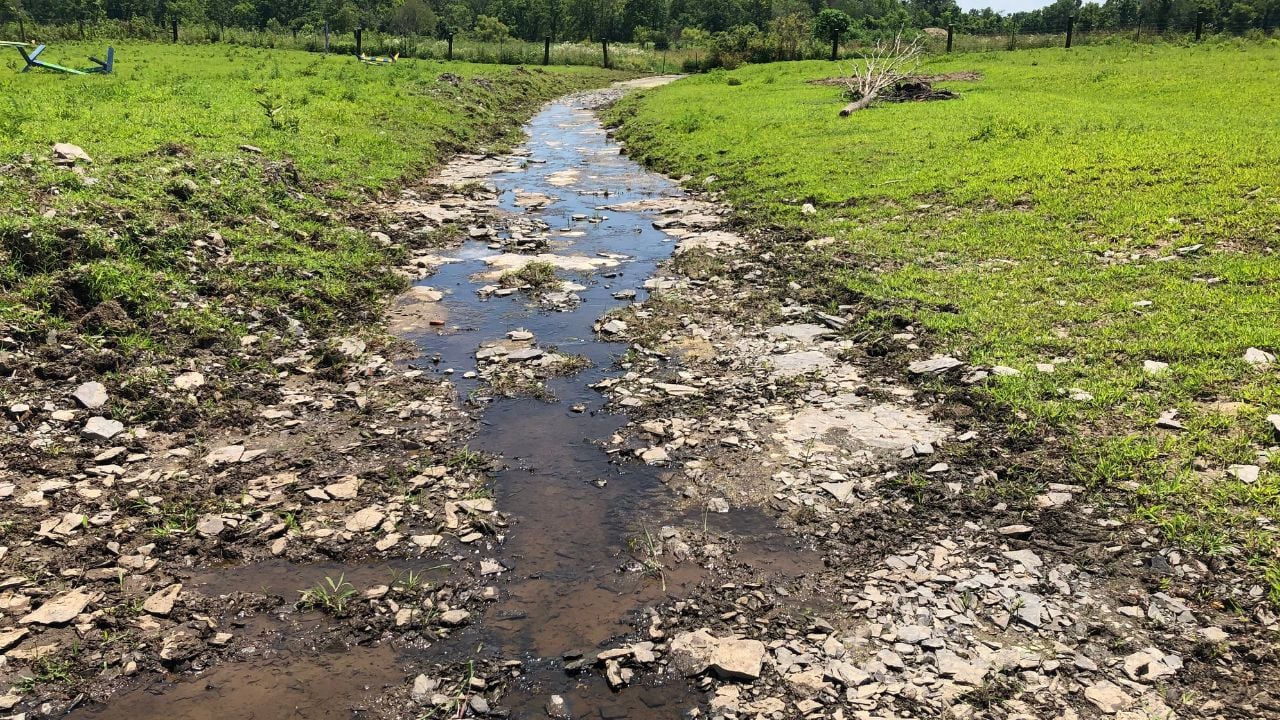
4 Rules That Decide Who Owns a Creek Running Through Kentucky Land

You paddle through a Kentucky creek that crosses private land, and then you step out to wade in it.
The law treats those two things differently.
Here are the rules that decide who owns a creek running through Kentucky land.
Note: This is general information, not legal advice. Property laws and court rulings are subject to change.
1. The Center-Line Rule
A creek that runs between your land and a neighbor’s generally splits down the middle, with each of you owning the bed out to the center.
Kentucky courts have applied that rule since at least 1867.
That year, a ruling over an Ohio River sandbar in Campbell County put a landowner’s title at the middle of the main channel.
A 1979 Attorney General opinion applies the center-line rule to waterways the tide doesn’t reach.
If your land is on both banks, the center-line rule generally gives you the whole bed since each bank’s title runs to the middle.
2. Meander Calls in Your Deed
A deed that follows a creek along its bends sounds like it stops at the water’s edge.
The court in that sandbar case didn’t read it that way.
The case turned on a land grant issued by Virginia in 1787, which started on the river’s bank and followed the river as it meanders.
The court still read that grant as running to the middle of the main channel.
General wording about the water line carries title to the middle of the stream.
If your deed uses general wording about the water line, the same reading may apply to you.
Read your deed twice.
3. Navigable in Fact
A creek that is navigable in fact leaves its private bed owner with a qualified title since the public has an easement over the water.
In a 1917 case, the U.S. Supreme Court described Kentucky as recognizing private ownership of stream beds, whether or not the stream is navigable.
What navigability adds is a public easement, which lets the public travel on the water above the bed you own.
Kentucky’s Court of Appeals has described an owner’s title to the bed of a navigable stream as qualified because it is subject to the public’s rights.
That case started when the city of Bowling Green built a dam across the Barren River and put property owners’ gravel bars underwater.
Courts judge navigability in fact by a stream’s natural condition, not as artificially raised by dams or similar structures.
What Navigable Means
Navigability decides whether the public has an easement over your creek, and a 1979 Attorney General opinion describes two requirements.
In its natural condition, the stream has to be capable of floating vessels, rafts or logs.
The stream also has to have been used for that purpose in the past.
In Natcher v. City of Bowling Green, Kentucky’s Court of Appeals said that a boat trip for a picnic a few times in many years cannot be deemed navigation.
If you own a creek that could float a log but never has, it may fall short of the test.
4. Gradual Accretion
When a creek slowly builds up land along your bank, your property line moves with it.
That slow buildup of soil is called accretion.
The 1867 sandbar case grew out of a channel between a bar and the bank that filled in gradually.
The court held that the landowner whose title reached the middle of the channel was entitled to the accretions.
When a stream gains ground slowly on one side, each owner’s title still follows the middle of the water.
If you own a bank that slowly gains a gravel bar, the added land generally becomes part of your property.
The reverse generally applies when a creek slowly eats away at your bank.
If your creek jumps to a new channel in one flood, that’s a different question for a surveyor.
Psst! How much do you know about land and water ownership? Take our quiz and see if you can ace it.
Quiz
Land and Water IQ
Answer these questions on Kentucky property and water law. We bet you can’t get them all right. Prove us wrong?
Along the Ohio River, where does Kentucky’s boundary with its northern neighbors sit?
Paddling Versus Wading
A creek that crosses private land can be open to a paddler and closed to a wader.
The Kentucky Department of Fish and Wildlife Resources says streams are public resources, but the land beside and beneath them is private unless a government agency owns it.
Boating or paddling a stream without permission is legal, but if you wade the channel, you need the landowner's permission.
Kentucky Revised Statutes (KRS) 150.092 bars you from entering another person's land to fish without oral or written permission.
The department names two exceptions for wading: Elkhorn Creek in Franklin County and streams that flow across public land.
Even then, access has to come through public land or with the landowner's permission.
Ask before you wade.
The Public Water Statute
The water in a creek is generally public water, even when you own the bed beneath it.
KRS 151.120 declares water in any creek, lake or groundwater source that can serve a useful and beneficial purpose public water of the Commonwealth.
The statute, amended in 2023, leaves out diffused surface water, which flows loosely over the surface of the ground.
It also says water left standing in natural pools after a creek stops flowing isn't regarded as public water.
Owners of the land next to those pools have rights to their use.
KRS 151.100 defines a stream as a river, creek or channel with well-defined banks where water flows for substantial periods of the year to drain an area.
If your ditch carries water only after a storm, it may not meet that definition.
Landowner Water Rights
Owning land beside a creek gives you a protected claim to some of its water.
KRS 151.210 gives landowners next to public water a continuing right to use it for domestic needs.
Domestic use covers household water and drinking water for poultry, livestock and other domestic animals.
The statute gives that domestic use priority over any and all other uses.
With a withdrawal permit, you may impound water behind a dam, but only when that won't impair existing uses or unreasonably interfere with other users.
Under KRS 151.210, an obstruction placed across a natural stream has to be approved by the state's Energy and Environment Cabinet.
The dam has to include an outlet that releases water the owner isn't entitled to use or withdraw.
You have to operate that outlet in accordance with the statute.
8 Kentucky Country Ham Rules Nobody Writes Down

A whole country ham just hangs in a smokehouse, looking simple.
It never is. These are the rules nobody writes down.
8 Kentucky Country Ham Rules Nobody Writes Down
5 Kentucky Traditions That Died With One Generation

An old drive-in ad made one promise louder than any other.
That drive-in is gone, along with many Kentucky habits that went with it.
