
7 Indiana Covered Bridges Worth the Drive After the Festival Crowds Leave

If you skipped the festival to avoid the traffic, you haven’t missed your chance.
Indiana’s covered bridges are still there once the crowds head home.
These are the ones worth the drive, in Parke County and beyond.
1. Medora Covered Bridge
Medora Covered Bridge dates to 1875, when J.J. Daniels built it to carry local traffic across the East Fork of the White River in Jackson County.
Its historical marker calls it the longest historic covered bridge in the nation, with 431 feet between its abutment faces.
The Indiana Historical Bureau’s booklet lists the bridge at 458 feet, so measurements differ by source.
It’s also the last remaining three-span covered bridge in Indiana, and more than 53 covered bridges are known to be Daniels’s work.
US 50 once crossed the river on this bridge, and State Road 235 did until 1972.
The Town of Medora’s website says it’s closed to vehicles and asks you to walk across, since running may cause damaging vibrations.
It sits beside State Road 235, east of Medora.
Friends of the Medora Covered Bridge and Area add that you can even go under the bridge if the river isn’t too high.
2. Narrows Covered Bridge
Narrows Covered Bridge sits on the east side of Turkey Run State Park in Parke County, where the 2026 festival ran October 9-18.
Joseph A. Britton built it over Sugar Creek in 1882, next to the site of Lusk Mill.
The main span runs 121 feet, with 8 feet of shed at each end.
The county’s tourism site says the road bypassed it in 1960 and the state Department of Natural Resources rebuilt it in 1977.
You can reach the bridge from a public road.
From there, you can get to three Turkey Run State Park hiking trails and canoe trips on Sugar Creek.
Cox Ford Covered Bridge and a swinging bridge also cross Sugar Creek nearby.
Psst! How much do you know about Indiana’s covered bridges? Take our quiz and see if you can ace it.
Quiz
Covered Bridge Trivia
Answer these questions on Indiana’s covered bridges and their builders. We bet you can’t get them all right. Prove us wrong?
The Indiana Historical Bureau estimates that how many covered bridges may once have existed in the state?
3. Cataract Falls Covered Bridge
Cataract Falls Covered Bridge stands near Cataract Falls, which Visit Indiana calls the largest waterfall in the state.
The bridge is the only covered bridge left in Owen County, according to its state historical marker.
Owen County commissioners contracted for a Smith's High Double Wood Truss in 1875, and it was finished in 1876 to replace a bridge a flood destroyed.
Vehicle traffic moved to a new concrete bridge in 1988, and the covered bridge became a pedestrian bridge.
State repairs began in 2000, and the National Register of Historic Places listed the bridge in 2005.
If you're hiking, the state Department of Natural Resources lists an Ed Dailey loop trail that connects the upper and lower falls.
There's also the site of the old Jennings Mill in Cataract.
4. Mansfield Covered Bridge
Parke County's tourism site says three loaded oil trucks once stopped on Mansfield Covered Bridge at the same time with no apparent damage.
The bridge is 279 feet long, which Visit Indiana says makes it Parke County's longest covered bridge.
It's a double-span Burr arch bridge over Big Raccoon Creek in Mansfield.
J.J. Daniels built it in 1867, and the National Register of Historic Places added it in 1978.
Cars can cross it, though walking is the better way to take in the site.
Mansfield Mill and its mill dam stand nearby, so you can add both to the stop.
County highway crews replaced the bridge's roof and deck in 1990.
5. Williams Covered Bridge
Limestone Country, Lawrence County's tourism site, calls Williams Covered Bridge Indiana's longest double-span covered bridge.
J.J. Daniels built it over the East Fork of the White River in 1884, and its total length is 402 feet, including a 13-foot overhang.
The Indiana Historical Bureau's booklet lists it at 376 feet, so measurements differ by source.
If you go, you'll find it just off Huron and Williams Roads, south of State Road 450.
The bridge was open to vehicles until 2010, when it was refurbished, and now you can cross only on foot or by bike.
The National Register of Historic Places has listed it since 1981.
Williams is also one of the bridges on the nine-bridge Covered Bridge Loop.
6. Roann Covered Bridge
Roann Covered Bridge crosses the Eel River in Wabash County.
Visit Wabash County says it's one of only two covered bridges left in the county.
The Smith Bridge Company of Toledo, Ohio, built it with steel tension rods and turnbuckles meant to stop sagging, according to Indiana Landmarks.
An arson fire destroyed half the structure in 1990, and it stood intact again within 21 months.
A county history story puts it on North Chippewa Street on the north side of town.
Indiana Landmarks' 2018 guide to Roann describes Stockdale Mill, built in 1855, as an operating mill and museum.
The mill's site lists free Saturday tours from noon to 4 p.m. during its 2026 season, so check its schedule before you go.
Roann's downtown is also on the National Register of Historic Places, with antique shops, cafes, a pioneer log cabin and a Carnegie library.
Visit Wabash County says a weekend-long festival is held in and around the bridge every September, so an October trip lands you after the crowds.
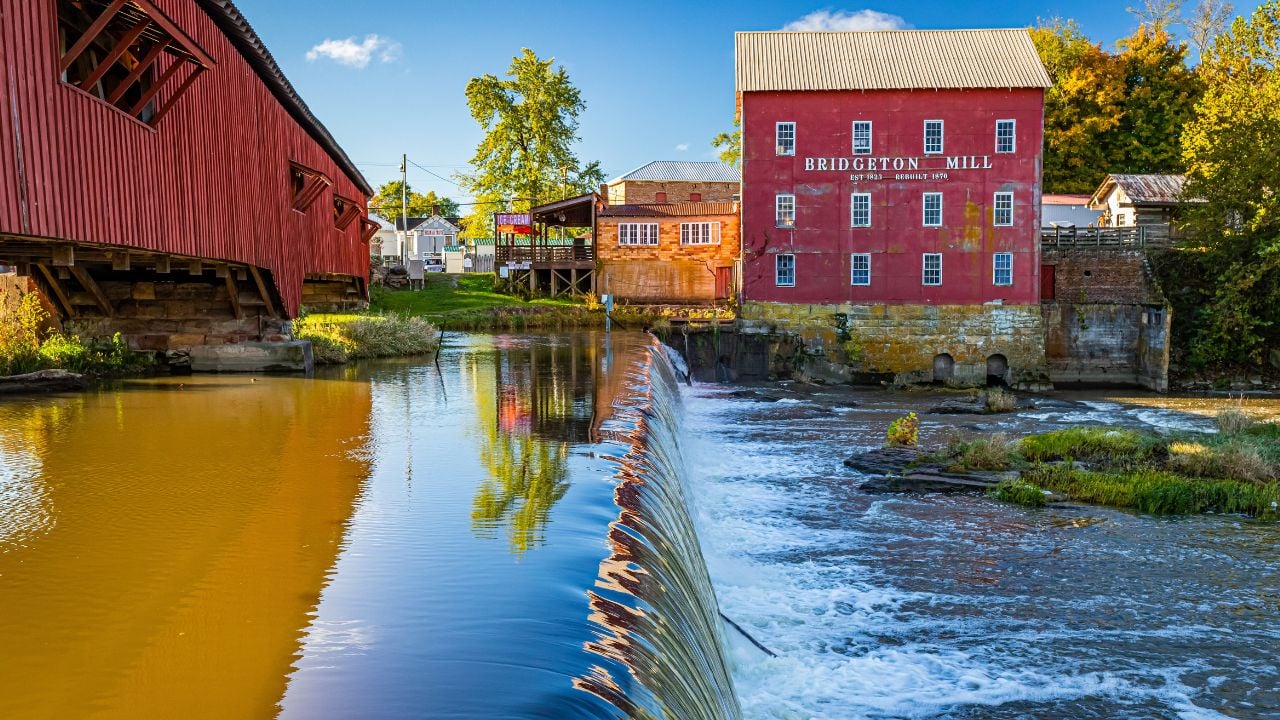
7. Bridgeton Covered Bridge
Dan Collom and the local community rebuilt Bridgeton Covered Bridge in 2006, and it now measures 245 feet over Big Raccoon Creek.
Arson destroyed the 1868 original on April 28, 2005, according to Parke County's tourism site.
That earlier bridge was noticeably narrower than other covered bridges, at 13 feet wide.
Plan to see Bridgeton Mill too, since its history dates to about 1823.
The current owner has restored the mill and produces more than 20 milled products.
Billie Creek Village
Three covered bridges stand at Billie Creek Village, east of Rockville on US 36: Beeson, Billie Creek and Leatherwood Station.
The county's tourism site lists all three.
Two of them were moved in: Beeson in 1979 and Leatherwood Station in 1981.
You'll also find a historic church, school, general store, governor's home and barn.
If you're planning a trip, check the village's site first, since its hours change with the season and for special events.
The Billie Creek bridge operates intermittently and typically closes to traffic during the village's operating hours.
9 Things That Change the Second You Cross From Indiana Into Illinois
Drive from Indiana into Illinois, and a few everyday habits shift on you.
Some of them might surprise you.
9 Things That Change the Second You Cross From Indiana Into Illinois
12 Old Gadgets Hoosiers Refuse to Replace With Newer Technology

Some Hoosiers love their old gadgets too much to give them up.
These are the old gadgets they refuse to replace.
12 Old Gadgets Hoosiers Refuse to Replace With Newer Technology
