
5 Things Iowa Grain Elevator Workers See Every Harvest That Most Iowans Don’t

A worker can’t just climb into a grain bin at an elevator.
There are rules for it, and you won’t see most of them from the road.
Here’s what Iowa grain elevator workers see every harvest that most Iowans don’t.
Note: This is general information, not legal advice. Grain-handling rules and weight limits are subject to change.
1. Moisture Readings
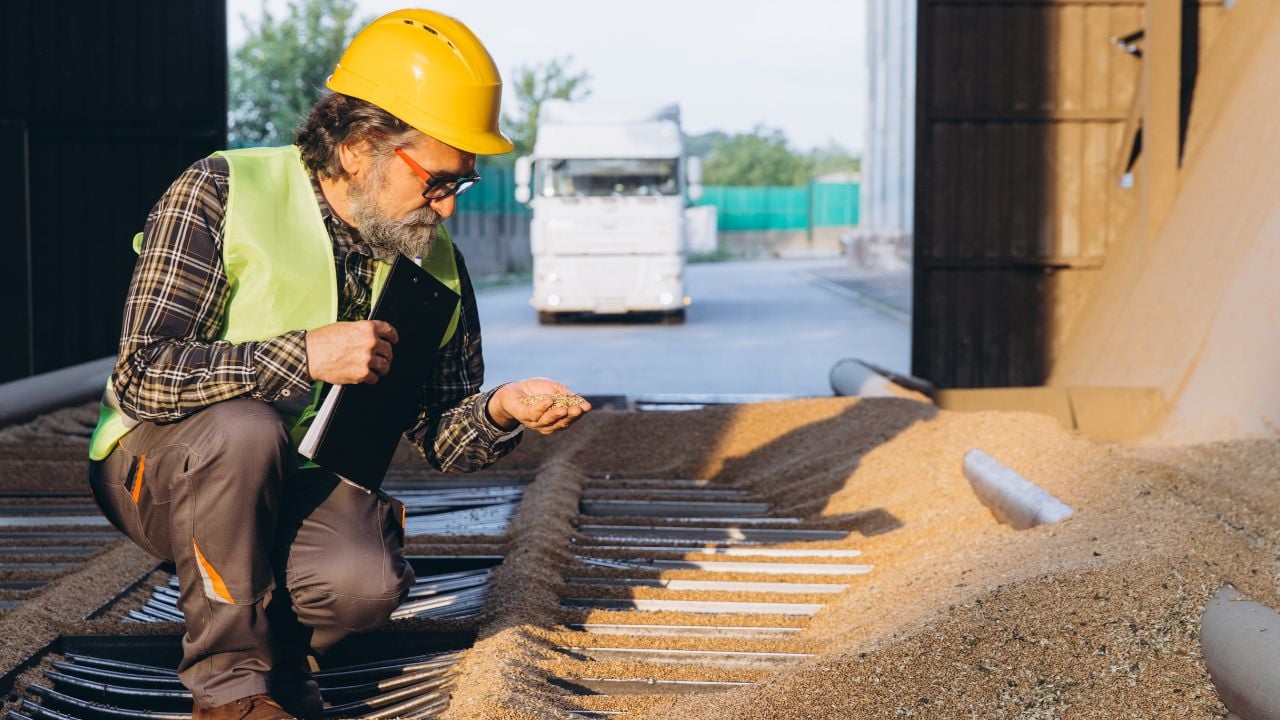
A grain elevator operator weighs your truck on the scale and takes a sample of the grain.
The sample gets a moisture reading, and 15% is the standard for U.S. No. 2 corn.
Every point above that can cost you.
Iowa State University (ISU) Extension’s 2022 pricing example charges a drying fee of 5 cents a bushel for each point of moisture removed.
Its other version combines that fee with a shrink factor of 1.4% for each point above 15%.
Shrink means the elevator pays you for fewer bushels than you hauled in.
Elevators differ on wet soybeans, too.
Some won’t accept beans above 15% moisture, and others take them at a discount.
ISU Extension advises asking your buyer for its moisture discounts, drying charges and shrink factors.
What Wet Corn Costs at the Elevator
Take a 1,000-bushel load of corn that arrives at an elevator at 20% moisture.
That’s five points above the 15% baseline.
At a drying fee of 5 cents a bushel for each point, the bill comes to $250.
At a shrink factor of 1.4% for each point, the load shrinks by 7%, so the elevator pays for 930 bushels.
Those are sample rates from the 2022 example, so your elevator’s numbers can differ.
2. Test Weight and Damage Checks
At a grain elevator, the operator tests the sample from your truck for weight and checks it for foreign material.
Sampling devices a producer may encounter include a hand probe, a pelican, a mechanical probe and a truck tailgate sampler.
The U.S. Department of Agriculture (USDA) defines test weight as the weight of the volume of grain it takes to fill a Winchester bushel.
U.S. No. 2 corn needs a test weight of at least 54 pounds a bushel.
The grade allows no more than 5% damaged kernels and 3% broken corn and foreign material.
If your corn tests at 53 pounds a bushel, it comes up one pound short of that mark.
Damaged soybeans tend to have lower test weight or damaged seed coats, and both bring price dockages at the time of sale.
3. Dump Pit Grates
When you dump a load at a grain elevator, the work floor is open and slatted, and your grain goes into a pit.
A belt with buckets attached scoops the grain up from there and deposits it into the silos.
The Occupational Safety and Health Administration (OSHA) requires the feed openings of truck receiving pits to be covered by grates.
The openings in those grates can be no wider than 2½ inches.
4. Bin Entry Permits
Before a worker enters a bin, silo or tank at a grain elevator, the employer has to issue a permit.
The one exception is when the employer or a representative is present for the entire job.
If you’re the worker in the bin, an observer equipped to help has to be stationed outside.
The employer also has to lock out and tag any equipment that could endanger you.
The standard bans walking on grain to make it flow, a practice called walking down grain.
Purdue University’s 2023 count of agricultural confined-space cases covers more than elevators.
In it, Iowa had the most grain entrapment cases of any state, at five.
Many people don’t get to see a bin entry.
5. Dust on Ledges
A grain elevator has to keep grain dust from building up on ledges, floors, equipment and other exposed surfaces.
The federal limit is one-eighth of an inch in what the standard calls priority areas.
Those include floor areas within 35 feet of inside bucket elevators.
Floors of enclosed areas with grinding equipment make the list, and so do floors of enclosed areas with grain dryers inside the facility.
If you haul in wet corn, your elevator can dry it for a fee.
A dryer inside the facility puts that enclosed floor under the same limit.
Once dust passes that depth in one of those areas, the employer must remove it immediately.
The standard requires a written housekeeping program that sets the schedule and methods for removing dust.
Piles and Truck Lines
In 2024, the Des Moines Register’s harvest coverage included a photo of corn piled up at an Iowa grain elevator.
The report said a fast harvest was forcing grain handlers in some areas to store corn outside rather than in storage bins.
It also described long lines of trucks waiting to dump their loads at some Midwest elevators.
In a 2016 Iowa Farm Bureau article, ISU’s Charles Hurburgh said piles need to be at an elevator, where there’s constant monitoring and some aeration.
Many people only see a pile like that from the road.
If you drive past corn heaped outside an elevator in a year like 2024, you may be looking at grain that had no room in the bins.
Psst! How much do you know about Iowa crops and harvest? Take our quiz and see if you can ace it.
Quiz
Iowa Harvest Pop Quiz
Answer these questions on Iowa crops and the harvest. We bet you can’t get them all right. Prove us wrong?
What did Iowa’s 2025 corn crop total, according to the Iowa Department of Agriculture and Land Stewardship?
Heavier Harvest Trucks
A truck hauling corn to a grain elevator can weigh more than usual when the governor issues a harvest proclamation.
Gov. Kim Reynolds' 2026 proclamation, signed September 10, allowed trucks hauling soybeans, corn, hay, straw, silage or stover to run up to 90,000 pounds gross.
Interstates were excluded.
Axle weights could run up to 12.5% over the usual table limits.
The proclamation covered 30 days and was set to expire October 10 unless the governor extended it in writing.
If you hauled corn during that stretch, you didn't need a permit for a load within the limit.
In 2023, the governor extended the harvest proclamation through Nov. 11.
In 2024, a 30-day extension ran from October 9 to November 8.
9 Things That Change When Nebraskans Cross Into Iowa
A Nebraska driver on the interstate feels the first change the instant the highway crosses into Iowa.
That's only the beginning of what shifts at the state line.
9 Things That Change When Nebraskans Cross Into Iowa
7 Iowa Small-Town Businesses That Only Open Certain Days Now

Walking into a small Iowa business whenever the mood strikes doesn't always work.
Some keep to a fixed schedule, and the list gets longer from there.
7 Iowa Small-Town Businesses That Only Open Certain Days Now
