
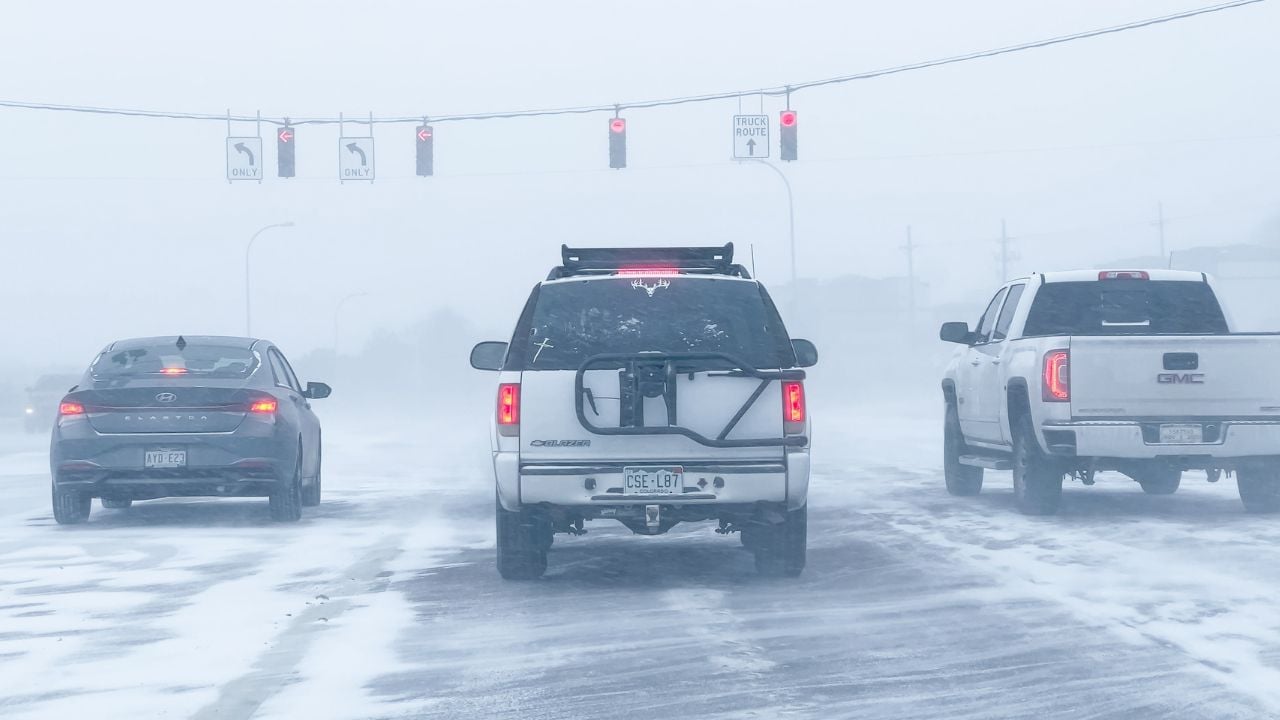
6 Things Illinois Drivers Can Be Ticketed for in a Snowstorm

Driving under the speed limit won’t save you from a ticket in an Illinois snowstorm.
The law expects you to slow down for the conditions, not just the sign.
Here’s what Illinois drivers can be ticketed for in a snowstorm, so the first big snow doesn’t cost you.
Note: This is general information, not legal advice. Traffic rules and penalties can change, so check the current law before you drive.
1. Skipping Your Headlights
Illinois law makes you turn on your headlights any time snow forces you to run your windshield wipers.
You also need your headlights on when weather hides people and vehicles beyond 1,000 feet.
You need them on from sunset to sunrise too, which covers a snowstorm after dark.
Parking lamps alone don’t count.
The section sets no fine, so the Code’s default penalty applies.
A first or second conviction is a petty offense, and a third within a year of your first is a Class C misdemeanor.
The same section also requires two lit tail lamps that show red light for at least 500 feet behind you.
2. Not Moving Over for Emergency Vehicles
When you drive up to a stopped emergency vehicle with its lights flashing, Illinois’ move-over law tells you to change lanes or slow down.
A first violation carries a fine of $250 to $10,000, and a second or later violation starts at $750.
On a highway with at least four lanes and two going your way, you move into a lane not next to the emergency vehicle when you can do it safely.
If changing lanes is impossible or unsafe, you slow down, keep a safe speed for road conditions and leave a safe distance until you’re past.
A snow-covered road changes what a safe speed is, and the flashing lights mean you should be ready to stop.
You also have to yield to any emergency vehicle working on a highway with its flashing lights on, whether it’s stopped or moving.
3. Driving With Snowy Windows
Illinois bans driving with snow or ice on any window or mirror that materially blocks your clear view of the highway.
That covers your side windows and mirrors, not only your windshield.
Illinois also requires every motor vehicle except a motorcycle to carry a driver-controlled device for cleaning snow and other obstructions from the windshield.
The $50 to $500 fine in that section covers window-tint and windshield-obstruction violations.
Snowy windows aren’t on that list, so a ticket for them falls under the Code’s default penalty.
4. Driving Too Fast for Conditions
Staying under the posted limit doesn’t protect you in a snowstorm, since Illinois law makes you decrease speed when weather or highway conditions call for it.
The offense is driving faster than is reasonable and proper for traffic conditions, and on packed snow that can be slower than the limit.
You also have to slow down as far as it takes to avoid colliding with any person or vehicle on or entering the road.
5. Following Too Closely
Illinois law bars drivers from following another vehicle more closely than is reasonable and prudent.
The law tells you to weigh the speed of both vehicles, the traffic and the condition of the highway.
Snow on the road is part of that condition, so the gap you leave on a dry afternoon may not be enough in a storm.
6. Chicago’s Two-Inch Parking Ban
Chicago’s two-inch parking ban covers 500 miles of main streets and can switch on once at least two inches of snow cover the street.
The city can activate it no matter the time of day or the calendar date.
If you park on one of those streets and two inches of snow pile up, you could get a ticket or find your car relocated.
The relocations let crews clear the snow.
Chicago’s Overnight Parking Ban
Chicago’s overnight parking ban keeps drivers off 107 miles of arterial streets from 3 a.m. to 7 a.m., December 1 through April 1.
The city enforces it regardless of snow, so a clear night doesn’t excuse you.
Cars left parked on those streets obstruct the path of snowplows and keep crews from fully plowing and salting when it snows.
The city says it implemented both parking bans to prevent a repeat of the problems from 1967 and 1979, when major snowstorms brought Chicago to a traffic standstill.
Signs are posted permanently along the affected routes, and the city puts flyers on cars parked on those streets as a reminder before restrictions begin.
If you leave your car there anyway, the city tows it to Pound 2 at 10301 S. Doty Ave. or Pound 6 at 701 N. Sacramento.
What an Overnight Ban Tow Costs
Chicago’s overnight parking ban carries a minimum $150 towing fee and a $60 ticket.
Storage adds $25 per day, so three days in the pound brings your bill to at least $285.
Because $150 is a minimum, your bill can run higher.
Move-Over Suspensions
If your move-over violation damages another person’s property, the Secretary of State suspends your driving privileges for 90 days to one year.
If the damage is to another vehicle, the violation is also a Class A misdemeanor.
An injury makes it a Class 4 felony, with a suspension of 180 days to two years.
A death makes it a Class 4 felony too, with a two-year suspension.
A court can also order you to perform community service.
The same penalties apply if you fail to yield to an emergency worker or to a pedestrian directly involved in the scene.
Psst! How ticket-proof is your winter driving? Run through this checklist and see where you stand.
Leaving a Running Car Unattended
Illinois’ rule on unattended cars isn’t tied to snow, but it applies to a car you leave running while you walk away.
Before you leave your car, you have to stop the engine, lock the ignition, remove the key and set the brake.
A car you leave idling doesn’t meet that list, since the first step is stopping the engine.
On a slope, you also turn the front wheels toward the curb or the side of the road.
The rule leaves out a locked car with its engine running after a remote starter system started it.
That means a locked car that you start from the kitchen and leave warming up doesn’t count as unattended.
The exception names a locked car and a remote starter system, so a car you start with the key doesn’t qualify.
13 Things Illinoisans Are Tired of Explaining to the Rest of the Country

Springfield, not Chicago, is the Illinois state capital, and that is one of the easier facts to explain.
Even the word downstate often means more than a map would suggest.
13 Things Illinoisans Are Tired of Explaining to the Rest of the Country
9 Illinois Originals You Can’t Get Anywhere Else
Many Illinoisans feel a visit home isn’t complete without a stop at certain places.
Some of them aren’t tourist attractions, but you’d notice if they disappeared.
