
Why Nevada Owns So Little of Its Land

Drive across Nevada, and most of the land you pass belongs to the federal government.
Nevadans have pushed back on that for decades, and the reasons go back to the deal that made Nevada a state.
Here’s why Nevada owns so little of its land, and what’s changed since.
Note: This is general information, not legal advice. Land laws and pending bills are subject to change.
1864 Statehood Terms
Nevada’s land story starts with the terms the territory accepted to become a state.
The Nevada Constitution has an ordinance in which the territory’s people give up all right and title to its unappropriated public lands for good.
It also leaves those acres at the sole disposal of the United States.
If you open the Nevada Constitution today, you’ll still find that ordinance there.
Congress made that disclaimer a condition of statehood.
Nevada joined the Union on Oct. 31, 1864.
The ordinance also bars Nevada from taxing federal land unless Congress says otherwise.
Small Grants, Little Private Land
In findings they wrote into state law in 1979, Nevada lawmakers said only 2.1% of the federal land in the state had passed into private ownership under the general land laws.
If you compare Nevada with Arizona, New Mexico and Utah by that same count, the gap is wide: Congress granted Nevada land equal to 3.9% of its area and the others about 11% of theirs.
Nevada also traded its 3.9-million-acre school-land grant for 2 million acres it picked from federal land in 1880.
If you add those figures up, you get a state where little federal land reached private owners and Congress granted the state little.
Keeping Land Federal
Nevada’s federal land has stayed federal in part because Congress decided it should.
In 1976, the Federal Land Policy and Management Act made keeping public land in federal hands the national policy.
Under that policy, land stays federal unless a federal planning review finds that selling a particular parcel would serve the national interest.
So if you want to buy federal land through the usual process, that finding has to come first.
The Federal Share
Federal land ownership covers 79.8% of Nevada, the highest share of any state, in the Congressional Research Service (CRS) count of federal acreage as of 2024.
The Bureau of Land Management (BLM) manages about 47.2 million of those acres.
The U.S. Forest Service adds about 5.8 million acres, the Fish and Wildlife Service about 2.2 million, the National Park Service about 800,000 and the Defense Department about 71,000.
That puts the BLM in charge of roughly two-thirds of the state you’re driving through.
The Nevada Division of State Lands manages about 345,000 acres, a sliver beside the BLM’s 47 million.
That portfolio doesn’t include land held by the Legislature, the university system or the transportation department, so it isn’t a total for every state-held acre.
Counting Nevada’s Federal Share
Nevada’s federal land share shows up as 80%, 87% or 88%, depending on who did the counting.
The CRS figure of 79.8% covers only land run by five federal agencies.
Nevada lawmakers put the share at 86.7% in their 1979 findings.
A 1983 federal appeals court opinion described it as approximately 88 percent.
Each number comes from a different document and year, so check which one you’re quoting.
Federal Land Sales
When the BLM sells federal land in Nevada, the state gets a share of the money, not the acres.
In September 2026, the BLM finalized the sale of nearly 940 acres to the City of Las Vegas for $94 million.
The sale ran through the Southern Nevada Public Land Management Act, which Congress passed in 1998.
The act lets the BLM sell federal land inside a set boundary around the Las Vegas Valley.
If you live there, that boundary marks which nearby acres can be sold.
The money from each sale splits three ways.
Of each sale, 85% supports projects across Nevada, 10% goes to the Southern Nevada Water Authority, and 5% goes to the state for education.
By 2023, the act had raised more than $4 billion.
Psst! How much do you know about Nevada and its public land? Take our quiz and see if you can ace it.
Quiz
Nevada Land IQ
Answer nine questions on Nevada’s statehood, geography, and federal lands. We bet you can’t get them all right. Prove us wrong?
When Nevada’s constitution was telegraphed to Washington in October 1864, about how many words did the telegram run?
The Sagebrush Rebellion
Nevada pushed back on federal land ownership in 1978, when it sued over a federal moratorium on private settlement of federal land.
The Ninth Circuit later described the suit as one aspect of what became known as the “Sagebrush Rebellion,” a protest of federal land ownership in western states.
The suit never claimed title to any land, and the court affirmed its dismissal after the federal government rescinded the moratorium.
Nevada's Legislature took a different route in 1979, declaring that the public lands and unappropriated minerals inside the state belong to Nevada.
Its findings called the 1864 disclaimer void.
The argument is that Nevada joined the Union on an equal footing with the original states, an idea lawmakers tied to an 1845 U.S. Supreme Court case.
Bills in Congress
In Congress, Nevada's lands bills would put more federal acres on the path to development.
In May 2025, Rep. Mark Amodei added a provision to a House budget bill that would have put public land in Nevada up for sale.
House Republican leaders told him to pull it before the House passed the bill.
A Senate subcommittee held a hearing in December 2025 on the Southern Nevada Economic Development and Conservation Act.
Sen. Catherine Cortez Masto's office says the bill would let Clark County develop up to 25,000 acres over the next 50 years.
It would also protect more than 2 million acres for conservation and recreation.
Under the bill text, Clark County and the Interior secretary would jointly nominate those acres, so if you live in Clark County, your county would help choose them.
In July 2026, Gov. Joe Lombardo wrote to congressional leaders asking them to advance Nevada's lands bills.
He said the proposals have had broad local support for years but remain stalled in Washington. He also tied land access to the state's housing crisis.
6 Nevada Towns Nevadans Are Surprised Anyone Still Lives In
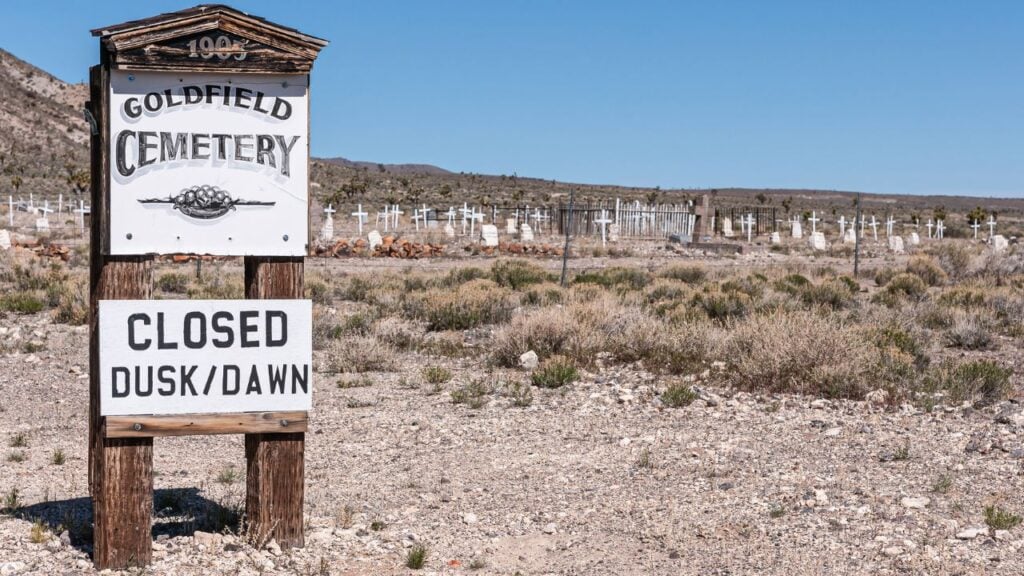
Some Nevada highways pass boarded gas stations and hand-painted population signs.
Many Nevadans live nowhere near them, and they're still surprised anyone stays.
6 Nevada Towns Nevadans Are Surprised Anyone Still Lives In
8 Nevada Foods and Drinks That Confuse Every Out-of-Stater
Nevada has an official state drink.
It's built on a shot of Amer Picon and finishes with a float of brandy.
