
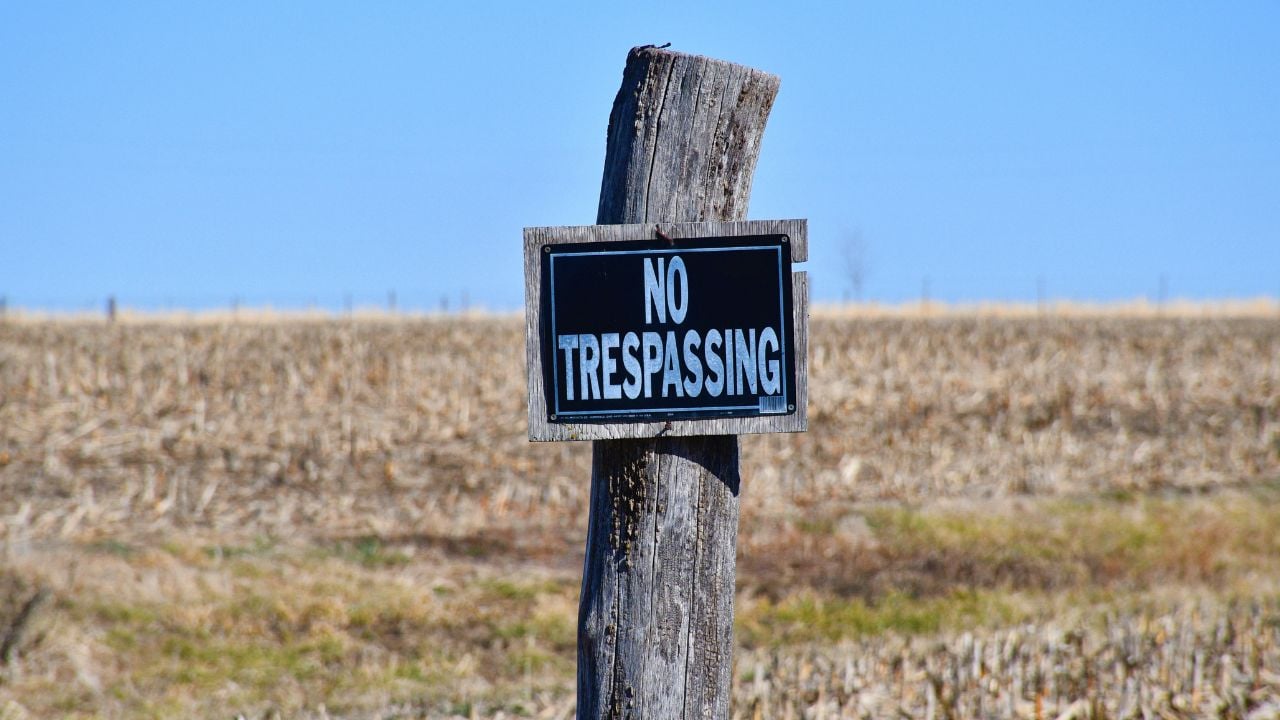
What Purple Paint on a Fence Post Means in Indiana, and 3 Other Trespass Signs Hoosiers Miss

Hiking in Hoosier National Forest?
A posted closure sign means that area’s off limits.
Indiana has more than one way to tell you to stay out, and not all of them say “No Trespassing.”
Here’s what purple paint on a fence post means in Indiana, and the other trespass signs Hoosiers miss.
Note: This is general information, not legal advice. Trespass rules are subject to change, so confirm the current details with the Indiana Department of Natural Resources.
Purple Paint on Fence Posts
Purple paint on a fence post has had the same legal effect as a No Trespassing sign in Indiana since July 1, 2018.
Purdue Extension’s forestry team says paint spares owners from replacing signs that get torn down, vandalized or unreadable in the weather.
If you’re looking at a post, the mark has to cover at least the top 2 inches of it.
Its bottom edge must sit between 3 feet and 5 feet 6 inches above the ground.
Marked posts can be no more than 36 feet apart.
At that spacing, you’d count about 10 marked posts along 300 feet of fence.
Each mark also has to be readily visible to anyone approaching the property.
Purple Paint on a Shared Fence
Purple paint that shows on both sides of a shared fence needs the agreement of all the owners or lessees first.
A lessee is a tenant who leases land along the fence.
Purple Paint on Trees
Indiana’s trespass statute sets different numbers for a tree than for a fence post.
If you’re checking a tree, look for a vertical line at least 8 inches long, with its bottom edge 3 to 5 feet above the ground.
Marked trees can be no more than 100 feet apart.
Purple paint also keeps nails out of trees.
1. Closed-Area Signs on State Land
Can one sign close part of a state property to you?
It can, under rules from the Department of Natural Resources (DNR) that let a sign close an area to public entry.
Those property rules also bar you from violating a sign posted that way.
State fish and wildlife areas mark safety zones, property boundaries and other restricted areas with signs.
Look for property boundary and safety zone signs, and don’t trespass on private property.
2. Closure Signs in Hoosier National Forest
A Forest Service order bans entry to any area of Hoosier National Forest that’s posted closed to protect threatened, endangered or sensitive species.
Without a permit from an authorized Forest Service officer, you can’t go into or be in a posted area.
Officers and members of an organized rescue or firefighting force are exempt while performing official duties.
The order covers nine Indiana counties, including Brown and Monroe.
If you ignore the order, you face a fine of up to $5,000 as an individual, up to six months in prison, or both.
3. Posted Court Orders
A court order posted on a property can work as a trespass sign.
That applies to property a city or county has designated as vacant, abandoned or unsafe.
A court can address the order to you or post it for the general public.
The law calls for conspicuous posting on or around the premises, in areas where you can observe the order.
Going in anyway after either kind of order fits the law’s definition of criminal trespass.
Psst! How much do you know about land access in Indiana? Take our quiz and see if you can ace it.
Quiz
Hoosier Outdoors IQ
Answer these questions on trespass laws, public land and outdoor rules. We bet you can’t get them all right. Prove us wrong?
Trespassing on which of these can be a felony in Indiana?
Spoken and Posted Notice
Indiana's trespass statute counts personal communication, oral or written, as a way to deny you entry.
A notice at the main entrance counts too, if it's posted in a manner the law prescribes or one likely to come to the public's attention.
If you're asked to leave and you stay, the same law treats that as a separate offense.
Law Enforcement Orders
Since July 1, 2025, Indiana's trespass statute lets a law enforcement officer acting for an owner deny you entry or ask you to leave.
Entering after that denial, or refusing to leave when asked, fits the law's definition of criminal trespass.
Another part of the law covers vacant property, where an officer can prohibit entry or ask you to leave.
An officer needs reasonable suspicion that criminal activity has occurred or is occurring before giving that kind of order.
Locked and Non-Public Areas
Walking into a locked area without permission or prior authorization is a separate kind of criminal trespass.
The law also covers refusing to leave an area that isn't open to the public.
That applies after an officer, or an employee or agent of the property's owner or operator, asks you to leave.
Both offenses apply when you act knowingly or intentionally and have no contract-based right to be there.
Farm and Timber Land
Indiana's trespass statute has a separate entry rule for farm and timber land.
It covers an agricultural operation's property, including any pasturage or land used for timber management.
If you knowingly walk in without the consent of the operation's owner or an authorized person, that fits the law's definition of criminal trespass.
An authorized person is someone the operation has authorized to act on its behalf.
The same part of the law bars you from walking into someone's dwelling without their consent.
Hunting on Private Land
Under Indiana's wildlife law, hunting on private land takes the owner's or tenant's consent, whether or not a sign is posted.
The same consent applies if you trap, fish or chase wildlife, or shoot a firearm or archery equipment.
Gathering plant life or artifacts on that land needs it too.
The law defines plant life to include fungi, so that covers mushrooms.
On land enrolled in the DNR's Indiana Private Lands Access program, hunters have to abide by posted signage and stay within the access boundaries.
If a deer you shot runs onto a neighbor's land, you need the landowner's permission, preferably written, before you go after it.
A landowner can still legally refuse to give up the deer, and a local conservation officer can help.
3 Cold-Weather Grooming Habits Indiana Veterinarians Say Do More Harm Than Good

Veterinarians at Purdue University say salt and ice-melt chemicals on a dog's paws can cause trauma to the paw pads.
Their winter tips include wiping your dog's paws after going outdoors to remove salt or deicer.
3 Cold-Weather Grooming Habits Indiana Veterinarians Say Do More Harm Than Good
