
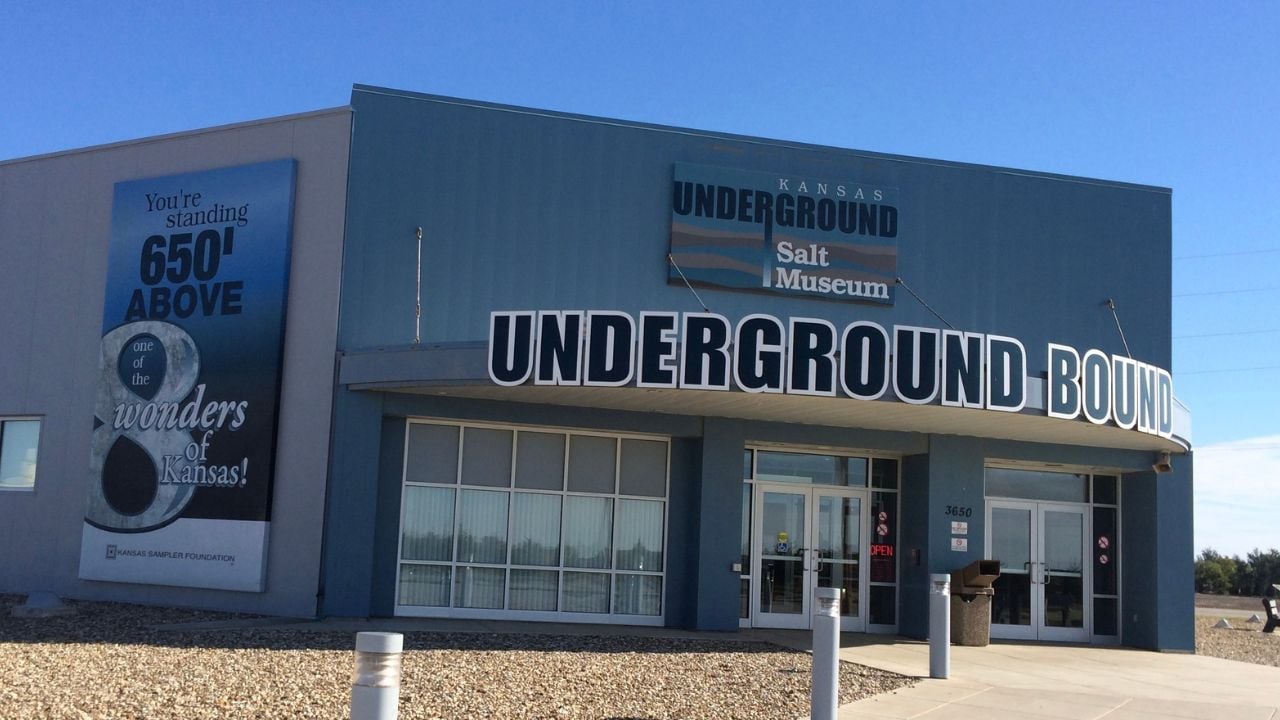
6 Things That Happen 650 Feet Under Hutchinson That Most Kansans Never See

Scout troops can spend the night 650 feet below Hutchinson, inside a salt mine.
Most Kansans drive over it without ever thinking about what’s down there.
Here’s what happens 650 feet under Hutchinson that most Kansans never see.
1. Mining Rock Salt
The Hutchinson salt mine is a working mine, and the Hutchinson Salt Company says it has run continuously since 1923.
The mine cuts into the Hutchinson Salt Member of the Wellington Formation, 650 feet below the prairie.
Today the company sells its rock salt for road deicing, farm use and industrial use.
If you’ve ever spread rock salt on an icy driveway, you’ve used the kind of product this mine supplies.
Rock salt is the term for natural salt deposits made of the mineral halite plus other impurities.
Strataca, the museum, operates inside that same mine.
2. Storing Film and Records
Underground Vaults & Storage operates inside the Hutchinson salt mine complex.
It preserves original film negatives, master recordings, documents and corporate archives.
A bank vault is where you’d expect to find archives like that.
The vault is a mine.
The storage company says it has operated since 1959, so the vault you’re picturing has more than six decades behind it.
The vault also keeps patient records, data tapes and oversized x-rays.
Space in the Hutchinson mine is leased for high-security record storage.
The 650-foot site is its flagship salt mine storage location.
Psst! How much do you know about Kansas salt? Take our quiz and see if you can ace it.
Quiz
Kansas Salt IQ
Answer these questions on Kansas salt, mines and landscape. We bet you can’t get them all right. Prove us wrong?
In 1887, drillers in central Kansas struck rock salt while hunting for what?
3. Underground Tours
Strataca's Dark Ride is a 30-minute tram tour through lit areas of the Hutchinson salt mine that explain mine safety challenges and solutions.
You can collect a souvenir piece of salt on the ride.
The True Geology stop adds years of historical artifacts.
You can also walk through the Mining Gallery, which shows what a miner's work was like and how mining practices differ from today's.
If you like trains, the Salt Mine Express is a seasonal 15-minute ride on the original rails and ties miners once used.
The Express rolls past what was once a miner's breakroom.
A Salt Safari adds a guided ride through select parts of the mine to see unusual salt formations.
On a Lantern Tour, a flickering lantern is your only light, and you walk in the spirit of the 1940s and 50s miners.
4. Running a 5K
Strataca's annual 5K Monster Dash is a Halloween-themed run through the Hutchinson salt mine.
You descend 650 feet for it.
It was scheduled for October 31.
A second event, the Salty Santa 5K, sends you on a fun run through the mine's passageways.
5. Sleeping Underground
Scout troops can sleep in the Hutchinson salt mine, 650 feet below the surface, on overnights that Strataca hosts.
Your troop gets after-hours access to the mine, a pizza dinner and a chance to sleep underground.
Your Scouts can also earn a Mining & Geology merit badge through hands-on activities led by expert guides.
Overnights run from October through March.
School classes visit too, on field trips that run August through May.
6. Candlelit Concerts
Strataca's 2026 calendar had the Salt City Orchestra playing in chambers inside the Hutchinson salt mine for Salt & Sound.
It was listed as a candlelit Halloween experience.
The 2026 show put the audience in the heart of the mine, in the same working mine where crews dig salt.
The Ride Down
Strataca's hoist is how you reach the Hutchinson salt mine, a double-decker elevator that the museum says takes up to 28 passengers down.
The descent takes 90 seconds.
You ride through a frozen aquifer and layers of rock and silt, in a shaft bored to make room for a 6-ton hoist.
Salt From an Ancient Sea
The Hutchinson salt mine cuts into salt that formed during the Permian Period, about 275 million years ago.
Salt is an evaporite, which means it forms when water evaporates.
The climate was hot and dry, and the sea was restricted to central Kansas.
Evaporation outpaced the water flowing in.
About 80 percent of the rock in the Hutchinson Salt Member is salt.
Salt is plastic, which means it flows very slowly over long periods of time.
Roughly 13 trillion tons of salt lie under Kansas, which is enough to form a salt cube more than 10 miles long on each edge.
If you visit the Permian Room at Strataca, you can see the strata that sea formed on its walls.
Underground salt mines across Kansas range from 600 to 1,000 feet deep.
Lyons and Kanopolis run active underground salt mines too, and Hutchinson's 650 feet sits near the shallow end of that range.
8 Kansas Regions Nobody Can Agree Where to Draw on a Map
Kansas can't even agree on the borders that don't move.
Ask around, and you'll hear a different answer every time.
8 Kansas Regions Nobody Can Agree Where to Draw on a Map
10 Kansas Phrases That Leave Out-of-Staters Completely Lost

A visitor stops at a gas station in Manhattan, Kansas, and asks the clerk a question every local has heard hundreds of times.
The clerk just laughs.
