
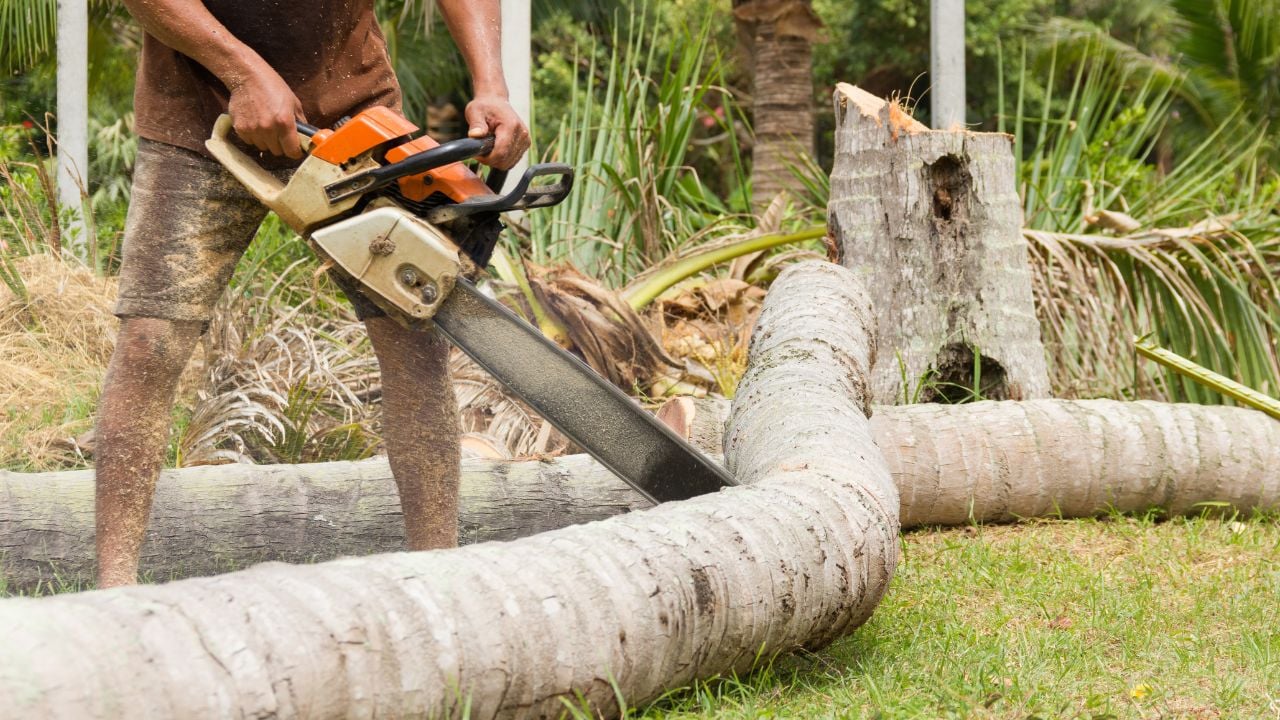
Florida’s Tree Removal Law: What a Homeowner Can Cut Without a Permit

Trimming a mangrove in Florida follows different rules than trimming an oak.
Florida’s tree removal law also covers only trees on residential property.
Here’s what a Florida homeowner can cut without a permit under the state’s tree removal law, and where its limits are.
Note: This is general information, not legal advice. Tree rules and local permit requirements are subject to change, so confirm the current requirements with your city or county government.
What Local Governments Can’t Require
When you hold the required documentation, Florida’s tree removal law bars your local government from requiring a notice, application, approval, permit, fee, or mitigation.
That covers pruning, trimming, and removing a tree on residential property.
What counts as documentation?
Only an arborist certified by the International Society of Arboriculture (ISA) or a Florida-licensed landscape architect can sign the documentation.
Without documentation, your city or county’s tree rules can still apply.
Even with documentation, your local government can’t make you replant a tree you removed under the law.
Who Can Sign the Documentation
Florida’s tree removal law treats a signed onsite assessment of your tree as documentation.
An ISA-certified arborist or a Florida-licensed landscape architect has to do the assessment and sign it.
The arborist or landscape architect has to follow the procedures in a 2017 guide the law names, Best Management Practices: Tree Risk Assessment.
A quote or estimate from a tree service doesn’t qualify because the law asks for the signed assessment.
Keep a signed copy.
You can check both credentials online through ISA’s directory and the state’s license lookup.
Unacceptable Risk Test
An arborist or landscape architect has to find that your tree poses an unacceptable risk to persons or property before Florida’s tree removal law applies.
A tree poses an unacceptable risk when removal is the only practical way to bring its risk below moderate.
Arborists using the 2017 guide the law names rate tree risk as low, moderate, high, or extreme.
Below moderate means low.
The same documentation covers pruning and trimming your tree as well as removing it.
What Changed in the Tree Removal Law
Florida’s tree removal law began with a 2019 bill.
The 2019 version required documentation that a tree presented a danger to persons or property.
A 2022 bill replaced the danger standard with the unacceptable risk test.
That bill added definitions of documentation and residential property, the terms the law uses today.
As of the 2026 statutes, the law’s history lists only those two bills.
Single-Family Home Requirement
Florida’s tree removal law covers only a tree on residential property.
Residential property means a single-family, detached building on a lot that’s actively used for single-family residential purposes.
The law doesn’t define “detached.”
If your home shares a wall with a neighbor, ask your city or county before you count on it.
Your lot’s use has to be a conforming use, meaning it fits your local land development rules.
Or it can be a legally recognized nonconforming use, meaning it was legal before those rules changed.
Psst! How much do you know about owning a home in Florida? Take our quiz and see if you can ace it.
Quiz
Florida Homeowner Trivia
Answer these questions on Florida HOAs, homestead exemptions and homeowner insurance. We bet you can’t get them all right. Prove us wrong?
What’s the longest stretch around collection day that Florida law lets you leave garbage cans at the curb without a homeowners association fining you?
Trees Without Documentation
A tree without documentation, or on a lot that isn't residential property, falls outside Florida's tree removal law, so your local government's tree rules can apply.
The tree removal law speaks to local governments, so check your community's governing documents before you cut.
Local rules vary.
Davie's FAQ says you don't need a removal permit for an invasive exotic tree, unless removing it leaves your lot with fewer than the required number of trees.
In that case, you can get a no-cost permit, but mitigation may be required.
Otherwise, Davie requires a permit in most situations, with a $35 application fee for up to two trees on an existing single-family lot.
Coral Springs requires a no-charge permit before you remove a canopy tree or palm on a single-family or duplex property.
If your property is in a homeowners association (HOA), you need its approval and have to include it with your permit application.
The city expects you to replace removed trees with like trees within six months of permit approval.
That means shade trees for shade trees, and palm trees for palm trees.
Miramar's tree care page says fines can be as high as $15,000 for removing a protected tree without permission.
Mangrove Trimming
Mangrove trimming runs on separate state rules, and Florida's tree removal law doesn't change them.
Those rules, plus any local rules the state delegates, are the only state and local regulations on trimming mangroves.
The rules exempt some trimming from permits as long as you don't use herbicide or another chemical to remove the foliage.
In the rules, trimming means cutting a mangrove's branches, twigs, limbs, and foliage.
Removal isn't trimming.
The exemption covers shoreline mangroves in a strip up to 50 feet deep.
Mangroves on uninhabited islands, public conservation lands, and mitigation areas that don't allow trimming fall outside it.
The mangroves have to be on land you own or control, or on state submerged land directly in front of it.
Before you trim, the mangroves can be no taller than 10 feet, and your cuts can't leave any mangrove shorter than 6 feet.
On a shoreline of 150 feet or less, the exemption applies to the property.
On a longer shoreline, you can trim no more than 65 percent of the mangroves along it under an exemption.
Professional Mangrove Trimmers
Florida's mangrove rules include a separate exemption for a professional mangrove trimmer who meets the state's qualifications.
If you hire that trimmer, the exemption covers the mangroves along your shoreline up to 24 feet tall, and the 150-foot shoreline and 65 percent limits apply here too.
The 6-foot minimum still applies.
The trimmer has to work on mangroves 16 feet or taller in stages, removing no more than 25 percent of the foliage each year.
A trimmer working on red mangroves for the first time under this exemption has to notify the state or a delegated local government in writing at least 10 days ahead.
9 Florida Fence and Property Line Rules Neighbors Get Wrong
Trees aren't the only thing that can cause trouble at a property line.
Fences can, too, and the details are worth a look.
9 Florida Fence and Property Line Rules Neighbors Get Wrong
10 Things Florida Neighbors Can Report You For That Are Perfectly Legal

Your neighbor might not like what you're doing.
Not every gripe holds up.
10 Things Florida Neighbors Can Report You For That Are Perfectly Legal
