
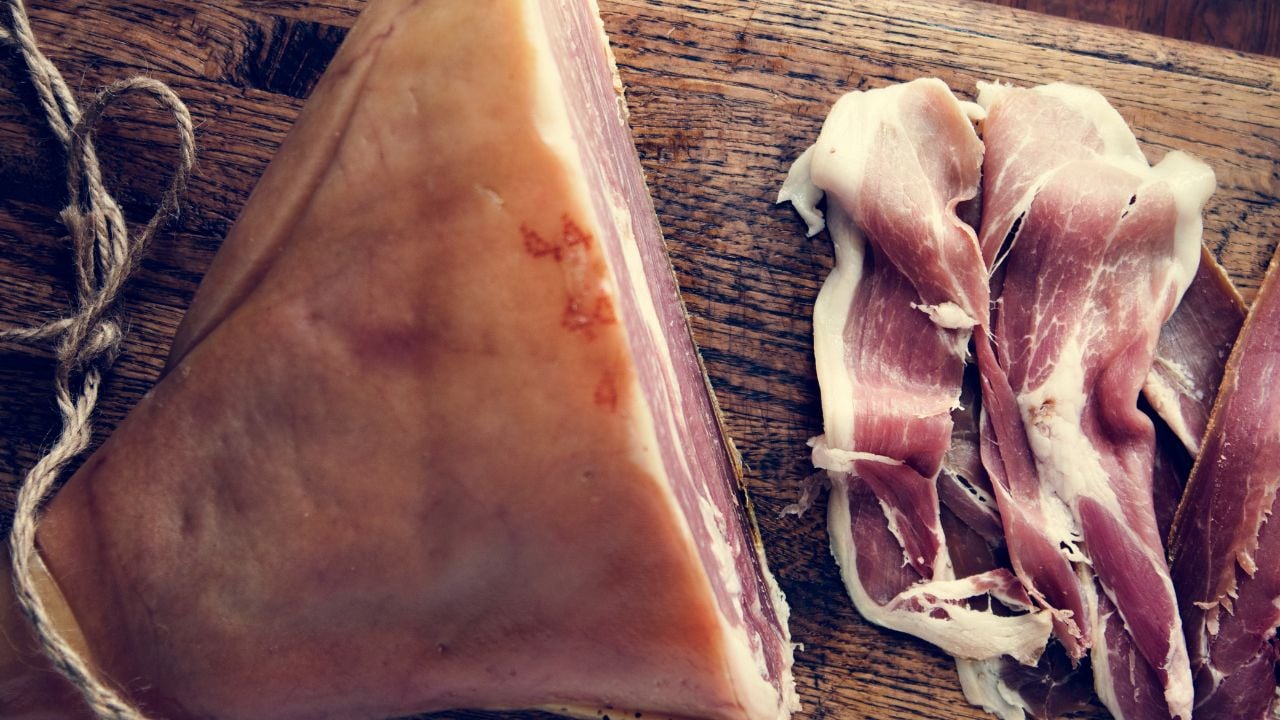
Only Ham Cured in Smithfield Can Be Called a Genuine Smithfield Ham. 6 Other Things Virginians Know About It

A Smithfield ham is on your Thanksgiving list, and you’re checking the label.
The company behind the name made a surprising move in 2024.
Here’s what Virginians know about Smithfield ham that leave out-of-staters baffled.
1. Gwaltney’s 1902 Ham
The Isle of Wight County Museum in Smithfield keeps a Smithfield ham that dates to 1902.
P.D. Gwaltney Jr. cured it, and it hung from a rafter in a packing house for about 20 years.
A 1921 fire destroyed two blocks of Commerce Street.
The ham survived.
By 1924, it sat in an iron safe that was opened daily for guests to view.
Ripley’s Believe It or Not featured the ham in 1929, 1932 and 2003.
You can check on it from your couch with the museum’s live Ham Cam.
To see it in person, adult admission is $2, but the museum is closed on Thanksgiving, Nov. 26.
2. Peanut-Fed Hogs
Peanuts shaped Smithfield ham’s flavor, Virginia Tourism says.
If you wonder how, free-roaming pigs ate the peanuts that became a major crop around Smithfield after the Civil War.
A 1926 act defined genuine Smithfield hams as cuts from peanut-fed hogs raised in the peanut belt of Virginia or North Carolina.
Lawmakers repealed the peanut requirement in 1966.
3. Low-Temperature Smoking
A Smithfield-style ham is smoked for a long time at a low temperature, below 90 degrees.
The Code of Virginia lists smoking among the steps a genuine Smithfield ham must go through inside town limits.
If you cure a ham in town but smoke it elsewhere, it doesn’t meet that definition.
4. End of the Genuine Brand
The meat company Smithfield Foods said in January 2024 that it would stop making Genuine Smithfield Ham.
Consumer preferences have shifted away from the brand, the company contends.
If you’re looking for the last Genuine Smithfield Ham, Smithfield Foods donated it to the museum in 2024.
Smithfield Foods said its smokehouse would make mild-cure hams, and the mayor said they would be cured in town.
The catch?
Those hams need only four months of aging, but a genuine Smithfield ham needs at least six.
What Else Makes a Smithfield Ham Genuine
Curing in Smithfield is only part of how the Code of Virginia defines a genuine Smithfield ham.
The cure must be the long-cure, dry salt method.
The aging must last at least six months, counted from the day the green pork cut first goes into dry salt.
5. Todd’s 1779 Invoice
Smithfield ham was already a business in the 1700s.
Capt. Mallory Todd, a Bermuda merchant, moved to Smithfield in 1767.
In Todd’s day, Commerce Street was a footpath to a public boat landing on the Pagan River.
You can trace his ham business to a shipment invoice dated 1779.
Helen Haverty King’s county history cites that invoice as proof that Todd was in the ham trade by then.
The Virginia Museum of History & Culture says Todd started a ham curing business in Smithfield in the late 1700s.
6. North Carolina’s Challenge
A challenge to Smithfield ham came in 1985 from town leaders in Smithfield, North Carolina, who invited Smithfield, Virginia, to settle the score.
The invitation was to a Ham & Yam Festival in Johnston County, and you can read the story in an essay for the Southern Foodways Alliance.
Johnston County curers placed first and second in the uncooked ham category that year.
North Carolina won again in 1986, taking five awards in four categories.
A rematch was offered in 1987, and Smithfield, Virginia, declined.
The festival later shifted to a competition among North Carolina curers.
Psst! How much do you know about country ham? Take our quiz and see how many you can get right.
Quiz
Country Ham IQ
Answer nine questions on country ham, curing and Virginia ham facts. We bet you can’t get them all right. Prove us wrong?
A whole, uncut country ham can be stored safely at room temperature for up to how long?
From Pet Ham to Museum Piece
Gwaltney gave the 1902 ham a brass collar and took it on tour as evidence of the Smithfield curing method's preservative powers.
The museum gained custody of the ham in 1985.
In 2024, the museum planned to display the last Genuine ham alongside the world's oldest ham, the world's largest ham and a 1930s-branded ham.
Virginia Commonwealth University (VCU) students scanned the last Genuine ham in the summer of 2024.
VCU's Virtual Curation Laboratory lets you download the 3D scan for free.
The USDA Definition
Smithfield ham is an aged, dry-cured ham, and the U.S. Department of Agriculture (USDA) lists it that way in its ham glossary.
Dry curing means rubbing the ham with salt and other ingredients.
Country hams can't be injected with a curing solution or placed in one.
Brine curing, which injects a curing solution into the meat, is the most popular way to make a ham, USDA says.
The Law's Reach
Virginia's Smithfield ham law covers more than selling.
Knowingly labeling, stamping, packing or advertising a ham as a genuine Smithfield ham is off limits too, unless the ham meets the definition.
If you knowingly mislabel a ham, the penalty is a Class 4 misdemeanor, which carries a fine of up to $250.
The Code's history note for the definition lists changes in 1966, 1968 and 2008.
The Hamtown Nickname
Smithfield, the home of Smithfield ham, is known as the "ham capital of the world" and "Hamtown," according to Virginia Tourism.
If you visit, you can find life-sized statues of market hogs around town, painted by local artists.
9 Things Only True Virginians Understand About Northern Virginia

Northern Virginia is still Virginia, but it doesn't always feel like it.
Many people who have spent time there will tell you it runs on a different rhythm, starting with Fairfax City's independence.
9 Things Only True Virginians Understand About Northern Virginia
Virginians, Here's What Happened After an Aunt Asked Reddit If She Could Keep Her Sister Away at Thanksgiving

If you're hosting Thanksgiving, keeping a problematic relative off your guest list may have crossed your mind.
This article follows one aunt who asked Reddit strangers to judge how rude that would be.
