
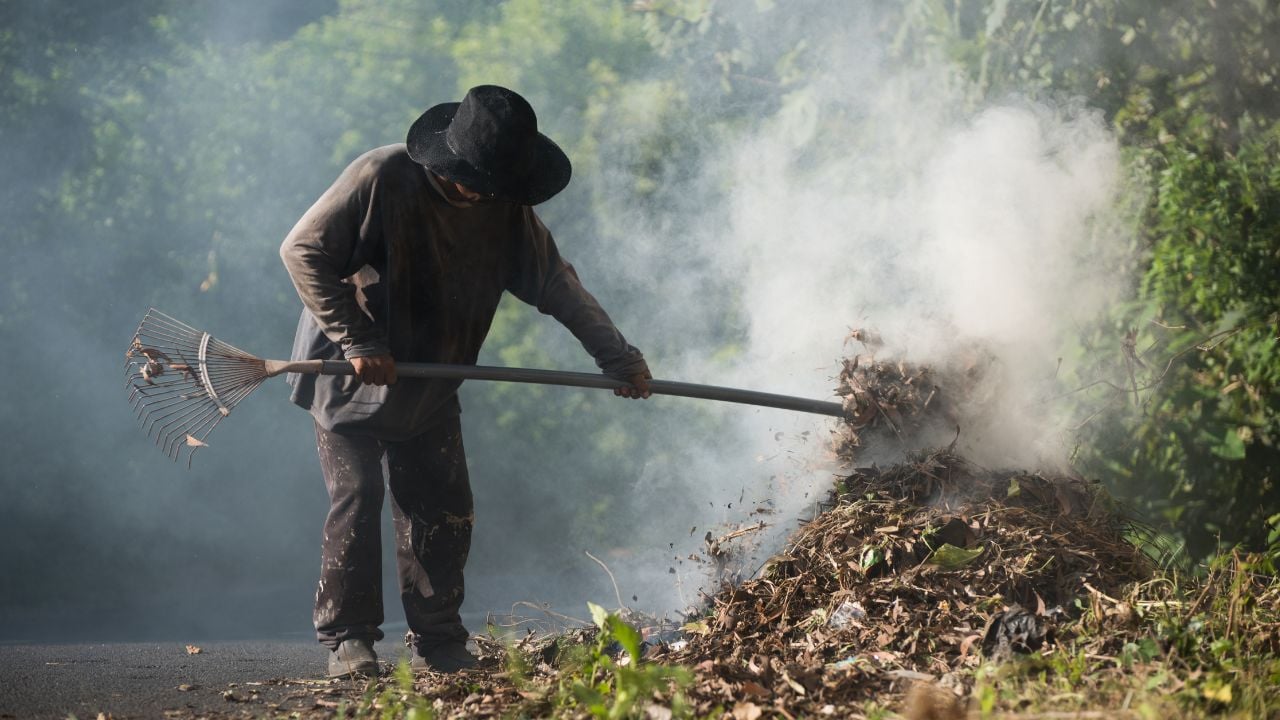
7 Florida Yard Debris Burning Rules That Can Get You Fined This Dry Season

You rake up a pile of branches and dry leaves behind your Florida house, and you reach for a match.
Where you build the pile matters as much as when you light it.
Here are the Florida yard debris burning rules that can get you fined this dry season.
Note: This is general information, not legal advice. Burning rules and penalties are subject to change, so confirm the current requirements with the Florida Forest Service.
1. Piles Over 8 Feet
A yard debris burn pile can be no wider than 8 feet across under Florida’s open burning rules.
Under that size, the state environmental agency’s page says residential yard waste burning doesn’t need Florida Forest Service authorization.
If you build the pile bigger, you need authorization from the Florida Forest Service before you light it.
If you light it without that authorization, state law makes it a second-degree misdemeanor.
The maximum penalty is 60 days in jail and a $500 fine.
Measure before you light.
2. County Burn Bans
A county can ban yard debris burning outright, even where the state’s rules would allow your fire.
In April 2026, Madison County banned burning any combustible material in an outdoor area.
Breaking that ban is a second-degree misdemeanor.
That’s more than a ticket.
Violators also have to reimburse the county and any responding agencies for the cost of response and fire suppression.
This dry season runs from November 2026 through April 2027 in Central Florida, the National Weather Service in Melbourne says.
Check your county’s burn ban status before every burn.
How Long a County Burn Ban Lasts
Madison County’s April 2026 burn ban started as a seven-day order.
The county manager could extend it in 7-day increments as necessary.
An enclosed gas or charcoal grill, attended by an adult, was exempt.
Agricultural, silvicultural, and land-clearing burns with Florida Forest Service authorization were exempt too.
3. Garbage and Plastics in the Pile
Yard debris burning has no room for garbage or plastics, which Florida’s open burning rules prohibit outright.
If you toss a plastic bag onto the pile, you’ve broken a state environmental rule.
State law allows a civil penalty of up to $15,000 per offense for violating a state environmental rule.
Each day a violation continues counts as a separate offense.
Burn only plant matter.
Psst! Think you know which materials are safe to burn? Tap each card and see if you can sort myth from fact.
4. Setback Distances
A yard debris fire has to sit at least 25 feet from wildlands, brush, or a combustible structure.
It also has to sit 50 feet from any paved public road.
The biggest gap is for neighbors, at 150 feet from any occupied building you don’t own or lease.
That’s half the length of a football field.
Pace it off.
If you ignore those distances, you’re breaking a state environmental rule.
A violation that shows reckless indifference or gross careless disregard is a second-degree misdemeanor, with a fine of up to $10,000, 60 days in jail, or both.
5. Burn Window Hours
Yard debris burning has a daily window under the state rule.
You can light the fire after 9 a.m. Eastern or 8 a.m. Central.
It has to be out no later than one hour before sunset.
Dusk is too late.
The rule also bars burning during windy conditions.
If you break the rules on purpose, state law raises the penalty to a first-degree misdemeanor.
That carries a fine of up to $10,000, six months in jail, or both.
6. Escaped Fires
If a yard debris fire escapes and becomes a wildfire, Florida law makes you liable for the cost of putting it out.
Anyone who causes a wildfire owes the cost of putting it out, or $150, whichever is greater.
Reckless burning of wild land that isn’t yours is also a second-degree misdemeanor.
A yard debris fire has to be attended at all times, with fire extinguishing equipment readily available.
Keep a hose handy.
7. City and County Permits
Yard debris burning can require a permit from your city or county even when the state rules don’t.
State law lets a local government run an authorization program for yard trash burning when the Florida Forest Service delegates that job.
DeLand’s city page, for example, lists a $25 fee for all permitted burning.
Permits vary by city.
If you burn without that local authorization, state law counts it as a violation of the same forest law that governs burn authorizations.
A Florida Forest Service employee can then issue a notice of violation, and the state can impose an administrative fine of up to $1,000 per violation.
Anyone who fails to follow a Florida Forest Service rule or order also commits a second-degree misdemeanor.
Psst! How much do you know about backyard burning? Take our quiz and see if you can ace it.
Quiz
Burn Pile IQ
Answer these questions on yard waste and what can go on a burn pile. We bet you can’t get them all right. Prove us wrong?
Which of these appears on Florida’s list of materials that can’t be burned in the open?
Checking Fire Danger Before You Burn
Before you burn yard debris, the National Weather Service in Melbourne maps the local wildfire threat using vegetation dryness, forecast humidity, and forecast winds.
The state's emergency management division describes the Keetch-Byram Drought Index as a scale for estimating how dry the soil and the layers above it have become.
Look before you light.
Osceola County's wildfire page, for example, lists whether a burn ban is in effect in unincorporated areas of the county.
For other areas, the same page sends you to the Florida Forest Service's list of county-enacted burn bans.
6 Signs Someone Grew Up in Florida Before Disney Changed Everything

Ask anyone who grew up in Florida before 1971, and the stories rarely start with theme parks.
Their memories come from an earlier Florida, one that Disney was about to change.
6 Signs Someone Grew Up in Florida Before Disney Changed Everything
2 Things Florida Home Sellers Don't Have to Tell You, and 2 They Now Do

A home can look great in the listing photos and still come with things nobody mentioned.
Buyers may assume the seller has to share everything, and the law doesn't work that way.
2 Things Florida Home Sellers Don't Have to Tell You, and 2 They Now Do
