

5 Things New Tennesseans Get Taxed on Even Without a State Income Tax

You moved to Tennessee for the lack of an income tax, and then other tax charges start appearing.
Here’s what new Tennesseans get taxed on even without a state income tax.
Note: This is general information, not financial or tax advice. Tax rates and rules are subject to change.
1. Everyday Sales Tax
At the register, the state’s general sales tax rate is 7%.
Your county and, in some places, your city add a local rate on top.
State law caps that local rate at 2.75%.
The Tax Foundation’s 2026 table puts the average combined rate at 9.61%, the second highest of any state.
At that average, $100 of purchases carries about $9.61 in tax.
Groceries are the exception.
2. Grocery Tax
On food and food ingredients, the state rate drops to 4%, with your local rate added on top.
The catch?
Candy, dietary supplements, prepared food, alcoholic beverages and tobacco stay at the general 7% state rate, plus your local rate.
At the 2.61% average local rate, $100 of groceries carries $6.61 in tax, while $100 of candy carries $9.61.
Psst! How much do you know about sales tax and property tax across Tennessee and its neighbors? Take our quiz and see if you can ace it.
Quiz
Tennessee Tax IQ
Answer these questions on sales tax, property tax and the states around Tennessee. We bet you can’t get them all right. Prove us wrong?
Which of Tennessee’s neighbors has the highest average local sales tax rate on top of its state rate?
3. County Wheel Tax
Counties may levy a privilege tax on motor vehicles, commonly called a wheel tax.
Each county may have one, and the amount varies by county.
Knox County's clerk lists a $36 wheel tax on all motorized vehicles and cycles.
Trailers don't pay it.
Some Knox County owners qualify for an exemption from $30 of the $36.
Look up your county clerk's tag page before you budget for registration.
4. Property Tax
Before the county can bill you, its assessor appraises your home and applies a percentage that state law sets.
For a home, that percentage is 25%.
Say your home is appraised at $300,000, so the assessed value comes to $75,000.
Your county commission, and any city that taxes you, then sets the rate on that assessment.
In Davidson County's Urban Services District, the trustee's page lists a rate of $2.814 for every $100 of assessed value, which would put that $75,000 at $2,110.50 a year.
The county's General Services District lists $2.782 instead, or $2,086.50 on the same assessment.
Same assessment, different bill.
The county trustee collects the bill.
5. Taxes at Closing
Buying a home in Tennessee brings two recordation taxes.
One is the realty transfer tax, and the other is the indebtedness tax.
The transfer tax is 37 cents for every $100, generally based on the greater of the price you pay or the property's value.
Mortgages carry a tax too.
The indebtedness tax is 11.5 cents for every $100 of your loan, after the first $2,000.
Tennessee Closing Taxes on a $350,000 Home
On a $350,000 home, Tennessee's realty transfer tax comes to $1,295 if the price and the value match.
A $280,000 mortgage owes the indebtedness tax on $278,000, which comes to $319.70.
Together, the two closing taxes total $1,614.70.
Single Article Tax
Pricey items pick up an extra state tax of 2.75% on the slice of the price between $1,600 and $3,200.
Local sales tax applies only to the first $1,600 of the item's price.
A dining room table is a single article, while a dining room set sold for one price isn't.
The Tennessee Department of Revenue's example is a $4,000 table with a 2.25% local rate, which comes to $360 in tax.
Cars count too.
You pay the 7% state rate and the single article tax on a new or used car, and your county may add a wheel tax and local tax.
Assuming the same 2.25% local rate, a $30,000 car carries $2,100 in state tax at 7%.
Add $36 in local tax and $44 in single article tax, and the total comes to $2,180, before any county wheel tax.
Cars From Out of State
Bought one in another state?
If that state's sales tax rate was lower than Tennessee's, you owe the difference when you register the car here, plus the single article tax if nobody has collected it.
Bring the bill of sale to show that the other state collected its tax.
If no one collected sales tax on the purchase, the county clerk collects it when you title and register the car.
Use Tax
If an out-of-state seller ships you something and doesn't collect Tennessee sales tax, you owe use tax yourself.
Out-of-state dealers that regularly solicit Tennessee shoppers and make more than $100,000 in sales over the previous 12 months must collect Tennessee sales tax themselves.
Otherwise, it's on you.
Use tax carries the same rate as sales tax: 7% of the price, or 4% on food, plus your local rate.
It applies to the merchandise price plus any delivery charges the merchant adds to your bill.
Digital videos, books and music carry a local use tax of 2.50%, no matter what your local rate is.
You file a use tax return and pay it monthly, quarterly, semiannually or annually, depending on how often you buy.
Most Tennesseans can file once a year if they rarely buy anything that carries use tax.
A calendar-year return is due on or before January 20 of the following year.
What the State Leaves Out
Tennessee used to tax interest and dividends under the Hall income tax, which dates to 1929.
It applied only to interest from bonds and notes and dividends from stock.
Residency mattered.
If you kept a Tennessee residence for more than six months of the year, the tax could reach you even with your legal home in another state.
Military personnel and full-time students legally domiciled in another state were the exception.
The Hall income tax was fully repealed beginning January 1, 2021.
6 Things New Arrivals in Tennessee Notice the First Time They Shop at Publix
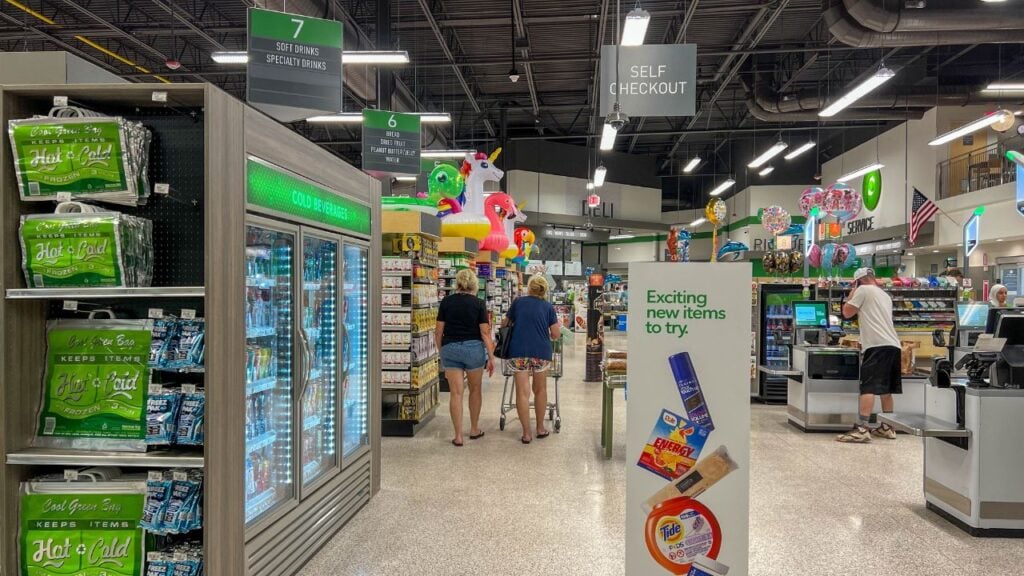
Think a grocery store can't surprise a Food City shopper?
Publix proves otherwise, especially for new residents moving from a state without the chain.
6 Things New Arrivals in Tennessee Notice the First Time They Shop at Publix
9 Everyday Words That Mean Something Else Once You Cross Into Tennessee

You know what a bag, a shopping cart and a winter hat are called, or at least you think you do.
Cross into Tennessee, and a lot of familiar words mean something else.
9 Everyday Words That Mean Something Else Once You Cross Into Tennessee
